




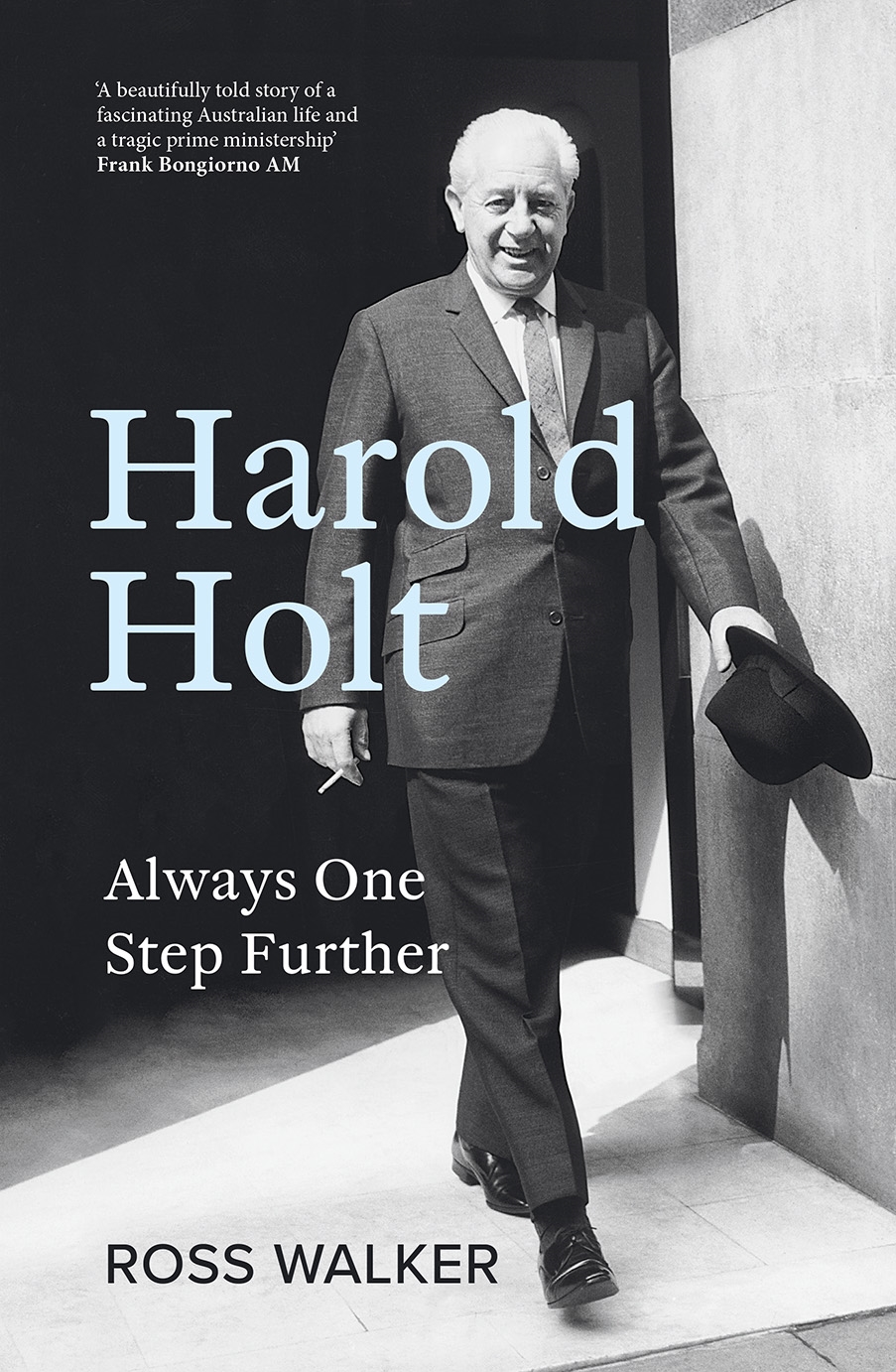
Harold Holt is rarely remembered these days and, if he is, it is as a result of his disappearance at Cheviot Beach in December,1967. That is a pity because he represented a type of moderate conservativism that, at least at the federal level, is an endangered species in this country. From a comfortable, but not wealthy, background, Holt worked as a solicitor for several years before entering Parliament in 1935 at the age of 27 under the mentorship of Menzies. Holt held a series of important ministries in Menzies’ post-1949 government – initially Immigration, then Labour Relations and then Treasury, before becoming Prime Minister in 1966 when Menzies retired and then won re-election in a landslide.
In Harold Holt Ross Walker delivers a well-researched, conventional political biography which takes us through a successful career that ended in an inexplicable tragedy. Looked at more closely however, Ross sees a streak of recklessness in Holt – evident in his sporting interests and in his mildly scandalous private life which may explain why he took that final fatal plunge at Cheviot Beach.
Walker does a good job of conveying how different the political atmosphere was during Holt’s heyday in the 1950s and ’60s. This was the Australia of Donald Horne’s Lucky Country or Nino Cullotta’s They’re a Weird Mob – a time of full employment and steadily increasing real wages; when trade unions were militant, class and religious differences were reflected in political affiliation and industrial disputation was the central political issue. It was also a country where you could be arrested for importing a D H Lawrence novel; where the population was overwhelmingly of British descent and where the Indigenous were not counted in the census.
Holt was a successful Labour Minister who maintained good relations with the leader of the ACTU and oversaw a massive decline in days lost to strike action. As Immigration Minister he began the dismantling of the White Australia policy. As Treasurer, he presided over the 1961 credit squeeze which saw Menzies returned to power in the election of that year by one seat, with the assistance of Communist preferences. And as Prime Minister, he presided over the 1967 referendum which effectively recognised Indigenous Australians as full citizens of Australia.
After he died, the Leader of the Opposition, Gough Whitlam, commented: ‘(his) ability to establish relationships with men of different backgrounds, attitudes and interests was his essential decency. He was tolerant, humane and broadminded. His suavity of manner was no pose. It was the outward reflection of a truly civilised human being. He was in a very real sense a gentleman.’
Well worth a look if you are wondering whether the Liberals have any options other than going further to the right.
Reviewed by Grant Hansen
ABOUT THE AUTHOR
 Ross Walker was for many years a high-school teacher of English and English Literature, about which he has published several books and many articles. He has a doctorate in American literature, and specialised knowledge of Australian and American politics, especially during the 1960s.



0 Comments