


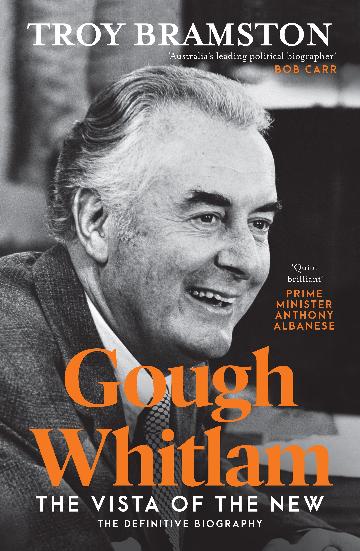
In 1972 my mother tried to take me to see Gough Whitlam’s campaign launch at the Blacktown Worker’s Club. The crowds meant it was impossible to get near the place, so we went home and watched it on TV. We did have a copy of the text of Gough’s speech and I confess I pretty much memorised it.
Very difficult to imagine a 12-year-old memorising one of Albo’s speeches – and impossible for any of his predecessors, though both Menzies and Keating are pretty quotable. It is hard to convey to people who were not around in 1972 the scale of excitement and engagement which the ‘It’s Time’ election campaign and its star – Gough Whitlam – attracted when the ALP ended 24 years of conservative government and proceeded to drag the country into the late 20th century.
It would be fair to say, not everything went according to plan. In particular, the 1973 Yom Kippur War and the related quadrupling of the price of oil ignited inflation in all Western economies and was arguably not well handled by Whitlam’s treasurer at the time one Dr Jim Cairns (who had other pressing concerns).
But Whitlam won the 1974 election, and his government introduced radical and overdue change in culture, foreign affairs, education, welfare, immigration and health. Our major cities were finally sewered.
Multiculturalism was established as official policy. Medibank provided universal health care. An Australian film industry rose from the dead. In 1975 he was dismissed by the Governor General and lost the ensuing election to Malcolm Fraser. Whitlam had been Prime Minister for only three years, but his government had changed the nation in a way not seen since (including by the Hawke-Keating opening of the economy)
For such a significant political figure we are not over supplied with biographies. Whitlam’s speech writer Graham Freudenberg’s A Certain Grandeur was published in 1977 – too soon to provide definitive perspective. Jenny Hocking’s His Time is extremely detailed, widely praised but authorised and therefore inevitably sympathetic.
Troy Bramston on the other hand is a News Ltd journalist who has written a number of solid biographies of Australian politicians and is a an old-fashioned- neoliberal. He is not going to let Gough off lightly. It is of particular significance therefore that his analysis in Gough Whitlam is overwhelmingly positive – criticism of Whitlam’s chaotic cabinet and economic missteps notwithstanding.
Bramston’s treatment of Whitlam is thorough and for the most part fair, though it is clear that The Hawke-Keating Government was more his cup of tea. For a well-researched, objective single volume take on a great Australian Gough Whitlam: The vista of the new is highly recommended.
Reviewed by Grant Hansen
ABOUT THE AUTHOR
 Troy Bramston is a senior writer with The Australian newspaper, reporting on politics, policy and popular culture. He is an award-winning and best-selling author or editor of twelve books, including Gough Whitlam: The Vista of the New (2025), Bob Hawke: Demons and Destiny (2022), Robert Menzies: The Art of Politics (2019) and Paul Keating: The Big-Picture Leader (2016). He was co-winner of an Australian Book Industry Award (2016), finalist for the Walkley Book Award (2017), shortlisted for the National Biography Award (2018) and shortlisted for the Australian Political Book of the Year Award (2022).
Troy is a member of the Library Council of the State Library of NSW and the National Archives of Australia Advisory Council. He was a judge of the Prime Minister’s Literary Awards in 2021 and 2022. Troy was awarded the Centenary Medal in 2001 for his contribution as a member of the NSW Centenary of Federation Committee. He lives in Sydney with wife, Nicky, and children, Madison and Angus.
0 Comments