




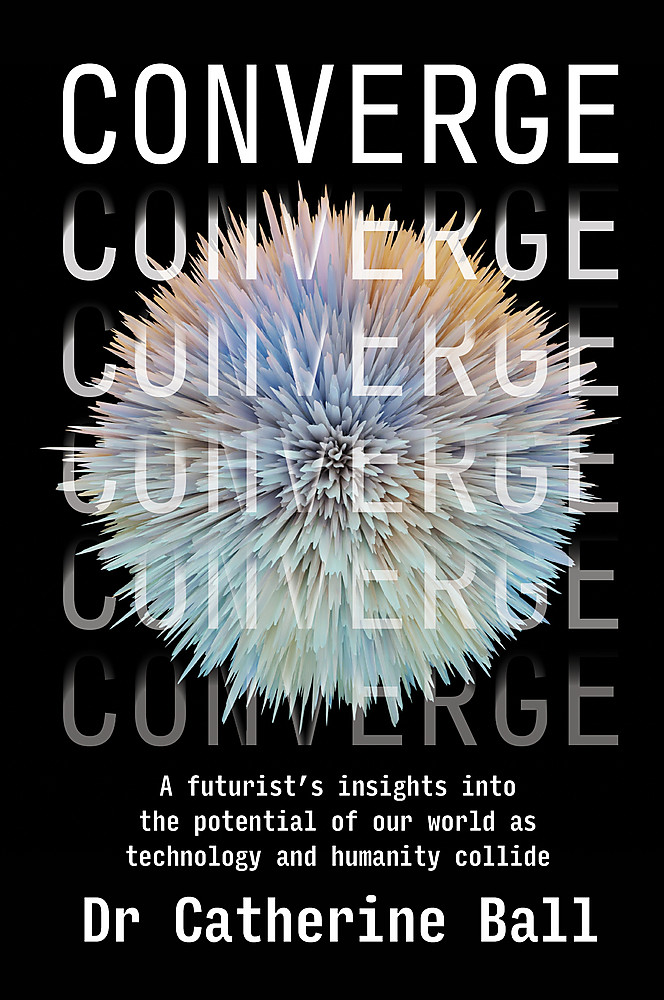
Dr Catherine Ball believes we need to get better acquainted with technology; the future is already here. Converge offers an enjoyably compelling snapshot of emerging technologies within a wide range of authentic and often complex contexts – social, environmental, cultural, and corporate. A range of technologies are intelligently explored, including robotics, social media, artificial intelligence (AI), machine learning, cybernetics, big data, medical techniques, and genetically modified food.
Dr Ball outlines ways the technology might potentially be used to address a range of needs across agriculture, environmental pollution, mental health, financial markets, crimefighting, tourism, and corporate workplaces. And how we might use technology well. A thought-provoking example is how robots and drones might be used for either destructive purposes – fighting and warfare – or in ways that are more positive and productive; such as transportation, sports, monitoring crops and oil spills, or reporting on bushfires.
Dr Ball suggests we open up educational opportunities so we can strive for what we want. By challenging assumptions around the related economics, governance, and politics we might have more significant input into what these technologies could be. The end-of-chapter sections ‘Get back in the driver’s seat’ offer practical suggestions for follow up.
Given the rapid changes in technology, it would be an interesting exercise to revisit Converge in a few years, just to see how things have panned out. A compelling reason to read Converge right now! Dr Ball optimistically concludes, when people work together as a species, there’s nothing we can’t solve.
Reviewed by Mark Parry
FROM THE AUTHOR

One of my earliest memories is from the famine in Ethiopia in the 1980s. My mum remembers me asking endless questions about how we could let something like that happen. Mum didn’t have all the answers. I can revisit that memory by watching the news article that was on the BBC over 30 years ago today on YouTube.
“Humans can do terrible things”
I also remember the Live Aid concerts, and the performances on the telly, chatter on the radio, and endless music sessions delivered by cassette tape. People donating, rock stars getting angry, children asking unending questions about ‘why’ these things happen. Even with events today we still find people fighting against the dark.
“Humans can do extraordinarily good things”
Looking to the future now, with my two children, I wonder what their ‘Ethopian Famine’ moment will be. Bushfires? Floods? The Bee Crisis? Climate Change? Killer Robots? And I also wonder what can be done right now to stop those terrible moments from happening. Where and how and when can we make the choice to do extraordinarily good things?
Industry 5.0 (the next (5th) industrial revolution) should tip the invisible hands of economics towards a purpose-driven economy, and let it be a natural transition via investors, subsidies, government policy, and media campaigns. But Industry 5.0 won’t be able to reach its full potential unless we all care enough to act accordingly. The future of work is already here, it is just not distributed the same way across different socio-economic, gender, nor geographical locations.
Australia has the capability to become a lighthouse for #techforgood and other purpose-for-profit business models.
I started getting into entrepreneurship because I had identified a number of gaps between technical capability and tangible action. We have technologies that can be applied to do some amazingly good work, but there are management, insurance, business-culture, and other human reasons why these changes are not making it to business as usual in a traditional economic model. The start-up ecosystem is fundamental to creating and curating innovation at low risk to traditional, large business.
A good friend of mine survived a terrible terrorist act. When asked what advice people should be given when watching such horror unfold she said to me “look for the people helping”. And the same can be said for the Science, Technology, Engineering, and Mathematics (STEM) community: There are always people investigating new ways of doing things, trying to help, working on a better way. From cancer drugs to ethical artificial intelligence, from methods of clean up for ocean plastics to using drones to monitor endangered species. If we can focus on the good that people are doing and share it across our networks then we amplify the voices of the excellent people doing extraordinarily good things.
Interesting opportunities are emerging from the digital technology space that will help people feel like they’re actually making a difference, this should encourage others to build purpose into their business models, whilst satisfying shareholders.
My works are a long love letter to my sons. After all, the future is theirs.
I just hope we leave them a good one



0 Comments