




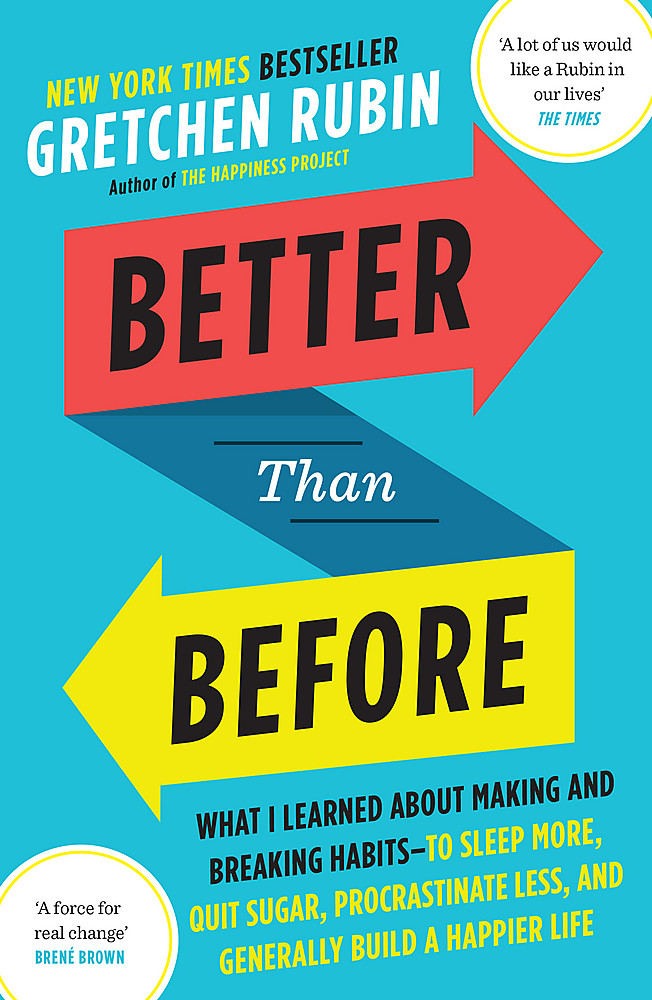
Gretchen Rubin became famous for writing about her one-year experiment to make herself happier in The Happiness Project. This has become a theme with her work, including her blog and her ‘Happier’ podcast. Her latest two books dovetail quite nicely into each other on the subject of habits.
Most authors approach habits with a one approach fits all. That pinnacle method to achieve your goal, by being productive/ effective/efficient. Gretchen Rubin offers an alternate way of success: know yourself, work with your dominant personality definers and the perspective you gain will help you become a better version of yourself.
The multitude of tips she provides in Better than Before is a veritable feast for a starving person. Knowing whether you are a lark or an owl, a sprinter or a marathoner, an abstainer or a moderator, to name just a few, all assist in self-knowledge and therefore self-development.
She introduces the concept of The Four Tendencies, an elegant framework to categorise people as to how they deal with expectations. It reminded me in its simplicity and effectiveness, of Gary Chapman’s The 5 Love Languages. The tips she provides including, accountability, monitoring and distraction, are measured in terms of their effectiveness for each particular tendency. This is surprisingly refreshing and tailored to the individual needs of the person.
She does not attempt to replace more personality-based tests such as Myers-Briggs Type Indicator or DISC, but profiles people as upholders, obligers, questioners or rebels to explain how they handle expectations. These become foundations for how we accept, resist or readily adopt new habits and get rid of old ones. Learning other people’s tendencies can allow subtle shifts in conversations to engage with them more effectively.
She goes into more detail in The Four Tendencies. Upholders, a relatively small part of the population, respond to both inner and outer expectations. Questioners adopt a habit only when they fully understand and reason through the benefits, making everything an inner expectation. Obligers respond and actually crave external accountability. Rebels, literally rebel any sense of expectation, even from themselves, following a path that gives them choice in their identity.
Rubin ultimately believes that, instead of trying to change a fundamental aspect of your nature, it’s easier to harness the strengths and counterbalance the weaknesses. She describes the pros and cons of each tendency without judgement, providing effective strategies for adapting circumstances to upholder tightening, questioner analysis paralysis, rebeldom authentic freedom quests and obliger-rebellion.
While her other books relied heavily on published research to shape the trajectory of her narrative, The Four Tendencies is the first based on her own quantitative research. The book is peppered with quotes and anecdotes from her blog readers, podcast listeners and survey takers, making it practical and very realistic.
Her honest, no nonsense and logically practical approach might be exhausting for some people, but I find her writing measured, intelligent and bursting with analytical yet creative thought.
Reviewed by Ester Perry



0 Comments