




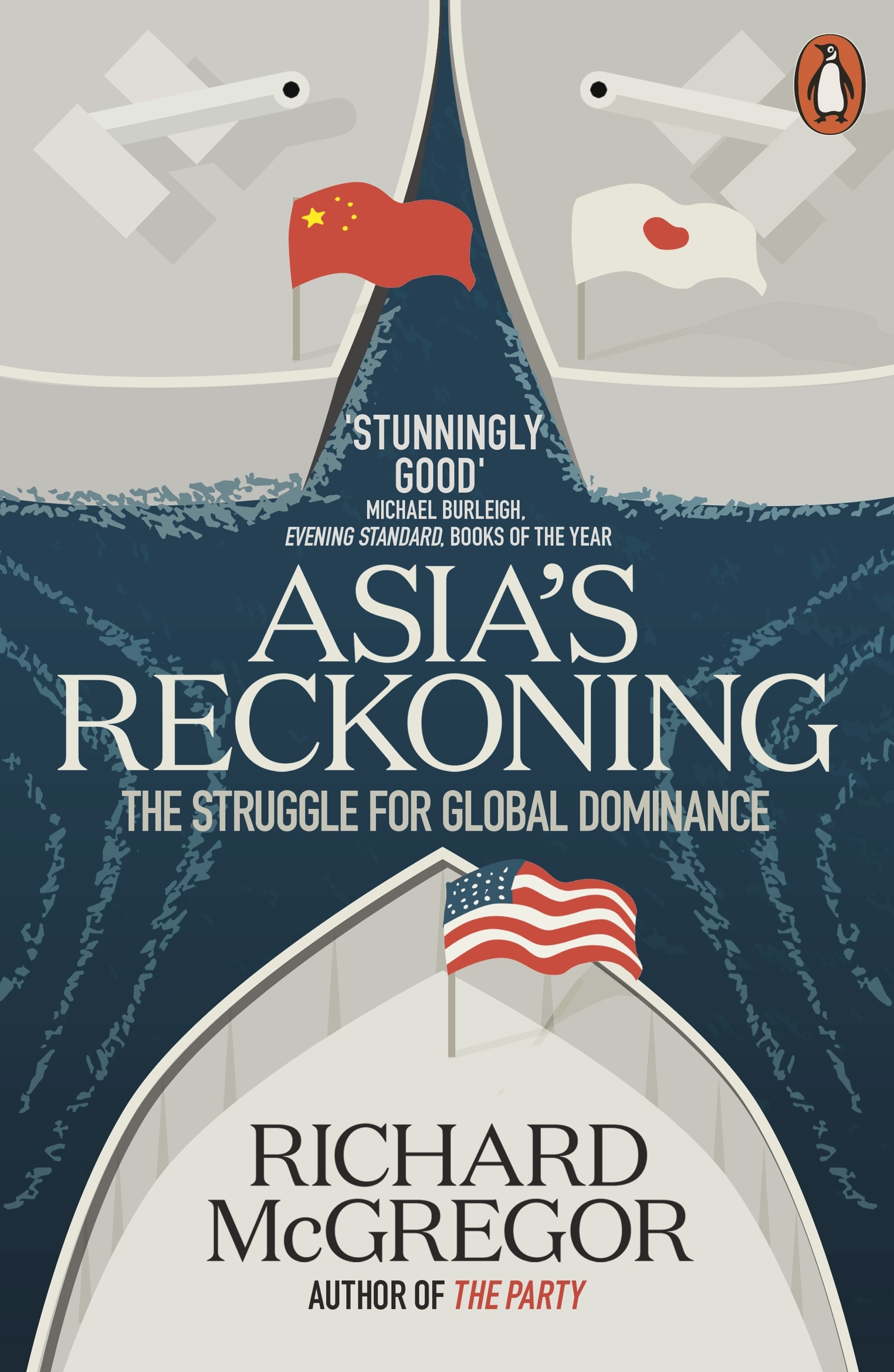
In his book Asia’s Reckoning: The struggle for global dominance, Australian journalist Richard McGregor likens the geopolitical relations between China, Japan and the US to a scene in the film Reservoir Dogs, in which three antagonists stand with guns all trained on one another. The crux of McGregor’s gripping book is the fact that the post-war peace that most of the world has enjoyed for decades – known by the moniker Pax Americana (Latin for ‘American peace’) – is beginning to crack.
China’s post-war economic growth has been meteoric. By 2025 China will surpass the US to become the world’s largest economy and, as McGregor writes, ‘It will be the first time since the 19th century that the world’s largest economy will be non-English speaking, non-Western, and nondemocratic.’
As China pulls up neck-and-neck in economic power with the US, two strongmen rule over the countries – Donald Trump and Xi Jinping. Trump’s publicly aggressive rhetoric on China and trade, and Xi’s similarly fiery attitude towards Japan, has exacerbated tensions.
Richard McGregor has worked as a journalist in all three of the countries he scrutinises in Asia’s Reckoning and has reported on Asia for over two decades. He points out that, while the nations in Europe made amends and came together at the end of World War II, Japan and China have never come to an amicable agreement about their history of invasion and counter-invasion. History wars still rage in both countries as each blames the other for past conflicts.
‘From the high point of seemingly amicable relations from the late 1970s to the mid-1980s, a corrosive mutual antipathy has gradually become embedded within their ruling parties and large sections of the public,’ McGregor writes. ‘What once seemed impossible and then merely unlikely is no longer unimaginable: that China and Japan could, within coming decades, go to war. If they do, they will not be fighting on their own.’
From that disquieting observation, McGregor embarks on a gripping journey through the history of relations between China, Japan and US, spanning both the nuances of personal relationships and the broad-scale trends of public sentiment in those counties.
As Australia is an ally of the US and the close neighbour of China and Japan, it’s a crucial book for Australians seeking to understand our place in this increasingly fractious jostle for power.
Indeed, the shifting relationships between each of the three countries has ramifications in every corner of the globe.
‘A single shot fired in anger could trigger a global economic tsunami, engulfing political capitals, trade routes, manufacturing centres, and retail outlets on every continent,’ McGregor writes.
Asia’s Reckoning won the Prime Minister’s Literary Award for non-fiction. The judges said it was ‘beautifully composed’ and ‘set to become the definitive text on this subject’.
It’s impossible to glean an understanding of the interplay between Japan, China and US relying solely on the daily news cycle. Asia’s Reckoning fills a gap in our knowledge of the world’s most crucial power struggle that could, in the near future, boil over into conflict.
Reviewed by Angus Dalton



0 Comments