



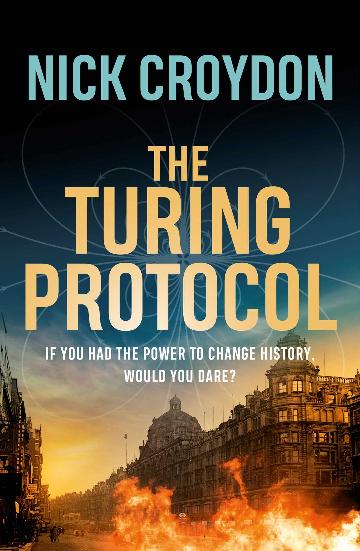
Alan Turing, a brilliant mathematician, developed a machine during World War II that played a crucial role in cracking Enigma messages sent by German military forces. What if Alan Turing had also invented a machine capable of sending messages that would enable historical events to be reshaped?
The Turing Protocol by Nick Croydon is a ‘what if’ historical novel.
To ensure the machine would only be used when humankind was severely threatened, Turing decided only one family should know how to operate it and an honour code should be in place: the Turing Protocol.
The author blends real-world events with imaginative twists. It was a while before I accepted the implausible plot developments and sat back to enjoy the absorbing romp.
In the prologue, we are introduced to Annabelle who, in March 2022, is watching television at her flat in London. Ukrainian soldiers are fighting Russian invaders. The war is intensifying by the hour. She has no solution. But she does have access to power – a technology, unknown to any other person alive – enabling her to reshape this war.
Before we hear her decision to operate the machine, we are transported back to June 1938. Alan Turing is receiving his PhD from Princeton University. He turns down a lucrative research position at Princeton and returns to England where he’s headhunted for a hush-hush job at the Code and Cypher School, Bletchley Park, Buckinghamshire.
Alan and Annabelle never meet but they are linked by the machine Alan invented.
Nick Croydon’s exciting book leads us from 1938 to 2022 via Churchill, Hitler, Osama bin Laden, MI6 and the CIA.
Reviewed by Clive Hodges
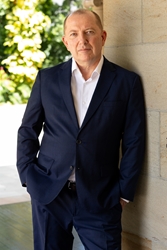
ABOUT THE AUTHOR
Nick Croydon was born in Surrey, England, and is the CEO of QBD Books Australia. He has more than 25 years’ experience running international publishing companies and book retail businesses across the United Kingdom and Australia.
The Turing Protocol is his debut novel. He lives in Brisbane with his Spanish wife, Esther, and their children.

0 Comments