



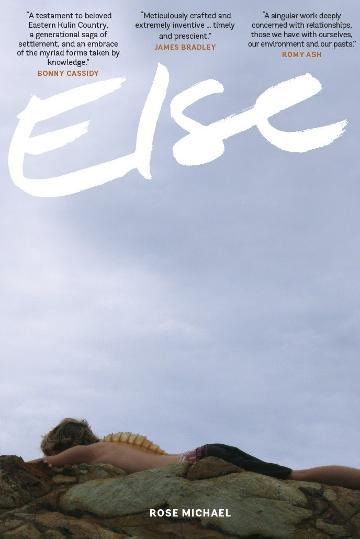
Many novels have already been written utilising an eco-dystopian setting. So, approaching this concept from a very different angle makes sense, and Michael has written this narrative in an experimental style, breaking up the so-far-so-normal prose with poetry, fictional family history and science.
Else is the daughter of Leisl. As the story begins, they leave the city behind and move to the family’s isolated homestead on a peninsula called the Ninch. With the eponymous daughter and the locale’s name, the reader gets a sense of Michael’s playfulness with language. Why call a ‘peninsula’ by its four syllables when it can be simplified to one? Else is a not-unusual first name of Germanic/Scandinavian origin, but in English it refers to something ‘other’. (There is someone else. There is someone: Else.)
Leisl and Else’s family, the Limesays, have been long-established on the Ninch. Leisl orates a family history while also lecturing Else (along with the reader) on detailed scientific facts relating to their environment. The science is a diametric contrast to the otherwise poetic sensibility. The seasonal weather becomes extreme, and they’re forced to find higher ground further along the peninsula, first by flood and then by fire (thus symbolising the entrapment of humanity in an altered climate.)
There is a plot, but it’s subsumed in the experimentation with language and grammar (onomatopoeia, assonance, full and half-rhymes, frequent random colons, enjambment, along with italicised, deliberately overwrought spelling). The dedication to an inventive concept should be applauded, but (perhaps in Michael’s style) it dis-tracts, de-tracts. If subversion of language is your thing, this will suit perfectly.
Reviewed by Bob Moore
ABOUT THE AUTHOR
 Born in England, based in Melbourne, Rose Michael is a writer, editor and academic who has been published in Griffith REVIEW, Best Australian Stories, Island, Muse, Cultural Studies Review. Her first novel, The Asking Game (Transit Lounge, 2007), was a runner-up for the Allen & Unwin/Vogel award and received an Aurealis Award honourable mention. An early extract of The Art of Navigation was published in Review of Australian Fiction.
Visit Rose Michael’s website here


0 Comments