



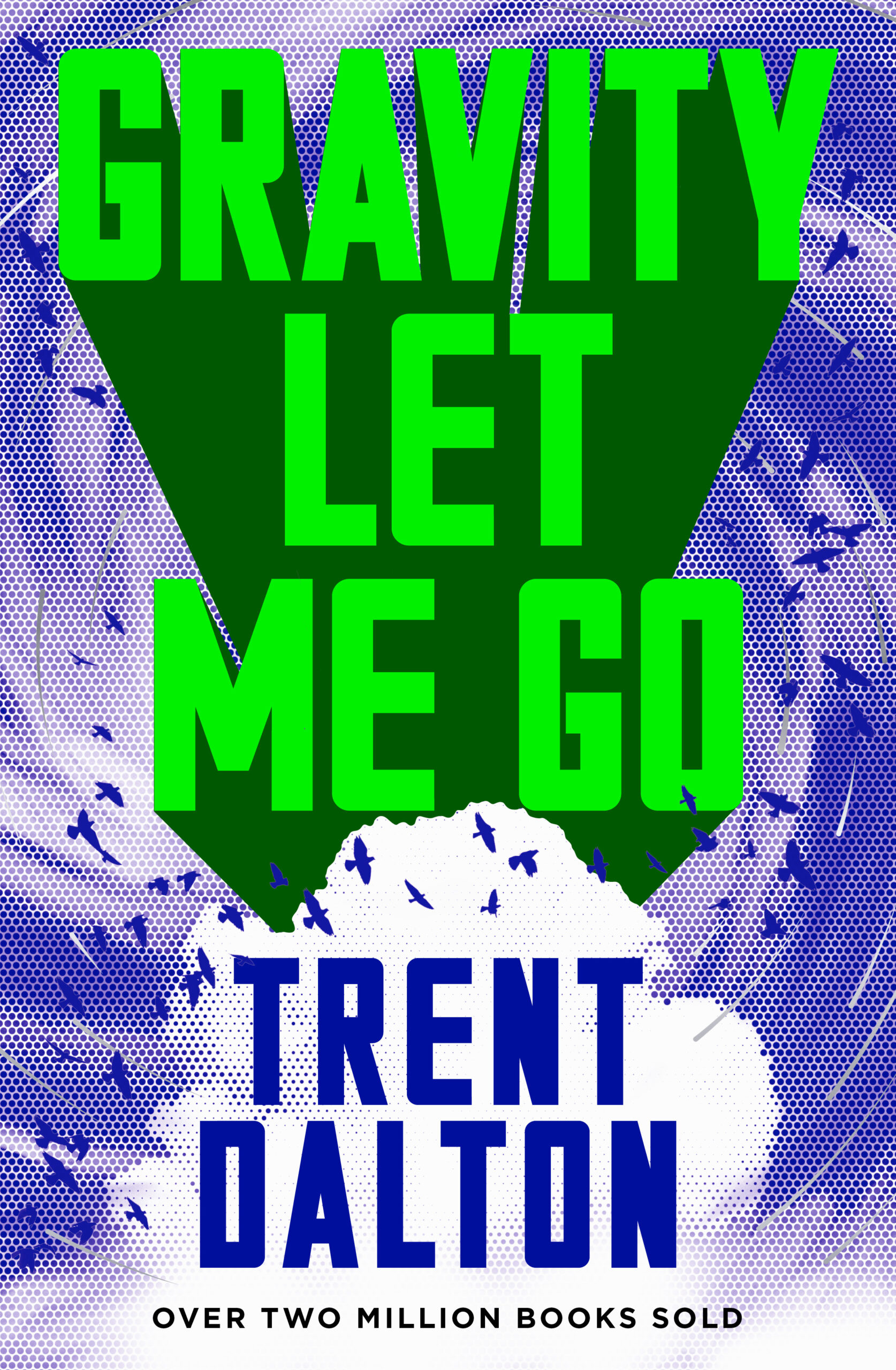
The astonishing new novel from the bestselling author of Boy Swallows Universe and Lola in the Mirror.
Dark, gritty, hilarious and unexpected, Gravity Let Me Go is a novel about marriage and ambition; truth-telling and truth-omitting; self-deception and self-preservation. It’s a novel about the stories we want to tell the world and those we shouldn’t, and how the stories we keep locked away are so often the stories that come to define us. TRENT DALTON met with Good Reading to answer all our burning questions.
What sparked the idea for Gravity Let Me Go?
One morning in my home in the northern suburbs of Brisbane, I opened my letterbox to check the mail and then I looked around my street and looked up to a darkening sky and then, for whatever reason – possibly my own natural born and highly welcome weirdness – I was struck by a thought of every last physical object in my street being released from the natural grip of gravity. The black Toyota, the kid making circles on her scooter, the neighbour weeding the garden, the neighbour’s cat, the blue Tesla across the road, the yellow bin, the red bin, the green bin, all of it, including me, rising instantly into the sky. I saw myself floating off across my suburb, holding on to a red lid wheelie bin as I floated all the way to the stars in space. Just a silly thought.
I went back into my house and put the mail on the kitchen bench and wrote four words on my nearest notebook: “Gravity let me go”. Then I thought about what else those four words could mean. About six months later, I had a book about a true crime journalist named Noah Cork who finds a note from a killer in his letterbox that leads him to a dead body. It’s the true crime scoop of Noah’s lifetime but no scoop comes without a cost. Then one day he finds a mysterious message etched into his bathroom mirror, four words that had to be written by someone he loves: “Gravity let me go”. If Noah can find out what those words mean, then maybe he can hold on to the only story that ever really mattered in his life.
 Did your background in journalism inform how you portrayed Noah Cork and his career?
Incredibly so. I have spent 20 years as a feature journalist walking the suburbs of Australia knocking on doors and asking people to share with me the darkest secrets of their lives. On many occasions, I have explored the very darkest aspects of human nature in these stories and have come to the realisation that there is a darkness that dwells beneath the great Australian dream. I’m exploring this notion in Gravity. There have been times in my journalism life where I chased these stories to places that I didn’t necessarily need to go but went anyway because I was so compelled by the addictive unfolding of the story. I’ve been obsessed at times, to the cost of almost everything else in my life, including being present for the three most important people in the universe: my wife and two daughters. But, critically, I’m also exploring the great theme that runs through all my books: there will always be light to be found in the ones we love that will help us find our way in the dark.
You began your career in journalism. In what ways has that shaped your approach to writing fiction?
Journalism, for me, was a 20-year writing school. Your teachers in a school like that are brutal editors who don’t just edit your stories, they spike them without remorse. One quickly learns to write with power and economy or they quickly find themselves out of a job.
The rules in feature writing apply greatly to fiction. Killer quotes in killer context. Actions speak louder than words. Remember the details. The photos inside the frames on a subject’s wall will say more than the words coming out their mouth. Their tattoos will say more, still. My job as a magazine feature writer was to hold a reader’s attention through twists and turns and narrative cliff-hangers that stretched across six pages and four thousand words. When I sat down to write my first book, Boy Swallows Universe, I asked myself if I could hold a reader’s attention across one-hundred thousand words and four-hundred pages. I thought I might have a chance if I knew my subject well enough. And my subject turned out to be me.
What significance does location and weather hold in how this story unfolds?
Location, location, location. There’s a reason I write so much about Brisbane. The place was the making of me. Brisbane helped my family in our darkest hours. I mean charity groups that gave us furniture and gave us food for dinner; people who wrapped their arms around my mum when she was running from dark places; the newspaper that gave me the job that changed my life. Brisbane finds its way into my books because it’s found its way into my blood.
Brisbane weather finds it way in too because it’s just so bloody unpredictable and dangerous and dramatic and literarily fruitful. You’re not in Kansas anymore, Dorothy. You’re in Oz. The weather here can kill you. It’s volatile. And it cannot be controlled, just like life can’t be controlled. Like Noah Cork discovers in Gravity: one minute you’re reading People of the Book on the couch, the next minute a storm is peeling the roof of your house from its fixings. Beautiful one day, deadly the next.
What drew you to weave a murder mystery into the heart of this novel, and how did you approach balancing that narrative thread with the more personal and emotional layers of the story?
Gravity is a story about communication. A husband failing to communicate with his wife. A wife communicating with the sky. A father struggling to communicate with his daughters. And a journalist communicating with a killer.
There’s been more than a few times in my working life where I have found myself in regular communication with extraordinarily volatile and dangerous men. It’s a dangerous game where simple requests can quickly turn to deals with devils. I have communicated with very bad men in the name of storytelling. “Anything for a story.” Journalists wear that notion like a badge of pride. I wanted to explore just how far someone like me would go for the story of a lifetime. Would you actually be willing to lose your own life for the story of a lifetime? What draws me to this stuff is not just my deep and abiding love of thrillers but also my own fascination with the dark stuff, the crime stuff, which probably comes from the fact that I was raised, for a time in my childhood, by men who did time in prison for doing very bad things, the same men I loved very much.
This novel is described as your ‘deeply personal exploration of marriage and ambition, truth-telling and truth-omitting’. What personal truths were you grappling with while writing this book?
Boy Swallows Universe was a very personal tale inspired by my childhood. But I feel I’m being far more personal with Gravity. The most personal thing we can do sometimes is share our failings. Speak about our flaws and our faults. This is me looking honestly at the cost of what I believe is a kind of strange storytelling addiction that I have, where I get so lost in these things I’m writing that sometimes I know that my characters get the best of me some nights, and my wife and children get the rest of me. That’s something I’ve actively worked on over the years and there’s some horrible stuff wrapped up in that: ambition, ego, fear, trying at all costs to build a secure world in my adulthood that is different to the insecure world of my childhood. It’s all very messy and interesting and worth exploring if I want to write from a place of truth, where all good writing comes from.
What emotions or questions do you hope readers will carry with them long after the final page?
Hold on to love. Pull as much love into your life as you can and hold on to it as strongly as gravity holds you to this beautiful earth.
From your beginnings as a journalist to becoming a multi-million-selling author, how does it feel to look back on that journey so far?
Eli Bell, the hero kid in Boy Swallows Universe, has this thing he keeps telling his mum: “It gets good”. He has this weird belief that everything bad that is happening in his life is occurring for some profound reason that is far beyond his human understanding. He believes it’s all leading to something meaningful that will justify and clarify every last misery his family has endured. I’m a 46-year-old man living in middle-class suburban Brisbane with an extraordinarily patient wife and two really kind and funny daughters who humble and dazzle me daily and I know that the kind of magical thinking that Eli Bell falls back on is strictly the stuff of dreamers and sentimentalists, but, I swear, when I look back on my years from my first journalism job to now, I can’t help but think Eli was right.
ABOUT THE AUTHOR

Trent Dalton is a two-time Walkley Award–winning journalist and the international bestselling author of Boy Swallows Universe, By Sea & Stars, All Our Shimmering Skies, Love Stories and Lola in the Mirror. His books have sold over two million copies worldwide.


0 Comments