




In The Shortest History of Japan by LESLEY DOWNER, she takes us through the great sweep of Japanese history, focusing on the dramatic stories of the colourful characters who populate it. She traces the flowering of Buddhism, the country’s complex relationship with the rest of the world, and the extraordinary creativity that produced the world’s first novel and the art of Hokusai, among much else. She brings in issues of contemporary interest, such as how Japan managed to avoid colonisation.
In this extract we learn about Edo: Tokugawa Renaissance1603 -1853.
ABOUT THE BOOK
A definitive new history of Japan, where ancient meets cutting-edge in unique and startling ways.
Everyone who has ever visited Japan says it feels ‘different’. It is a small island nation with few natural resources, limited space and a history of swinging between isolation and openness to the outside world. This past has produced an extraordinary aesthetic culture that has inspired artists, architects, writers and thinkers worldwide.
This entertaining history takes the reader from Japan’s prehistoric beginnings right up to the present day. It offers a captivating introduction for readers who know nothing about Japan while being full of insights for the Japan specialist, with an aha! moment on every page.
Along the way, she explains the history and significance of Japan’s unique traditions, from samurai and geisha to kabuki and the tea ceremony. She ends by considering where the future might take Japan, as it navigates new challenges and takes on a new role as the world’s capital of cool, home of manga and anime, street fashion, Nintendo and Pokemon.
Edo: Tokugawa Renaissance
1603–1853
A great peace is at hand. The shogun rules firmly and with justice at Edo. No more shall we have to live by the sword.
I have seen that great profit can be made honourably.
I shall brew sake and soy sauce and we shall prosper.
Mitsui Sokubei Takatoshi, 1616
The Tokugawas gave Japan 250 years of peace and prosperity and presided over a spectacular renaissance. While Heian literature, fashion and culture were created by and for the aristocrats and the centuries of war were dominated by the warrior class, the Edo period was the heyday of the down-to-earth merchants. Their dazzling culture of pleasure and leisure spawned many of Japan’s most beloved works of literature, art and theatre.
Closing the country
In autumn 1614, 100,000 warriors hunkered down around Osaka Castle’s massive fortifications. Inside were Hideyori and his mother, the still-alluring Lady Yodo, and a force of 90,000 die-hard loyalists.
When winter set in, the wily Ieyasu, now seventy-one, proposed peace terms. Hideyori could keep his castle but the Tokugawa forces would fill in the outer moat; for who needed a moat if they were at peace? His men immediately set to work, filling in the moat and tearing down the outer walls. Hideyori protested and the tearing down stopped but the castle was fatally exposed.
The following spring, as Ieyasu had foreseen, the defenders began to re-excavate the moat, breaching the peace terms. The Tokugawa forces stormed across the half-filled moat and fought their way into the castle. Then a fire started in the kitchens. As the castle went up in flames, Hideyori and Lady Yodo killed themselves.
Ieyasu was now unquestionably lord of all Japan. But there was still one piece of unfinished business – the Portuguese and Spanish, who continued to spread their grip across the country.
He had, however, an unexpected ally.
In 1600, a Dutch ship, the Liefde, had blown ashore off eastern Kyushu. The pilot, an Englishman called William Adams, had fought with Francis Drake against the Armada.
As far as Ieyasu knew, the Portuguese and Spanish represented the west and Catholicism was the western religion. His Jesuit interpreter, realising the danger if he discovered the truth, told him that Adams and his men were pirates and should be executed. As Adams recorded, Ieyasu replied that they had not done ‘his lande any harme nor dammage, [and] therfore [it was] ageinst Reason or Justice to put us to death’.
Adams brought Ieyasu up to date on the European wars between Catholics and Protestants and the shogun came to prefer the company of the straight-talking Englishman to the fanatical Jesuits.
In 1605 Ieyasu abdicated and his son became shogun, thereby ensuring the succession. Ieyasu made Adams a samurai and sent a letter to the Dutch East India Company base in Bantam, in Java, inviting them to trade. Two Dutch ships arrived off Nagasaki, and with Adams’ help set up a ‘factory’, a trading base.
Japan could now enjoy the benefits of foreign trade without having to put up with foreign priests. The Catholic converts of the troublesome Spanish and Portuguese included many of the western daimyos, Ieyasu’s ancient enemies, who would jump at any opportunity to rise against him, particularly with foreign arms and armies to back them.
Ieyasu was well aware of the colonising activities of the Catholic powers and of the fleet of Spanish galleons anchored in Manila, not far away. He needed urgently to deal with the potential threat to his country. In 1614 he signed the Christian Expulsion Act, banning Christianity and expelling all missionaries.
He died in 1616, having put pretty much everything in place for the future.
There were still Christians practising in secret and Portuguese priests hiding out. In 1637 there was a huge uprising of Christians and impoverished peasants, backed by Portuguese missionaries and traders. It was the last straw. The country was closed to westerners apart from the Dutch trading post at Nagasaki, through which all foreign trade had to pass. Japanese were forbidden to leave on pain of death and the era of the ‘closed country’ began.
At the door of the bay
Ieyasu’s capital, Edo, ‘the door of the bay’, was an unpromising fishing village on a marshy estuary where three rivers met. But it was well located, dominating the approach to the rugged north-eastern provinces. Here Ieyasu set to work to build a huge castle with fortifications carved from gargantuan blocks of granite and a defensive network of canals and moats spiralling out around it.
He designated land on the hills to the north and west for the 200-odd daimyos to build mansions. The ‘inner lords’, who had fought on his side at the battle of Sekigahara, had land close to the castle and participated in government. The powerful ‘outer lords’, who had sworn allegiance only after they were defeated, were from grand old western and south-western families who had been far senior to Ieyasu before he rose to pre-eminence and were a perpetual threat. He settled them a safe distance away.
A stretch of flat land facing onto Edo Bay went to the merchants, artisans, architects and builders who poured in to work on the enormous program of landfill, waterworks and construction projects and hopefully make their fortunes. Villas, temples, shrines, tenement houses, shops and stalls sprang up along with alleys, roads and a maze of canals that made the city an eastern Venice.
Kyoto was still the official capital and home of the emperor. But under Ieyasu, Edo was to be not only the military and administrative hub of Japan but also its economic and cultural centre.
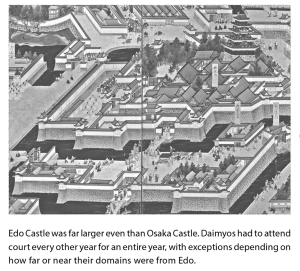 To make sure there were no more rebellions, Ieyasu made the daimyos pay for and provide men to build his magnificent new capital. In return they were allowed to rule their own provinces with a fair degree of autonomy, but they had to swear allegiance and recognise Ieyasu’s position as overall ruler. After his death they paid for and built his splendiferous mausoleum at Nikko, ensuring they had no time or money left to even think of rebelling.
Every year or two they had to make the long and arduous journey to Edo to spend up to a year at court before returning to their provincial seat, a system known as ‘alternate attendance’. At any one time half the daimyos were in Edo, which made it easy to keep an eye on them. Their families lived there permanently, effectively as hostages.
The highways jostled with vast and splendid processions going back and forth and a very efficient transport network developed with inns, including palatial hostelries for the lords, where travellers hired horses and porters and arranged food and entertainment. At the frontier posts guards watched out for women sneaking out of Edo and weapons being smuggled in.
There was a strict social hierarchy along Confucian lines. At the top were the samurai, who flaunted two swords and received regular stipends in the form of bales of rice. With no wars to fight they turned into bureaucrats. The highest-ranking formed the governing class while at the bottom were thousands of pen pushers, who earned a small salary to supplement their stipend.
After them came peasants who grew the rice. They worked in the fields morning to night and gave up most of their crops in taxes. Then came artisans and craftspeople who made the exquisite artefacts that furnished people’s houses and at the very bottom merchants. In theory merchants were parasites, the lowest of the low, who produced nothing and dirtied their hands with money. The government recognised the need for them, and mercantile cities such as Sakai, Osaka and Nagasaki had long been prosperous cultural centres. The daimyos and samurai borrowed huge amounts of money from the merchants to pay for their journeys to and from Edo and for their splendid establishments and lifestyle.
There were also courtesans, prostitutes, travelling players, and outcasts who carried out unsavoury jobs such as butchery and executions, so low that they were classified as non-humans.
For many years the system was hugely successful. Japan had plentiful resources and a vigorous economy. It didn’t need the west for trade or culture. Finally people could settle down to make a good life for themselves.
But no one could have foreseen the extraordinary consequences.
ABOUT THE AUTHOR
 Lesley Downer is an author, journalist and historian. She has written four novels, The Shogun Quartet, set in the glittering world of nineteenth-century Japan. She has also written several works of non-fiction, including Geisha- The Remarkable Truth Behind the Fiction and The Brothers- The Hidden World of Japan’s Richest Family, which was chosen as a New York Times Book of the Year. She lives in London with her husband, the author Arthur I. Miller.


0 Comments