




Why do some people flourish in high-stress situations, while others feel overwhelmed or discouraged? How do some remain calm under pressure, where others succumb to stress?
The difference is in mindset.
ABOUT THE BOOK
When you have the skills and knowledge to stay in control, regulate your emotions and manage your reactions, even the most difficult circumstances become opportunities to excel, thrive and grow. But this quality – also known as poise – is not innate. It comes from preparation and practice.
In this book, experienced paramedic Leigh Anderson:
– shares true life-and-death stories from his career
– explores the latest scientific research on mindset, stress and resilience
– reveals his secrets for maintaining poise.
The result is an arsenal of clear, effective and actionable tools that will boost your ability to perform under pressure.
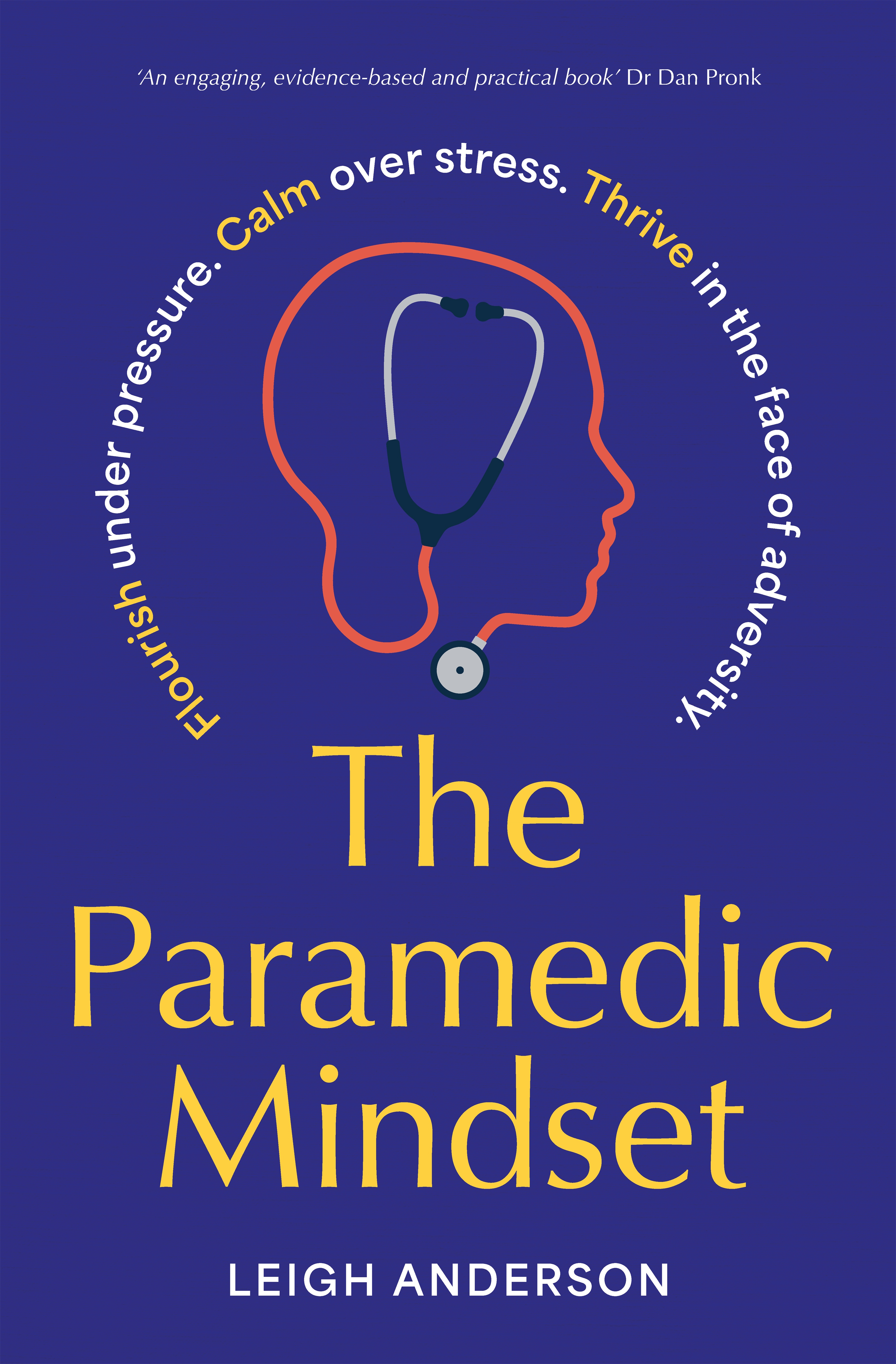
Read on for an extract from The Paramedic Mindset by Leigh Anderson.
EXTRACT
 When you are isolated and alone, dealing with one critically ill patient is hard enough, but four was really going to test me. The fun all started just after 11 pm. That’s when I was called to a 24-year-old female with abdominal pain: a fairly routine callout. After a thorough assessment of the patient, I could not confidently diagnose her with a specific cause of her severe pain. I had a few ideas, but no definitive diagnosis could be made without an ultrasound.
I was working on an island at the time. I requested a marine rescue boat to come to the island and transport the patient to the hospital. Because this generally takes about two hours, I had to work on my small talk. As I waited for the rescue boat, I received a call from my communications centre, informing me that I had a second patient: a 55-year-old male having a seizure.
It was normal to be dispatched to a second patient as I waited for the boat, so I knew what to do. I called a volunteer driver who would sit with the abdominal pain patient while I went to the man having a seizure – the higher-priority case.
I arrived on scene to find the patient in bed with what appeared to be seizure activity. He had tremors and was shaking uncontrollably, but he could look at me and follow my words. He would moan and groan when I asked questions. This didn’t feel like seizures I’d seen before. My first thought was that he was faking it: what’s called a pseudo-seizure. And that was something I had seen before. I spoke to the patient’s wife, who informed me that he had a condition called functional neurological disorder. It is a condition that can’t be explained by a discernible physical issue in the body, but causes significant distress and problems with functioning.
The patient became unable to communicate verbally; he went completely mute and couldn’t tell me his concerns. You could see the anguish in his eyes. He couldn’t write his thoughts down either, because of the tremors. He had lost complete motor control, and was unable to walk or even move.
As I was trying to manage this complex patient, I received a third phone call informing me that I had another patient. This time, it was an acute behavioural disturbance – behaviour that puts themselves or others in immediate harm. In this case, the patient was swimming naked in a pool, threatening suicide by drowning himself.
I already had two patients to deal with, so I rang the security guards for assistance – there were no police on the island. They managed to restrain the third patient and protect him from drowning while I moved the other patients to a central location. The security guard was able to drive the aggressive patient to me, which helped me manage all three patients at the same location. I was very grateful for this.
The aggressive patient was heavily intoxicated and verbally abusive towards me. He was very agitated, yelling and threatening harm. I placed the patient in a room with the security officer to help contain the situation. There were still two other sick patients in the back needing my attention. I rang a second ambulance volunteer to come and assist me.
I was reassessing the other patients when I received a fourth call: a patient with shortness of breath having an asthma attack. This patient was unable to drive and couldn’t come to my location. I wasn’t sure how I was going to get the patient to my current location, and I didn’want to leave the others. I couldn’t ask the security or volunteers to leave, because their hands were full and they didn’t have the medical knowledge or equipment to treat an asthma attack. I really didn’t want to leave, but I couldn’t just leave the fourth patient at home alone, could I?
I had no choice. I told one volunteer to watch the first two patients, then asked the security officer and another volunteer to stay with the aggressive patient while I drove, lights on and sirens blaring, towards the asthmatic patient.
It was probably the worst treatment I’ve ever given someone on the scene before. I pulled up outside their house and did a quick visual assessment. The patient was walking and talking, which meant they were well enough, given my other cases. ‘That’ll do,’ I told myself. I put the patient in the ambulance and drove straight back to the house of chaos.
I rang my communications centre to ask for a situation report on the estimated time of arrival for the medivac. They informed me that the boat was delayed due to bad weather. It was going to be another hour at least, and the helicopter was still not available.
At this stage, I had the urge to curl up in a ball and forget what was going on, but I had a sudden moment of calm amid the chaos. I had a simple thought that made me smile: what an amazing challenge this stressful situation is, a great opportunity for growth and to allow me to apply my skills and test my abilities.
I began to laugh and giggle out loud at this thought. I’d read so much about mindsets, but I’d never actively applied the knowledge in real time. I was proud of myself for thinking of it at that moment. I felt as if I was stepping outside myself and could see the scene from a bird’s-eye view. It was a very strange sensation. Even though the scene was busy and complex, I had a strong sense that everything was going to be okay. I felt grateful that I’d been able to rise to the occasion.
Another hour had passed as I walked back and forth between all four patients, but it was obvious that the aggressive and non-compliant patient was taking up most of my valuable time. They were not the sickest patient, but if I didn’t manage to de-escalate their aggressive behaviour, I wouldn’t be able to help anyone.
I tried various techniques: respecting their personal space, estab- lishing a rapport, identifying wants and feelings, listening intently and trying to identify areas of agreement to offer choices and optimism. All of it was only enough to maintain the status quo.
Two paramedics eventually arrived on the boat to help me, which was fantastic, but we still hadn’t solved all of the problems I faced. How were we going to transport four patients – including a potentially violent one – on a single boat?
We decided that we couldn’t put the aggressive patient with the other three. Instead, the paramedics who arrived on the scene would transport three patients in their boat, leaving the aggressive one with me. I had to organise another boat to transport that patient.
Fortunately, my volunteer worked for a boating company and had a boat licence. We decided to take his boat. It’s fair to say it was not designed for medical retrievals, but it was the best we were going to get. After helping the other paramedics load and depart with their patients,
it was now time to move the aggressive patient to the recreational boat. As soon as I mentioned that we were departing for the hospital, the patient suddenly snapped. Bellowing, he sent a big right hook for my face, and tried to follow it up by ramming the security officer into the wall. The security guard and I had to quickly gain control of the scene.
We managed to wrestle the patient to the ground and stop the assault. The security officer was able to hold the patient as I quickly drew up medication for sedation. The problem was that I really didn’t want to sedate a patient in a confined space, spending the better part of an hour in the middle of the ocean, while operating alone. ‘What’s the alternative?’ I asked myself.
I guess we could have sat there for a few more hours and hoped for a sudden change in attitude. By this time, though, we had already been there for several hours with no success. It had to be done.
The security officer was becoming fatigued and couldn’t stay in this situation for the rest of the night; remember, he was operating outside of his normal day-to-day responsibilities just to help me out. I decided I had no other choice and administered the drug.
It was a long, hot and bumpy ride across the ocean in the middle of the night. Waves were forcing water over the bow, so we had to keep the front hatch closed, which meant there was no airflow. Not being able to look out, I became seasick. As someone who is a sailor, it wasn’t my proudest moment, but we made it. I had to wait another 30 minutes for a crew to transport the patient to the hospital, but wasn’t I glad to see them walking down the boat ramp at 5 o’clock in the morning!
As we drove back to the island watching the most beautiful sunrise over the ocean, we all felt a great sense of camaraderie and I no longer felt alone. The best way to fight loneliness is to dedicate your time and energy to working alongside other people to help other people. Despite feeling alone at the start, if it wasn’t for the non-paramedics’ help, I would have been completely lost at sea.
Habits of Mind
We all have varying mindsets, which we refer to throughout our daily lives and working environments. You will commonly hear of the financial mindset: ways to make more money and be rich. To achieve this goal you learn strategies and tools from financial experts. If you’ve ever been to Bali, you’d notice people very quickly develop the Bali mindset – they have the tattoos and the scars from crashing the scooters to prove it.
Mindsets help set us up for success. They shape the world around us, the actions we take, and the possibilities for our influence. In this chapter, we will explore a range of tools that you can use to rely on the paramedic mindset during an emergency, giving you the power to be mentally flexible and perform under immense pressure.
The word ‘mindset’ was first used in the 1930s to mean ‘habits of mind formed by previous experience’. In simple terms, our mindset is our view of the world, the sum of all the assumptions we make, beliefs we hold onto and attitudes we show.
The way we act while under pressure depends on our previous experience and habits. If we’ve never had a positive experience during a pressure situation, we will find it exceedingly difficult to act in a positive way that will influence the outcome of the situation. We will need to shift our perception and develop strategies to act in an environment where we’ve had negative encounters or fears.
In this way, if you can create new pathways to deal proactively with a daunting crisis, you will develop a mindset that sets you up to flourish.
We see the world through the filter of our mind, which can distort reality and cause us to make misleading and mistaken decisions. Without strategies and tools to shift our mindset in that moment, we can fall into the trap of allowing our mind to deceive us.
I have witnessed paramedics overtreating their patients, administering drugs that were not warranted or necessary, because of the intense pressure of the situation. Their worldview became distorted, making them believe the injury was worse than what it really was.
An onlooker sees someone bleeding from a cut and believes the patient has lost copious amounts of blood, which requires immedi- ate action, only for the paramedic to arrive and reframe that belief. For the paramedic, the blood loss is minimal, because they can compare it with past experiences. The outcomes of the paramedic’s previous encounters tell them that the amount of blood this patient has lost is not going to cause life-threatening haemorrhagic shock – where the body loses enough fluid to cause organ damage and even failure. All that is required here is a simple dressing.
Experience shapes our mindsets, which shape our actions, which radiate out like ripples in the ocean. The ripple of our thoughts will build overtime and can result in a crash on the beach or a wave worth surfing. If you want to be able to perform effectively in pressure situations, then you must be willing to shift your thinking and develop a paramedic mindset.
My aim is to get you to make these subtle and deliberate shifts in thinking that will click on in your mind like a light bulb. This will allow you to see the world differently when exposed to a scene of carnage and trauma, changing how you perceive the incident.
Cultivating the paramedic mindset is extremely important in performing under pressure. Having all the knowledge and skills in the world becomes useless if we are unable to act in the moment with a clear and focused mind.
Have you ever wanted to buy a new car, and then suddenly it seems like you always see people driving your dream car on the road? You start seeing it everywhere, but in reality it was always there. Before you wanted to buy it, you never even noticed it, but now it seems everyone owns the same car. It’s unlikely that the car unexpectedly had a massive increase in sales overnight. Your mind just did not perceive it earlier, as it didn’t serve a purpose in your life at the time: you had a different mindset.
When you develop a paramedic mindset, your mind will actively shift its perception of the world to help you see things that will lead you towards achieving your goal. The mind actively searches for opportunities that will aid you in reaching your goal, ignoring other stimuli.
 ABOUT THE AUTHOR
Leigh Anderson is an accomplished paramedic with 15 years of operational experience and first-hand, extensive knowledge of how to perform and thrive in high-stress, unpredictable situations.
Outside of an ambulance, Leigh has a keen desire to improve the human experience of stress to set people up to flourish. He has a Bachelor of Paramedic Science and a Graduate Certificate of Emergency Health. He has lectured and tutored at university level and been a peer reviewer of scientific journal articles.
Leigh live in Brisbane with his family.


(5/5)
For a non emergency services worker, I still feel I’ll be able use these strategies in my job. Love reading the true stories of emergency jobs.