


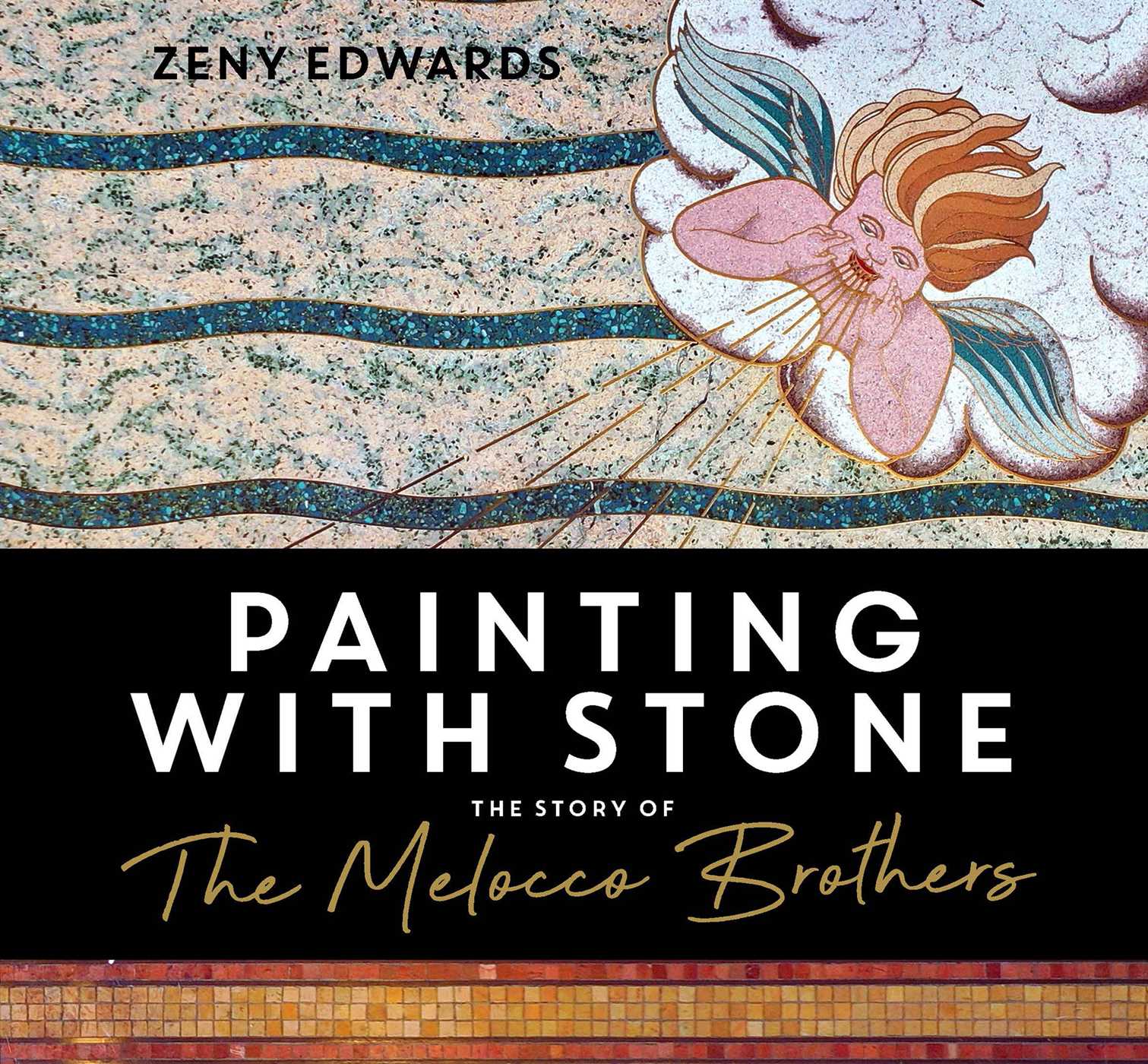
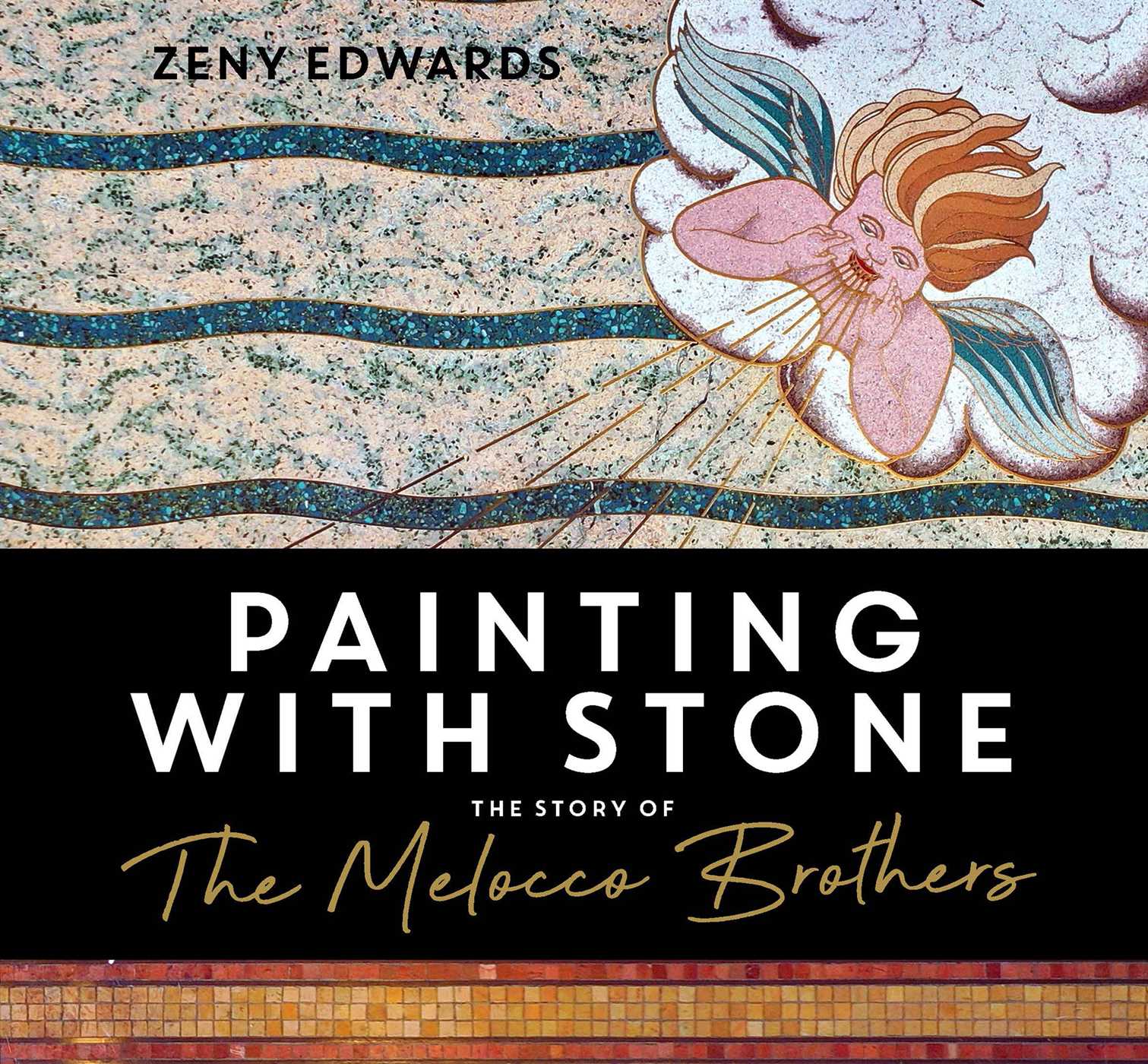
Painting with Stone tells the story of the Melocco Bros. In mosaic, terrazzo, sgraffito, scagliola and many derivations of this ancient art, these exotic terms are presented in mages as the story unfolds about how three extraordinary brothers who migrated from a small village in Italy to Sydney made their mark in history, painting with stone.
ABOUT THE BOOK
The work of Melocco Bros is embedded in the architecture of Australia. In mosaic, terrazzo, sgraffito, scagliola and many derivations of this ancient art, these exotic terms are presented in stunning images as the story unfolds about how three extraordinary brothers who migrated from a small village in Italy to Sydney made their mark in history, painting with stone.
Speaking through the language of stone, each inanimate piece of their tesserae ‘earth’ enriched Australia’s architecture and elevated it from beyond architecture to the realm of art. Astonishingly, ninety per cent of the marble, scagliola, and terrazzo work in hundreds of Sydney’s public buildings up to the 1960s bear the handiwork of Melocco craftsmen. Despite the ubiquity of the Melocco Bros’ work, detailed acknowledgement of their achievements has been lacking until now. In Painting with Stone, architectural historian Zeny Edwards rectifies this gap and shows that these three brothers were masters of innovation and craftsmanship who have long deserved special recognition in Australia’s architectural history.
**********
PROLOGUE
The imprint of the work of Melocco Bros is embedded in the architecture of Australia. In mosaic, terrazzo, sgraffito, scagliola, and many derivations of this ancient art, these exotic terms are presented in stunning images, as the story unfolds of three extraordinary brothers who made their mark in history, painting with stone.
Melocco Bros was a Sydney-based company, and their work abounds in the city. Sydneysiders might have caught the train, booking their ticket amidst the mural frieze and terrazzo mosaic floor at Central Station’s State Booking Office. They may have driven over roads or walked over concourses laid by Melocco pavers. Later, they might have entered through the mosaic entrance at Dymocks or shopped at the marbled marketplaces of David Jones and Mark Foys. Elsewhere, they may have done transactions amidst the gleaming columns of the Commonwealth Bank at Martin Place, or the Bank of New South Wales in George Street. In the evening, they might have been entertained in the glorious picture palace of the State Theatre.
On the weekend, Sydneysiders might have gone to the State Library to peruse old books, entering through the massive doors of the Mitchell Library and marvel at the magnificent Tasman Map at the entrance foyer. A brief rest under the fig trees in Hyde Park would have led them to dwell in silent contemplation of the heroic exploits of the Anzacs in the Hall of Memory and at the Well of Contemplation at the Anzac Memorial. A short walk from there would have led them to St Mary’s Cathedral to be awed by the extraordinary mosaic and terrazzo crypt beneath the church.
Fortunately one can still indulge, albeit virtually, through historical images, at the opulence of the demolished Hotel Australia or the Tattersalls Club and cast envious glances at the Hollywood-Dream style private residence, Boomerang, overlooking Sydney Harbour.
Ninety per cent of the marble, scagliola, and terrazzo work in banks, churches, educational institutions, theatres, memorials, and hundreds of other buildings bear the handiwork of Melocco craftsmen up to the 1960s; more functional are the principal thoroughfares in Sydney, which attest to the quality of concrete construction by Melocco’s pavers. But, most significantly, Melocco Bros were the masters of mosaic innovation and craftsmanship that deserve special recognition in the architectural history of Australia. Their work is ubiquitous, and their name is something to conjure with.
But, despite the Melocco Bros’ creative contribution to the architectural heritage of the country, there was little publicity in the past and, as has become apparent through researching this publication, proper acknowledgement of their achievements remains grossly lacking in recent documentation of their work – until now.
This is a story about the Melocco brothers, immigrants from a small pastoral village in their old country of Italy who made it to their new country of Australia with nothing more than their talent and the indomitable desire to succeed. They have embedded Australian architecture with works of art as the Melocco Bros company, creators of the finest mosaic art in Australia from 1908 until 1960.
There is a clear theme that runs through this story: the family spirit is paramount and extends far beyond the immediate family circle, well into near and far relatives and beyond, manifested in the altruism displayed towards their town folk, employees, labourers, and anyone who they felt needed help.
This selfless spirit of humanity was borne through the benefits reaped from the bounteous resources of rock and stone that nature provided.
This is a story grounded in earth. How do I interpret this in its proper context? How do I contextualise this word ‘earth’? To the three principal characters in this story, the Melocco brothers, Peter, Antonio, and Galliano, ‘earth’ conveyed different meanings, and their various interpretations resulted in different outcomes for each of them yet merged into one unified purpose. By trying to explain myself, I quote this statement which comes closest to what I mean: ‘Language is an intrinsic part of the human experience; it is the basis for how we express ourselves, communicate with others and carry forward our collective knowledge and experience. The act of writing is a personal one that is shaped by who we are – our experiences, identity, and cultural context – and this leaves its mark on the language we choose to use.’
The language that I employed allows me to be factually imaginative and enables me to be more courageous in communicating something worth telling so that the reader can place the story in its context – that is, through the eyes, minds, and hearts of the Melocco brothers, as they rode the ebbs and flows of life.
What I have discovered throughout the writing process was that the written word was only half of what this book was about.
Through the years, the Melocco brothers communicated through the myriad nuances of ‘earth’, as they mined, perceived, and shaped it in their hands. From light grey to russet brown (as in travertine); from black to deep red and pink (as in granite), blue grey to creamy white (as in marble), and countless shades in between (as found in tesserae) these objects were considered hard as rock, yet malleable enough to enable human expression to be reproduced. And it is only fitting that the story ends in the 1960s with the death of Peter Melocco: the man who painted with stone.
The Melocco brothers spoke through the language of stone, each piece of tesserae becoming an integral part in the telling of the story of mosaic, shaped and coloured to enrich the whole image and convey meaning to all who experience it. The ‘earth’ – inanimate – was used to breathe life into the story and ultimately became an integral part in enriching Australia’s architecture and elevating it to the realm of art.
Zeny Edwards
 ABOUT THE AUTHOR
 ABOUT THE AUTHOR
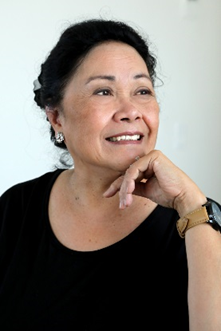
Dr Zeny Edwards is an architectural historian, award-winning biographer, and cultural heritage and human rights advocate. She has published a number of biographies and architectural histories. Zeny served in various lead roles: Immediate past-president of the Australian Council for Human Rights Education; president of the National Trust of Australia (NSW); chair of UN Women Australia (NSW), trustee of Women’s Plans Foundation and Director of the UNAA Peace Program.
Currently, Zeny serves as President of the Institute for Global Peace and Sustainable Governance, Vice-president of the World Citizens Association of Australia in charge of Asia Pacific Relations and has recently accepted to be a member of the Board of Museum of Understanding Through Tolerance and Inclusion. Zeny is committed to serving the community and the preservation of heritage, which formed the basis of her citation for the Order of Australia Medal Award.
0 Comments