




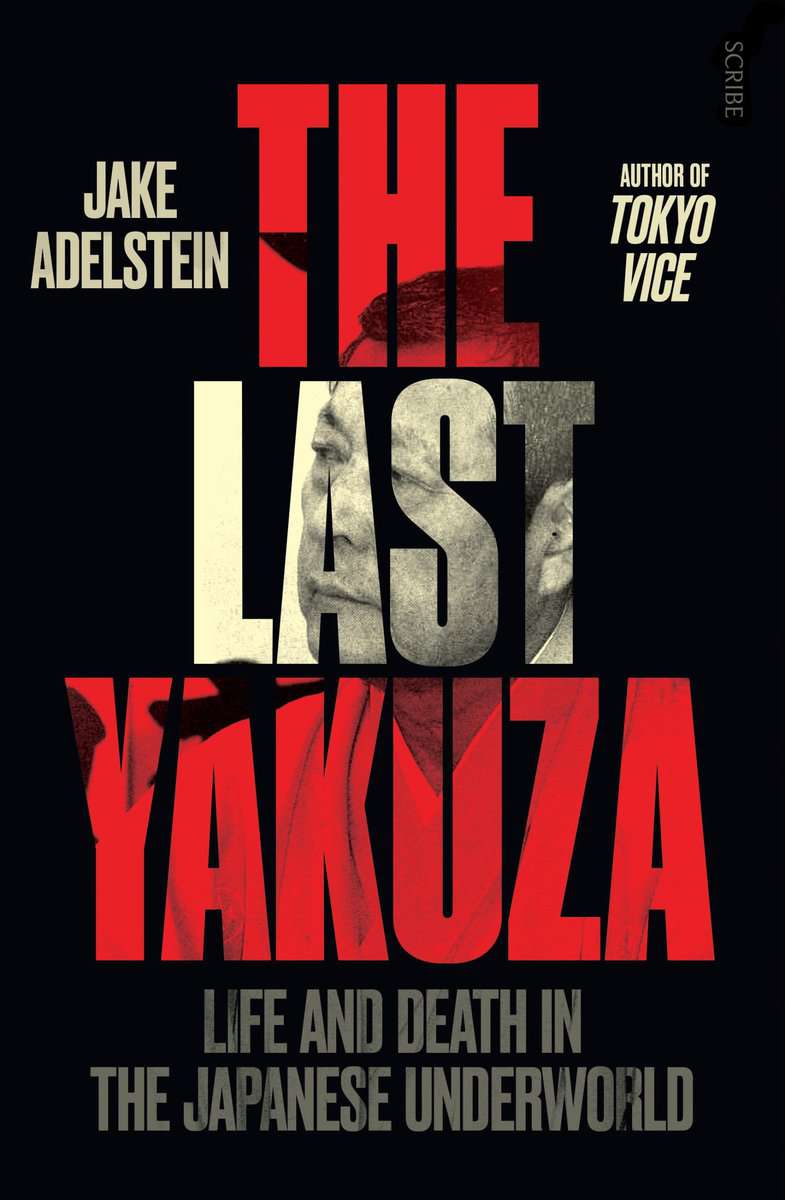
In The Last Yakuza JAKE ADELSTEIN presents a sprawling biography of a yakuza, through postwar desperation, to bubble-era optimism, to the present. Including a cast of memorable yakuza bosses – Coach, the Buddha, and more – this is a story about the rise and fall of a man, a country, and a dishonest but sometimes honourable way of life on the brink of being lost.
Read on for an extract.
ABOUT THE BOOK
 The Last Yakuza tells the history of the yakuza like it’s never been told before.
Makoto Saigo is half-American and half-Japanese in small-town Japan with a set of talents limited to playing guitar and picking fights. With rock stardom off the table, he turns toward the only place where you can start from the bottom and move up through sheer merit, loyalty, and brute force – the yakuza.
Saigo, nicknamed Tsunami, quickly realises that even within the organisation, opinions are as varied as they come, and a clash of philosophies can quickly become deadly. One screw-up can cost you your life, or at least a finger.
The internal politics of the yakuza are dizzyingly complex, and between the ever-shifting web of alliances and the encroaching hand of the law that pushes them further and further underground, Saigo finds himself in the middle of a defining decades-long battle that will determine the future of the yakuza.
PROLOGUE
July 2008
There were three of us in the room. Me, Makoto Saigo, and, having come along for the ride, Tomohiko Suzuki.
Saigo, pronounced like ‘sigh’ of relief, and ‘go’, as in get up and go, was a former yakuza who had once lorded over 150 soldiers as the boss of a subset of the Inagawa-kai, which is the third-largest organized crime group in Japan.
Tomohiko Suzuki was one of the best yakuza writers in Japan and a former editor of the yakuza fan magazine Jitsuwa Bull. Suzuki seemed more like yakuza than the people he wrote about. He sat on the floor; Saigo sat on the red faux-leather sofa; and I sat on the chair across from him. Between us was a small, round table, a chabu-dai, great for a tea ceremony and not bad as a coffee table or a place to put an ashtray.
The living room was silent. It felt like someone had turned down the sound on the whole world. It was cold for June. The rain had been pouring since morning, with a strong wind. It rattled the amado (rain shutters), and I could hear the rain splattering on the windowsill. And in that raindrop-punctuated silence, I thought about the circumstances that had brought us together.
I was in a bit of a tight spot. I’d managed to piss off one of the most vicious crime bosses in Japan, Tadamasa Goto, a Yamaguchi-gumi consigliore. The Yamaguchi-gumi is Japan’s largest crime group, with 39,000 members. How I had pissed him off is a long story, and one I’ve told elsewhere.* (* In Tokyo Vice: An American Reporter on the Police Beat in Japan.) Let’s just say that I dug up some dirt about the man in question that proved he had traded favors with the feds in the United States, for his own benefit and to the detriment of his organization.
For the moment, I had the protection of the Tokyo Metropolitan Police Department, excluding one corrupt cop working for Goto. I had a tacit alliance with one member of the Yamaguchi-gumi. I didn’t feel that the odds were in my favor. Still, I had an ace in the hole – I just needed to keep myself alive long enough play it.
I had to write an article that would get Goto off my back. Once the story was public, I would be a much harder target to hit.
I was stuck in Japan for two months trying to figure out a way to get the story out. I didn’t want him following me home to the United States and having him use his connections to take me – and possibly my wife and two children – out.
To be honest, I was kind of hoping that if I could get the story written, his own people would kill him. It seemed like a reasonable bet. Nobody likes a rat, especially the yakuza. In Japan’s case, the word for a rat is ‘dog.’ Either way, the yakuza took a dim view of one of their own cooperating with law enforcement.
I contacted Suzuki, because if anyone could help me get a detailed story into print, it would be him. I also needed him to put me in touch with Saigo, whom we both knew. I knew things hadn’t gone well for him in recent years—he’d either left or been kicked out of the Inagawa-kai. I wasn’t sure what had happened there. I did know he was looking for work and that he had a one-year-old son. I needed a bodyguard, and I wanted to hire him to protect me.
Before I asked Saigo to work for me or with me, I wanted to be absolutely sure I could trust him. I had known him casually for many years. His nickname was Tsunami. He was called Tsunami because he was like an unstoppable force of nature, relentless and violent, and nobody could predict when he would come and launch a rain of destruction. However, in the underworld, you never know someone entirely. That’s just how it is.
I contacted the only man in the underworld I sort of trusted. It wasn’t easy to reach him. I had to go to a pay phone and then call one of his front companies, leave a message, wait for the message to get to him, and then pick up the phone when he called. He would call from a public pay phone, and, thanks to the miracles of Japanese technology, my phone would tell me as much when he called.
He called just before midnight the same day I reached out to him. I explained the situation, and I gave him the name.
‘Ah, Saigo. I knew him well. He’s a kyodai [practically brother]to one of our own – not my faction, though. His oyabun is a stand-up guy. So is he.’
He sounded perfect. But my ‘advisor’ had a word of caution.
‘He’s very stubborn. Won’t listen to reason, and when he decides he’s in the right and loses his temper, he plows down anything in his way.’
It sounded good to me. If Saigo really was a storm incarnate, that could make me a mini-Raijin, the Japanese god of thunder and lightning. It would be an improvement over feeling like a tangerine placed on a Buddhist altar for the dead.
Saigo had come to the house with Suzuki dressed in a black suit that had seen better days; it was a funeral suit, as best I could tell. He was huge for a Japanese man, his hair slicked back, and tattoos flashing past the cuff of his whitish shirt. He was polite and quiet. His eyes looked sunken, as though the sockets had been punched back and stayed there, but even in his late forties you could still feel a raw power coming from him.
I asked Saigo to protect me, and pulled the rough draft of the story out of my bag, ignoring Suzuki’s unsubtle signals to put the thing back immediately. Saigo took a long time to read it, going over it word by word, his finger touching each character as though he was reading Braille.
The snake knows the way of the serpent. Ja no michi wa hebi.
That is one of my favorite Japanese proverbs. It is also like its counterpart: treat poison with poison. I figured the best way to get through this entire problem with the Goto-gumi was to hire another yakuza – even a former yakuza from an opposing group. It couldn’t hurt, and it might help.
The big question was, would Saigo take the job.
He put down the manuscript and looked me in the eyes.
‘I think you have a serious problem. I hope you’ve realized that yourself. You’ve pissed off Goto Tadamasa. Let me tell you something—I know Goto. He’s not like other yakuza.’
‘How’s he different?’ I asked.
‘He’s an asshole; an arrogant, double-dealing asshole. He used to be one of ours, an Inagawa-kai member, but jumped ship to the Yamaguchi-gumi. I know him.’ Saigo pulled out his cell phone, flipped it open, and scrolled through the directory. There it was: Goto Tadamasa and his number.
Goto killed people, or had them killed – ordinary people, civilians – and he didn’t flinch. ‘That’s not how the yakuza are supposed to operate,’ Saigo said. ‘Katagi ni meiwaku o kakenai.’ (‘Don’t cause trouble to ordinary people.’) That used to be the rule. Goto got to where he was, and had amassed the money he had made, because he never paid attention to that rule. Maybe he defined the future of the yakuza. It all seemed to come down to money these days.
‘Jake-san, how much is this story worth to you? Because there’s a good chance that, before you publish it or even after, I’ll get killed protecting you, and then Goto will kill you.’
I had thought about just getting the hell out of Japan, but I’d always be looking behind me. There was more to it than that. It wasn’t just a story anymore. It had become personal. Maybe it was a vendetta. I hesitated to say such melodramatic crap, but I couldn’t grasp better words.
‘It’s worth my entire life.’
‘Well,’ Saigo said, rolling the words out of his mouth, ‘then I guess it’s worth my life as well.’
With that, he agreed to be my bodyguard. He was willing to risk dying for me – but he wanted to know what I was willing to do for him in return. It wouldn’t have mattered what I offered in return. He’d already made up his mind. His question to me was largely a formality.
‘What would you like me to do?’ I asked.
‘Let me think about what I want for a second,’ he said, almost in a whisper.
He lit up his cigarettes, Short Hopes, inhaled, and closed his eyes, deep in thought. His huge hands made the cigarette look like a matchstick. He held his tobacco in a way that made it hard to notice he was missing the first two joints of his pinkie.
Actually, ‘missing’ would be the wrong word. As I learned later, he’d amputated it in the yakuza tradition of paying penance. I didn’t know why he’d done it, and I certainly wasn’t going to ask. Not today.
He sat back on the couch, and I got a better look at his face. He had a crew cut and a beard that was speckled with gray hair. Not only his eye sockets, but his cheeks were sunken, and his skin had an unhealthy gray pallor. He looked like the living dead. That wouldn’t be bad, I thought. You can’t kill a zombie; they keep on coming. He would be the perfect bodyguard.
‘When it’s all done, you write my biography. I’m proud to have been a yakuza, and I want my son to know who I was and what I did. I don’t think I’ll live long enough to see him grow up.’
I hesitated. I needed him to be my bodyguard, but I wasn’t willing to become a yakuza cheerleader. It wasn’t worth it.
‘I’m not going to write something glorifying the yakuza,’ I said. ‘If I were to write it, it would have to cover everything.’
His answer surprised me.
‘I’d expect nothing less.’
And, with that, our lives were bound together, but I wouldn’t find out Saigo’s real reasons for taking the job until much later.
ABOUT THE AUTHOR
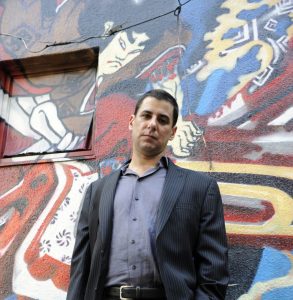 Jake Adelstein was a reporter for the Yomiuri Shinbun, Japan’s largest newspaper, from 1993 to 2005. From 2006 to 2007 he was the chief investigator for a U.S. State Department-sponsored study of human trafficking in Japan.
Considered one of the foremost experts on organized crime in Japan, he works as a writer and consultant in Japan and the United States.
He is also the public relations director for the Washington, D.C.-based Polaris Project Japan, which combats human trafficking and the exploitation of women and children in the sex trade.
Follow Jake Adelstein on Instagram


0 Comments