




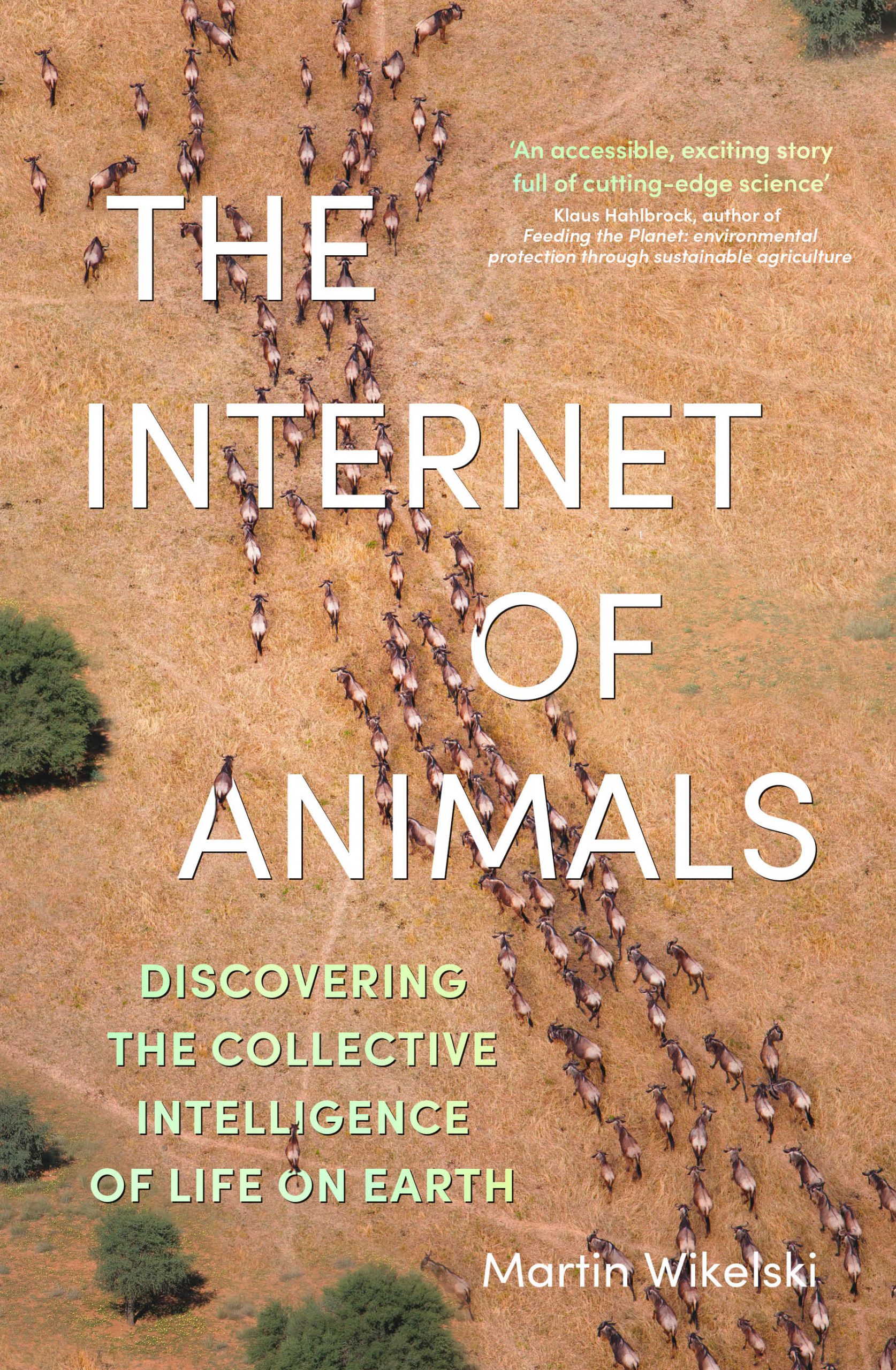
In The Internet of Animals Martin Wikelski reveals intimate and delightful insights into the behaviour of animals, from lone foxes in the Arctic to wild elephants in Thailand. He describes the exciting process of getting his project off the ground, from securing funding from NASA to tagging animals himself in remote corners of the world. We also learn what his research means for our future.
In this extract we meet Caruso, a seal with a good memory.
A SEA LION NAMED BABY CARUSO
The sea lions on the beach are loud today. Something must be going on. I’m sitting under a wide shade tent supported by bamboo poles – our home away from home here on Isla Genovesa – getting ready to cook for our crew of four. We’ve been living on this uninhabited island in the middle of the Pacific for about five months observing marine iguanas.
Our goal is to find out why the marine iguanas on this island in the Galápagos have a specific body size. Why are they as small as they are and not, say, 15 times larger like their relatives on the neighbouring island of Fernandina? To carry out our studies, we have set up camp on a beach tucked away on the west side of the island. It’s surely one of the most beautiful places in the world, and perhaps one of the most remote. There’s nobody here except for the four of us, and we have a special permit to camp on the island. It’s a great privilege to spend time in an area where none of the animals are afraid of people. In a place where, it seems, no one has scared or persecuted them for millennia.
Our daily routine consists of getting up at sunrise, emerging from our individual tents, walking to the beach for a morning wash, returning to our communal shade tent to make coffee, grabbing our binoculars and notebooks, and heading out to the beach to observe the iguanas. There are lots of other animals in and around camp: red-footed boobies, blue-footed boobies, frigatebirds, mockingbirds, hermit crabs, sea lions. In fact, the hermit crabs have just pre-cleaned the dishes that I am supposed to wash on the beach today. I grab the plates and pots and cups, put them in a bucket, and walk barefoot over the sand toward the ocean.
As I start rinsing the dishes in a convenient tide pool, I hear calls from a sea lion I don’t recognise. Like everybody in our team, I know what each one of the roughly 40 sea lions on the beach sounds like. The big bull, our beachmaster, makes deep, growling noises befitting an old bear of the ocean.
The sounds I’m hearing today are different, higher pitched and clearer than the others. I track them down to a newborn pup. The calls are simply beautiful and make me happy as I rinse the dishes in the calm pool in preparation for a thorough cleaning in the waves dashing onto the beach.
As I walk over to the ocean, the big beachmaster, who recently lost one eye in a fight with another bull, lumbers toward me with astonishing speed. A quarter-ton blob of muscle and fat in fast motion – heading in my direction. Perhaps he hasn’t recognised me? All I can do is kick sand at him and shout at him briefly. Thankfully, he stops immediately. I’m not a threat to him. It could be that he just mistook me for a young competitor. Or wanted to show me who owns the beach. Just in case. He looks at me, barks a few times, and everything is good. He knows me, we know each other – and we both respect each other’s duties. I walk back to camp with the clean dishes and tell my friends about the sea lion who was born with a beautiful voice. We call him Baby Caruso.
Three years later, in spring 1993, we’re wrapping up our observations on the island. It’s the typical scene: red-footed and blue-footed boobies hanging out in camp, a short-eared owl in the bush behind us hunting a mockingbird, and hermit crabs still pre-cleaning the dishes. After a good day of observations, I retreat to my personal tent as the sun sets to enter data in my laptop computer.
This year, I’m living a luxurious life in camp. I brought along a small table so I can work in my own tent, where I won’t be disturbed by the wind and the waves. The entrance faces away from the beach, so my laptop is somewhat protected from the salty air. I’m fully immersed in my work when I hear the beachmaster bellowing. It’s still the same old male – the one who lost an eye three years ago in a fight and who is now also getting hard of hearing, it seems.
We know this because more often than in previous years, when we wash the dishes on the beach, he appears to not recognise us and comes charging over, stopping only when we talk to him very loudly. He then realises it’s us and not another male sea lion, and he’s content. He knows that he’s not allowed to enter our camp (because he is a bit too stinky and would trample over all our boxes and dishes and perhaps even damage the ham radio we use to communicate with the outside world).
Beyond the bellowing of the bull, I hear calls I haven’t heard for two and a half years: the unique voice of Baby Caruso. It’s much deeper now, but unmistakable. I’m thrilled to hear him – and totally amazed. I thought after he was weaned from his mother and left our beach, he had probably died because he never came back to visit. But here he is back on the beach, serenading the females and trying to challenge the old beachmaster.
The old beachmaster is not impressed and makes a mad dash for Baby Caruso. I hear sand being thrown up in the air, a brief fight, deep growling from the beachmaster, and a shriek of fear from Caruso, followed by the lumbering gallop of two sea lions. Sea lions only gallop when they are terrified and urgently need to escape (or when they are in hot pursuit of a terrified opponent). Apparently, the young male has gone too far approaching the beachmaster’s females and needs to make a speedy exit.
I hear the sound of galloping sea lions coming closer. Now I’m worried there’s going to be a fight in front of my tent, which could be dangerous. Like when two enraged dogs get into a fight and totally ignore everything around them. Before I can get up from my table to see what’s happening, I spot Caruso lumbering up to the entrance of my tent. He stops abruptly a few feet from me, head up, looking directly into my eyes. Then he lowers his head and sneaks into my tent and under my table, laying his head on my feet. He’s not moving at all now and I can hear his fast, shallow breathing. He’s totally exhausted. And I’m totally flabbergasted. The beachmaster is close behind him. I can hear him drag himself up to the tent entrance. But he knows he’s not allowed here. I shout at him. He recognises my voice and probably expects me to kick sand at him. He retreats to the beach, still roaring with rage. Caruso remains motionless under my table.
I can’t believe what I’ve just witnessed. Unbeknownst to me, three years ago a sea lion pup must have observed – and completely understood – my social relationship with the beachmaster. Caruso apparently realised and remembered for three years that the beachmaster is not allowed in camp. Somehow Caruso knew that the big bull and I have an agreement: the bull is the boss of the beach and I am the boss of the camp. Caruso had been gone for two and a half years before returning to his birth colony. When he followed his instincts to approach females, he immediately got into deep trouble with the old beachmaster. When Caruso was out of options and close to being seriously beaten up by the big bull, he decided to run to a place he knew that, he remembered, was off limits to the beachmaster. My tent. Caruso had made a mental connection between his sea lion world and my human world. He understood the intersection between the two and knew how to exploit both.
I have made it my life’s work to understand the human-animal connection from the human side of the equation.
ABOUT THE AUTHOR
 Martin Wikelski is Director of the Department of Migration of the Max Planck Institute of Animal Behavior and Honorary Professor at the University of Konstanz. He returned to Germany in 2008 as Director at the Max Planck Institute for Ornithology in Radolfzell (which became the MPI-AB). As well as a Full Professor at the University of Konstanz (until 2016). He has previously been a Professor at Princeton University and the University of Illinois, Urbana-Champaign. Martin was also a research fellow at the Smithsonian Tropical Research Institute in Panama.
Wikelski investigates global animal migrations with the goal of creating an intelligent sensor network of animals – the Internet of Animals – and protecting animals worldwide. He has pioneered a system for continuously tracking thousands of animals from space, ICARUS, and in doing so has opened up a frontier in harnessing animal observation as a tool for conservation.
Wikelski is a Niko-Tinbergen Laureate of the German Ethological Society and Bartholomew Laureate of the Society for Integrative and Comparative Biology. In 2008 the National Geographic Society u him as Emerging Explorer, and in 2010 he was designated Adventurer of the Year for his leading contribution to the research of global animal migration. He became elected member of the Leopoldina – German national science academy in 2014, was awarded with the Max Planck Research Award in 2016, and State of Baden-Württemberg’s highest u, the Order of Merit in 2021.
Follow Martin Wikelski on X / Twitter


0 Comments