



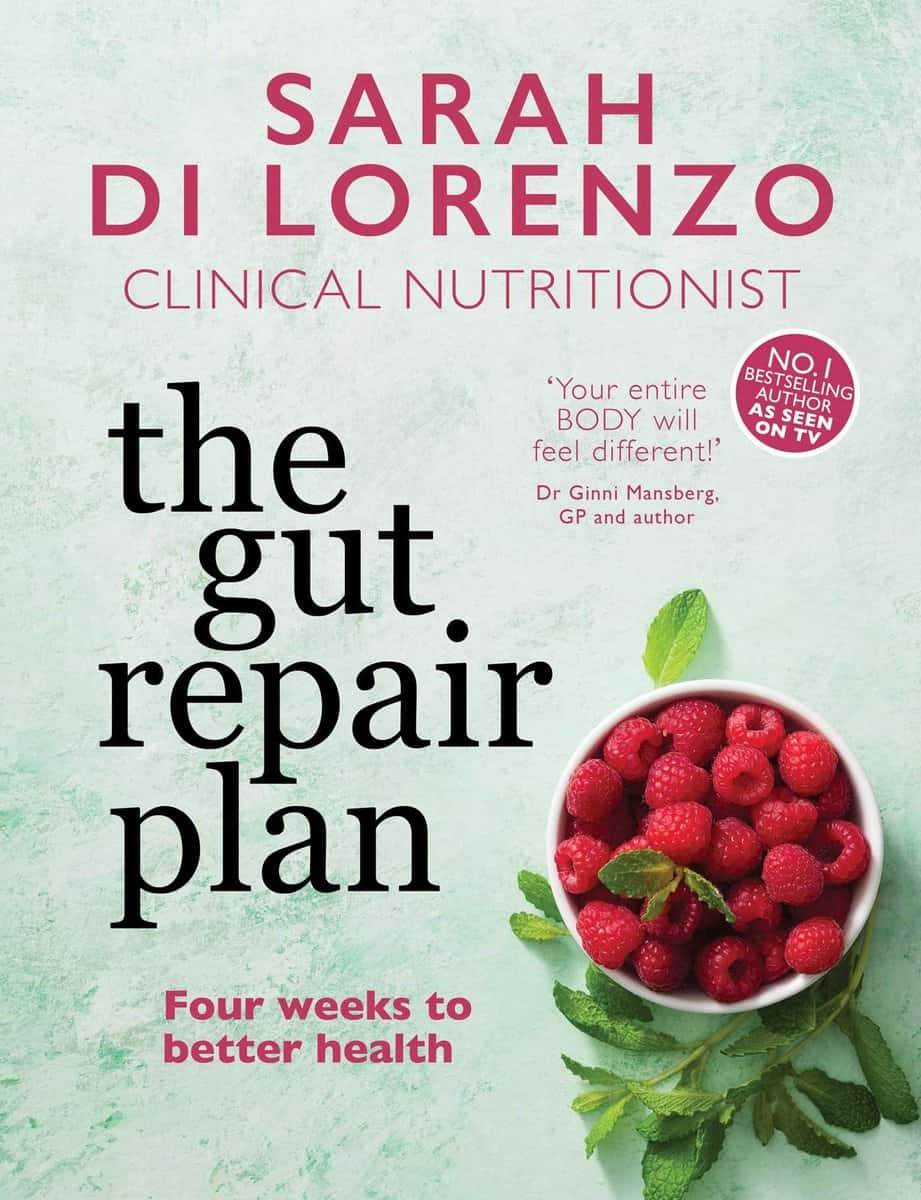
Clinical nutritionist and best-selling author Sarah Di Lorenzo’s The Gut Repair Plan examines the science behind gut health and gives you tools to transform your gut health and change the way you eat forever.
In an extract from the book Sarah looks at the guts anatomy and how our gut health impacts our entire body.
ABOUT THE BOOK
 Better gut health, better you! Revitalising your gut health can help with bloating, weight-loss, sleep, sugar-cravings, energy, immunity, mental health and a range of treatable diseases.
Clinical nutritionist and best-selling author Sarah Di Lorenzo’s four-week plan has helped thousands of her patients repair their inner health and now she’s sharing it with you.
The Gut Repair Plan is packed full of essential information about how the digestive system works, the good and bad bacteria in our gut, which foods are prebiotic and probiotic superstars, and which are the worst offenders. Sarah examines the science behind gut health and gives you tools to transform your gut health and change the way you eat forever.
With practical advice, easy-to-follow meal plans and more than 50 delicious new recipes that are all nutrient dense, easy to prepare, low carbohydrate and cleansing. It’s the perfect way to cleanse, repair, rebuild and seal your gut!
EXTRACT
Chapter 4
THE DIGESTIVE JOURNEY
I’ve always been fascinated by anatomy and how the human body works. Biology was easily my favourite subject at school. I think that when we understand a subject comprehensively, then we can make changes more easily. I much prefer explaining why I want people to do something rather than simply tell them; it’s more empowering.
One reason I’ve always taken care of my health is because I know about anatomy and physiology. When I look at food and beverages, I think how my body would feel ingesting that food. I love the feeling of eating really healthy food because I know my body is working well – absorbing, processing, breaking down and loving the process. When I think about how my GI tract would feel when I eat unhealthy foods, it’s an instant discouragement. Most of us don’t think beyond our mouths. When you’re reading this chapter, I encourage you to start thinking about how your digestive system would feel eating certain foods. Imagine the difference in impact on your body when you eat a red apple versus a red frog. Think of all that gorgeous fibre, vitamin C, vitamin K, copper and potassium, which will nourish your body. Then think about the red frog, which will dissolve and lead to inflammation, elevated blood glucose and excess calories.
As a healthcare provider and presenter, I love helping and educating people about their health. This means starting at the core.
Our gut’s anatomy
To understand the gut, first we need to understand its anatomy.
In simple terms, the GI tract is a tube linking a series of organs that enable you to ingest food via the mouth, break it down, digest and absorb it, then expel any waste (faeces) via the anus. The main organs include the mouth, oesophagus, stomach, small intestines, caecum, colon or large intestine, rectum, and anal canal. Other organs play assisting roles, such as the liver, gallbladder and pancreas.
The main organs contain layers of muscle, which move food along the tract by a process called peristalsis. Peristalsis is a set of wavelike contractions or motions that moves food along the digestive tract, allowing the breakdown and absorption of foods to take place.
I’m going to take you on the journey food makes through our GI tract.
Mouth
Our digestive tract starts at the mouth. Did you know that digestion begins before you even take your first bite? It starts with the sight and smell of food stimulating your salivary glands. When you chew food, saliva mixes with the food in your mouth, starting the breakdown process so your body can absorb and utilise the food.
The most powerful muscles in the body are the jaw muscles, and the most flexible striated muscle is the tongue. When they work together, these muscles can be extremely effective in manipulating our food. Did you know that tooth enamel is the hardest substance produced by the human body? It’s rightfully so, given that the jaw can exert a pressure of up to 80 kg bite force on our molars.
***
Our food takes an incredible journey from the start of our GI tract to the end – the human body is just so talented.
Gut health affects the entire body
Most people I talk to about the gut think that gut health is only about digestion, but it’s so much more. Our gut impacts all aspects of health, from the minute we’re born through every moment of our lives, including:
• brain health
• digestion
• emotions
• immunity
• inflammation
• metabolism
• musculoskeletal system
• nervous system
• nutrient availability to the body
• physical health
• skin health
• weight.
Think for a moment about how important these all are to your health and wellbeing. It drives you to want to be healthy and eat well, right?
When you eat, do you feel like you’re feeding your bacteria rather than just yourself now?
Sarah’s story
When I’m deciding what to eat, I think about how my gut bacteria will respond when my stomach has released its contents into the small intestine, ready for them to work their magic. I’ve always thought about this, especially when I realised I’d lived for years with non-coeliac gluten sensitivity (NCGS). I remember first looking up what gluten was, and reading that it was the Latin word for ‘glue’. When you look at gluten, it actually looks like a big piece of rubber that is very hard to tear.
Anyway, I always keep a jar of sauerkraut in my fridge as something to add to meals for flavour and to ensure my gut bacteria are happy with me. Maybe I sound like a ‘pleaser’ … I sure am when it comes to my internal residents!
Getting out of that rut
Have you ever had a bad day and you’re not sure why when everything seems to be going okay? The reason could be poor gut health. Maybe you feel like you’re in a rut and can’t find your motivation – well, the answer could lie in your gut. If you’re someone who has these lulls, then you should consider a gut repair as a first-line treatment.
I believe in going to the roots of health crises, rather than treating our health with band-aids. By ‘band-aids’, I mean just treating the symptoms; for example, putting topical cream on eczema but not finding out the root cause of the eczema. By looking at our health from the root, or core, we’ll get long-term results.
When our gut isn’t healthy, it impacts our entire body, and when it is healthy we’re rewarded with:
• clear thinking
• better moods
• improved relationship with food
• better heart health
• lower risk of disease
• lower risk of cholesterol
• lower risk of bowel cancer
• easier weight management.
Improving our health span
As we grow older, it’s important to have diversity in our gut bacteria for healthy ageing and improving our health span – not just our life span. The more diversity we have, the better our health will be.
Remember the keyword ‘diversity’ when doing your meal plan and shopping for the week.
A great place to start is having a different breakfast every day. Research is ongoing into healthy ageing. Some findings show that older adults whose gut microbes changed over their lifetime lived longer than those with fewer changes. This brings me back again to the importance of having diversity in the diet. Some studies have found that changes in our gut microbiome can be linked with autism, coeliac disease and cancer of the colon, but it’s unknown whether the disease is occurring before or after the change in the microbiome. More research is needed, but this is something to keep in mind at all life stages. When there is dysfunction in the gut, it impacts so much of our general health.
Edited extract from Sarah Di Lorenzo’s book The Gut Repair Plan


0 Comments