


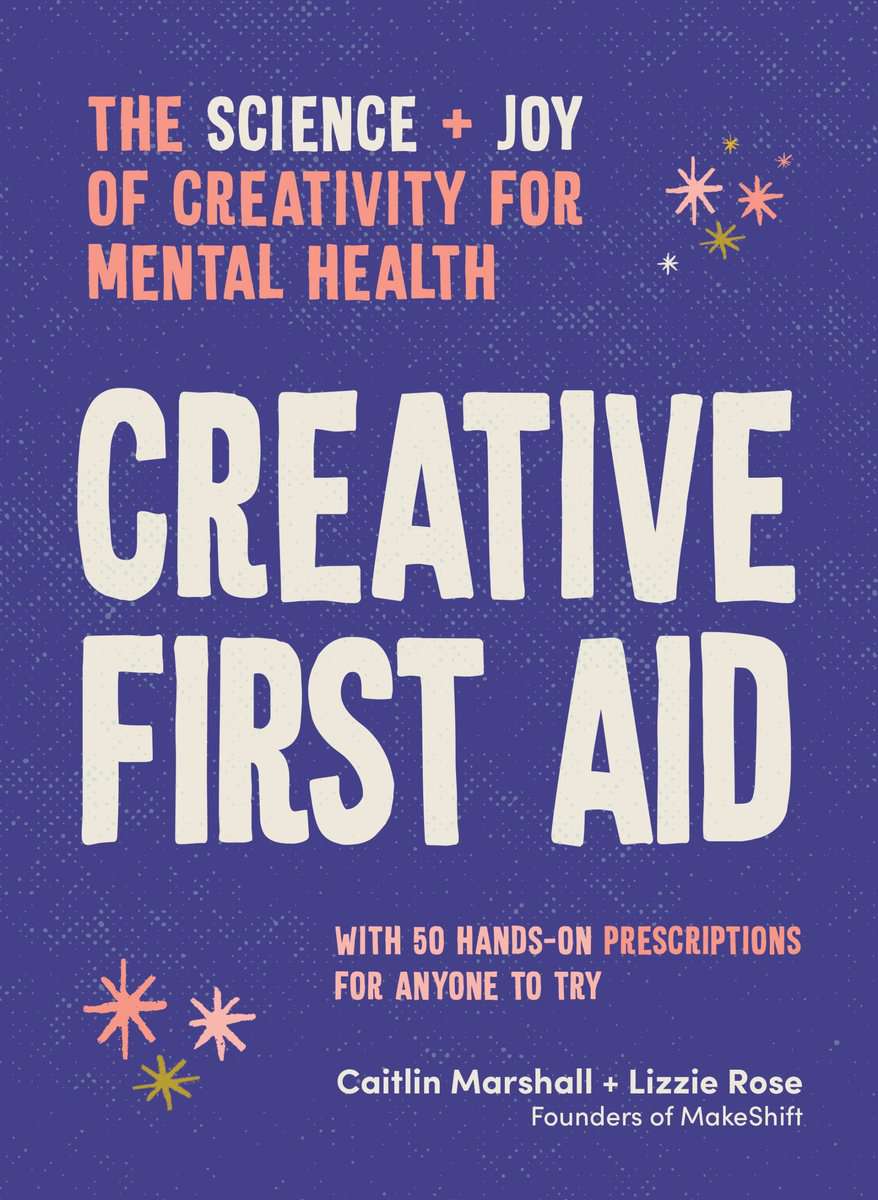
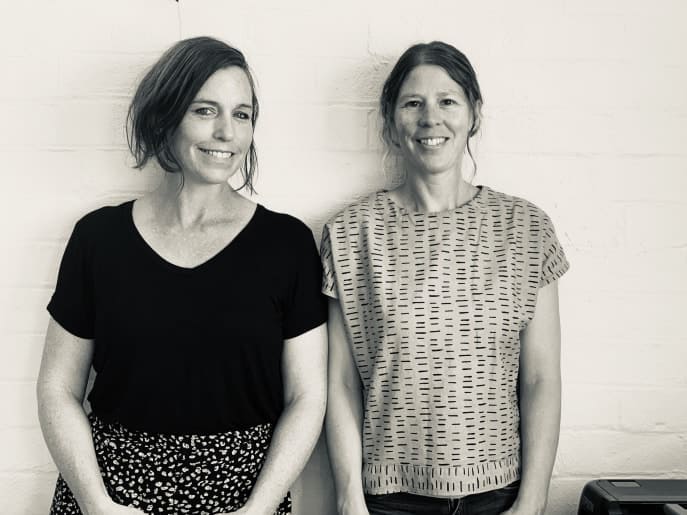
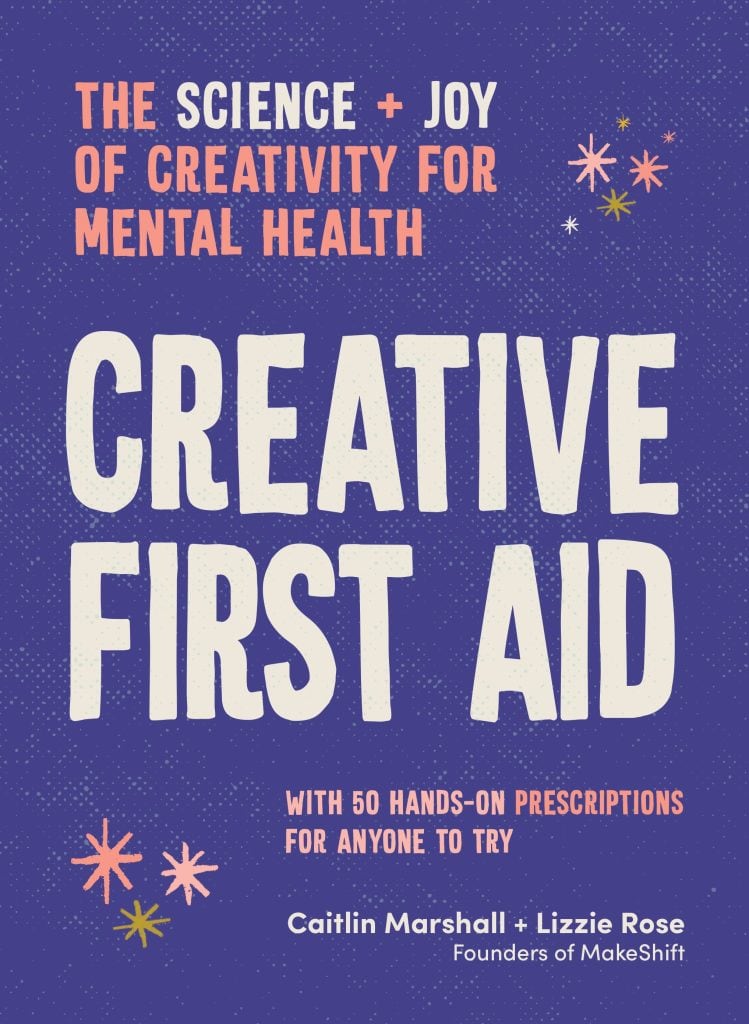
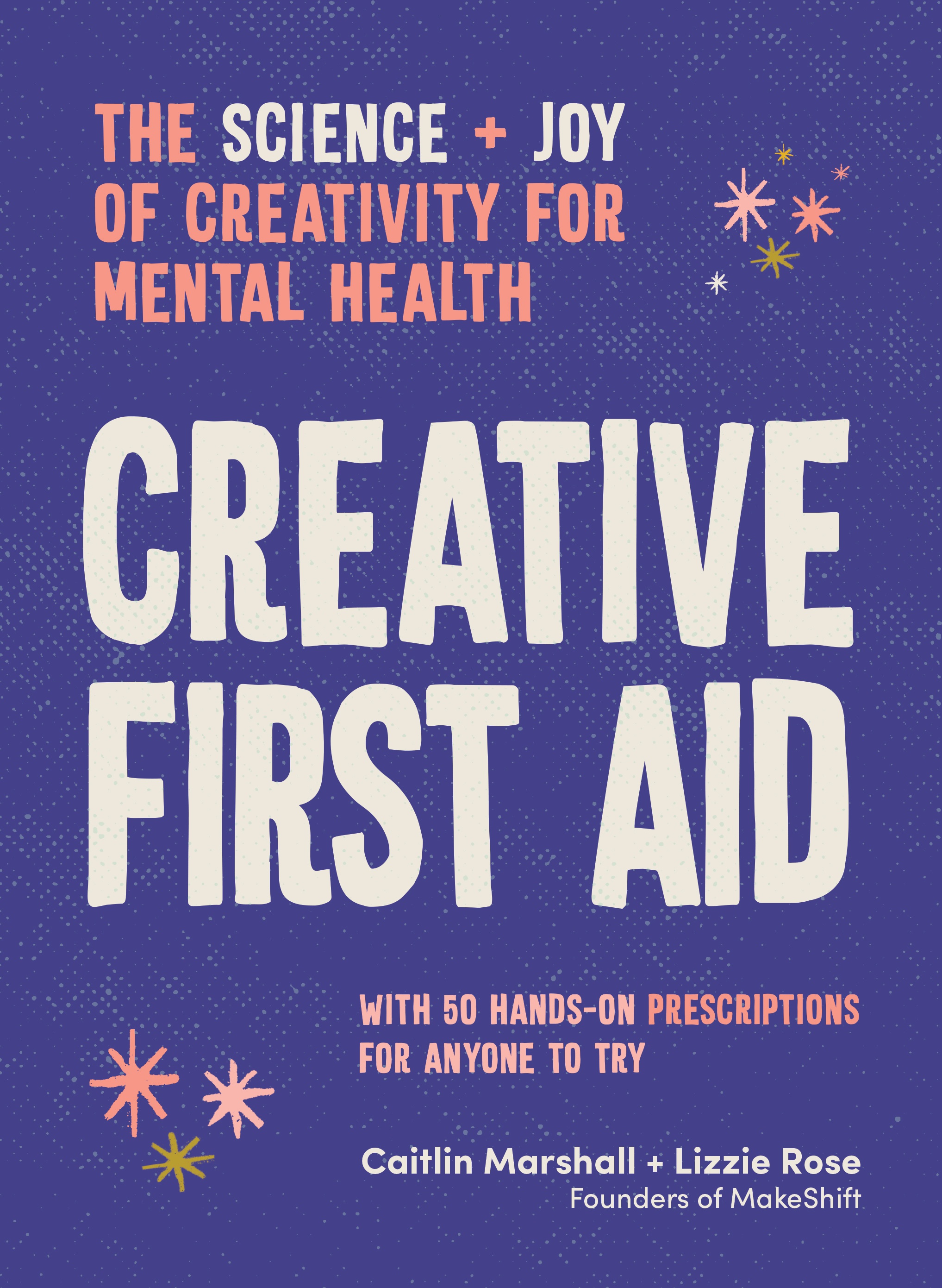
Caitlin Marshall and Lizzie Rose are the founders of MakeShift, an award-winning agency that provides trauma-informed creativity and mental health programs for communities, workplaces and groups since 2013. Their book Creative First Aid is your roadmap for how to look after yourself on tough days, amazing days – and all the days in between.
Good Reading spoke to the authors to find out more about Makeshift and get five tips to help us manage anxieties.
Can you tell us a bit about Makeshift, who started it and what its aims are?
Originally, we started a grassroots organisation that was designed to give community members opportunity to both teach a skill, and learn a skill related to creativity, sustainability and DIY. After a while, people started telling us this was helping their anxiety. It was helping them feel connected to the community, and improving their mental wellbeing.MakeShift was founded by the two of us, Caitlin and Lizzie in 2013.
Thousands of community members came along to creative, low-frills workshops taught by fellow residents. We also heard that a lot of GP’s and Psychologists were referring people to our classes. This was meaningful to us. We spent some time researching and designing a program to offer creative practice as a prescription for mental health challenges like anxiety, depression and trauma.
 In 2019 we piloted our 8 week ReMind program, which worked with people on workers compensation with psychological injury. We took people through a process of exploring a range of different creative practices. With the purpose of building connection, self care strategies, nervous system support, and empowering their recovery. It was an enormous success.
We transformed our organisation into a service that uses the framework of creative prescribing. ‘Creative first aid’ is a powerful, free, and always available resource that every single person has. It can support psychological health, and social connections.
Part of the aim of MakeShift is to undo mixed messages about what it means to be ‘creative’. Many people are given the idea, often in formative years, that unless they show immediate talent at singing, drawing or painting, that they are not creative at all. They then close this door for life.
MakeShift is about opening that door for people again. By creating the conditions for people to connect to their own creativity in ways that feel good. They can bring that spark of delight, joy and glimmers of hope. Humans have always been creative, in every culture around the world, since the beginning of human history. Our work is about connecting people to this reality.
Through connecting accessible content about the nervous system, how our mental wellbeing can be challenged, and what supports shifts towards recovery. With hands-on creative practice, we give people the tools to be empowered. This allows some control over how they respond to stress, grief, loss, distress, trauma and change in their lives. We work in trauma-informed ways to connect people in our shared humanity. We all have mental health, and we all need to play, rest, and connection. This is what Creative First Aid offers.
We have worked with young people in juvenile detention, First Responders like Police and Paramedics. As well as people experiencing workplace injury, survivors of bushfires and floods, NDIS participants, workplace teams, community service workers and more. Our approach is that while people are diverse, we share the drive and need to play. As well as the need to feel safe, connected, and have some control over our thoughts and emotions. Creative First Aid is a pathway to this.
What are you hoping to achieve with your new book?
Our book aims to remind every person who picks it up that they are indeed creative, and that our innate creativity is a rich, powerful and reliable tool that can support our wellbeing, our connection to ourselves, each other and the planet.
The book brings together all the knowledge that we share in our programs and events, and puts it in the hands of the reader. We are stripping away the myths and mysteries associated with the idea of ‘creativity’ and sharing a real, accessible and easy path for people to reconnect with this part of themselves, as a daily practice that can support nervous system regulation and mental wellbeing. The book offers a dispensary of 50 prescriptions of creativity that are designed for anyone of any experience to try. They also don’t require a lot of money or time!
We make the case for how creative practices impact our psychology. The book offers research and evidence from around the world. We tell stories of some people who had never picked up an instrument or a paintbrush, discovered that through creative first aid, they found themselves again, and reconnected to a pathway to recovery from significant trauma.
The goal of our book is to foster curiosity, for people to give themselves permission to explore this part of themselves, and be reminded that to take time to play, to connect with joy, to experience awe and wonder – these are essential experience for humans to have, in order to be well, connected, and able to support each other.
What is creativity and how is it helpful for mental health?
Creativity is about linking things together, that weren’t connected before. It’s about making something, that wasn’t there.
It can also be a practice that connects us to sensations, to our body, and to the world. This is incredibly powerful and helpful in regulating our nervous system. The nervous system is the headquarters for our stress, emotional, psychological and thought responses to things happening around us.
All the research shows that when we do something creative, get immersed in something and are in a state of flow, it immediately impacts our brain chemistry. Just being in proximity to nature – trees and mountains, lowers our stress hormones. Drawing, doodling, moving paint around a page – these things lower cortisol and increase serotonin. Serotonin is the hormone that creates feelings of connection and pleasure. Listening to, or playing music, has been identified in a series of research studies as like a ‘natural antidepressant’. This mimicks the positive impacts that pharmaceuticals have on our bodies and brains.
All of this adds up to a compelling invitation to utilise creativity, because it’s good for us. We don’t have to be good at it for it to make a difference. With physical exercise, we can do this, badly, without good technique or training, and still get the benefits of the cardio fitness, the endorphins, the heart rate going up. In the same way, a regular creative practice can signal to our nervous system as a flag of regulation – we can shift out of fight/flight/freeze mode and come into what’s known as our ‘window of tolerance’ – where are are grounded, can problem solve, think logically, feel empathy and compassion, and make sophisticated decisions.
Creativity is just a practice of something that connects new ideas, or makes something that wasn’t there before. Doing this as a habit, and along with the five elements of creative first aid that we outline in the book, turns this act into a prescription for wellbeing, that promotes mindfulness, and can build a sense of control, empowerment, and a feeling of connection to our lives. This rings true with what hundreds of people that we have worked with have told us too.
A creative practice as a prescription offers a way to explore different versions of ourselves, to surprise ourselves by taking risks, or trying something new and discovering a love or joy that we didn’t know existed! It can give our brain and body a giant rest, a chance to restore and repair from the relentless task of being productive, and consuming constant information and input from the world around us. In the times we live in, this is essential!
What do you say to those who say they don’t have a creative bone in their body?
We say this: that is an idea that has been planted in you in some formative moment, and has rooted it’s way into your core beliefs. That doesn’t mean it is true. Humans are inherently creative. We only have to look at small children – as young as 2, who dance, invent, make stories, draw, make things, create fantastical ideas. No one has shown them how to do this. It’s an urge within them, within all of us.
 Our culture tells us that only certain people are allowed to think of themselves as ‘creative’. Those that show immediate ‘talent’ in an art form of some kind.
Creativity isn’t the same as being an artist. You can be creative in the way you make the most out of few resources, or the way you approach a problem.
Creativity is a muscle within us all, whether we use it or not. Just like our actual muscles, it gets stronger, the more we use it. If you were to go to the gym for the first time, you aren’t going to deadlift 80kg. You would start with the small, light dumbbells, maybe 3kg, and work your way up. Many people expect to be able to paint a portrait, or sing a song perfectly when they try and ‘be creative’. They then feel like a failure when it falls short of expectations.
But if that creative muscle has been dormant a while, of course we aren’t going to be able to do those things! When we start small, just getting used to making marks on a page. They don’t need to look like anything at all, and instead focus on the feeling it creates. When we do that, we slowly reconnect with our creative muscle, and start to flex it.
Do you have an example story of someone who has been helped by your program?
(Excerpt from Chapter 3)
Let’s meet Vince. It was when Vince turned up on Zoom towards the end of a ReMind program with a hand-stitched lorikeet that I knew something was working. Vince was in the police force for 23 years. I met him when he’d swapped his uniform for Hawaiian shirts. He was really struggling with PTSD and had tried a plethora of therapies. We chatted about surfing and things that made him feel good. His mum, sunsets, cars and anything that lifted the weight of angst that he was feeling after being medically retired from the force. ‘I’m not creative,’ he told me, ‘but I’ll try anything.’ That was all I needed to hear and we were off and away.
It wasn’t easy for Vince to ring the doorbell on the Zoom room, but he did for eight weeks, and over that time he went from not getting out of bed in the morning to cooking his family dinner from scratch most nights and calling his mum every Sunday to do embroidery together.
Vince told me he would put the phone on loud speaker so his hands could keep stitching. His mum, Norma, started embroidery when she learnt from her mother at age ten. She mended and stitched her whole life. Vince had never threaded a needle.
After one session with textile artist Michele Elliot and me on Zoom, Vince went from making lines with thread to hand-stitching lorikeets. He went on to do this every Sunday with his mum, over the phone, until he had a menagerie! Keeping his hands busy kept his brain calm; stitching with his mum was easier than finding things to talk about. Slowly he was connecting with himself, with her and with the world. This unexpected practice of stitching became a trusty companion he could depend upon.
Vince later told me that embroidering was not something that he could have imagined doing ‘in a million years’. But through this experience, Vince began to connect with both his family and the larger community, specifically the ReMind participants.
Like Vince’s threads, stories carry us through our days. We are incessantly creating them and they can really assist us to make meaning of life, as well as filling us up with feel-good hormones. When we deeply listen to stories, it changes our brain chemistry, flooding it with oxytocin, which builds empathy. This exchange is the core of building trust and connection.
Our work at MakeShift has been driven by a deep urge to find ways for people to connect through shared interests, passions and ideas instead of shared problems. Finding glimmers of joy, like Vince stitching lorikeets produces feel-good hormones in the person experiencing the moment of joy. There’s also a wonderful after-effect: we almost always want to share what we have experienced when it comes from a pleasurable state. Passing on glimmers becomes irresistible!
So many people suffer with mental health issues. For those of us who feel we can’t improve, or find a way out of our struggles, what do you say?
Challenges to our mental health can create a sense that things are never going to change. These challenges affect our thoughts about ourselves and the stories we have about who we are. The feelings and behaviours that come with that can bring moments that feel unbearable, lonely, distressing.
We invite you to zoom in to the small and micro, to one day at time. Supporting your nervous system to be in a grounded state helps to ensure we can make good decisions for ourselves – for our health and wellbeing.
Doing something that connects you to pleasure, to enjoyment, or to mindfulness helps to regulate your nervous system. It could be going for a walk, outside. It could be being with a pet, patting a dog. Listening to music you love. Stretching and moving your body. Looking at pictures of forests and plants.
These small acts serve as little moments of repair, recharge and restoration for our nervous system. It helps to step slowly back away from being in fight, flight, freeze or fawn. Instead, being in a state where we are connected to logical thinking, creative problem solving, empathy and compassion. It is in this space that we can continue to follow the long path towards recovery and support.
Caitlin Marshall & Lizzie Rose’s five tips to help improve our mental health and cope with anxieties
- Remember that feeling anxious or challenged psychologically is really normal. Over half of all Australians will experience mental health challenges in their lifetime. These experiences shift and change, they are not static. Remembering this, and having self compassion that you are not ‘broken’, is important
- Give yourself permission to tend and care for yourself. When we are ‘regulated’ – when our nervous system is in its optimal state and able to problem solve, feel compassion, connect and reason. This is where we can make good decisions for our wellbeing. Becoming regulated happens through self care
- Self care looks different for everyone. You don’t have to follow instructions of what we are told this looks like. You might hate baths, yoga, and relaxation music! Maybe your way to self care is dancing to heavy metal, or whipper snippering your lawn. Any practice that gets you into a state of play. Where you are immersed in an activity in the present moment, and doing something you enjoy. This is valuable and vital.
- Stay curious. It’s very hard to be critical and judgemental of ourselves and others when we are curious. When we are in a state of collapse, distress or anxiety, it can be easy to be tripped into a judgemental mind – deciding how things are. Instead, if we can dial up curiosity a little, asking questions instead of making statements. This can help us find new ways to approach these times. I wonder what would happen if I called a friend? If I let myself rest? If I tried something new?
- Practicing creativity and self care can calm our nervous system in a way that helps us to reach out to others. If you are really feeling very alone, distressed, depressed, or anxious, reaching out for support – from a friend, a support service, or professional help is important. Give yourself permission to ask for help!

0 Comments