




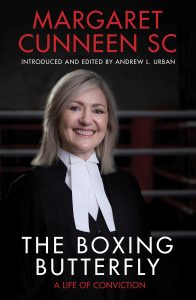
MARGARET CUNNEEN SC was a Crown Prosecutor in NSW who prosecuted cases of murder, paedophilia and gang rape. Since 2019 she has been in private practise as a barrister, representing people charged with criminal offences. Her book The Boxing Butterfly chronicles her career. Read on for an extract.
ABOUT THE BOOK
The Boxing Butterfly is a career chronicle of Margaret Cunneen SC – the boxing butterfly who turned the tables on ICAC, amidst prosecuting murderers, pedophiles and rapists – as she launches into her new chapter as a defence barrister. In her rear view mirror, Cunneen sees her trial successes – her convictions – interspersed with the flak from the ground fire of some colleagues who resented her success and were determined to stop her climb to greater heights. She regrets nothing and is totally satisfied with what she does. As Madam Crown, she empathised with the victims and their families. Now, as defence counsel she empathises with the accused she defends.
And what stories she tells! Some are gruesome and confronting, such as prosecuting the irreverent Skafs for gang rape, Robert ‘Dolly’ Dunn for paedophilia, the Butcher of Bega for unspeakable medical malpractice and the Charbaji Brothers for an ice-fuelled torture session that ended in murder. Others – especially relating to her defence clients, are filled with humanity.
EXTRACT
MILESTONE CASES AS MADAM CROWN
 Sexual assault, child abuse, rape, murder, drugs, extortion and torture – that was the world of Margaret Cunneen SC as Madam Crown. Not one case was like another, and some stand out for various reasons. Here, she provides a glimpse into just a few of the milestone cases in her career as a prosecutor. And some of the unexpected friendships made amidst the horrors.
MICHAEL GUIDER: SEXUAL ASSAULTS, UNDERAGE GIRLS
In 1996 I was given a brief to appear in the sentence of Michael Guider, who was at that stage charged with sexual assaults on 11 underage girls. He had no alternative to pleading guilty because the police had located photo albums of Guider filled with photos of his victims in indecent poses, apparently asleep, with his distinctive hands in the frame. In fact there were photos of many more than 11 girls but in some cases the police were unable to identify the girls and in others the girls, who had never before realised that they had been defiled in this way, did not wish to go through the process, even though, as it transpired, they would not be required to give evidence due to the guilty plea.
Guider however did give evidence, no doubt keen to apprise the court that his victims were unconscious at the times he had assaulted them because he had drugged them with Normison (temazepam). The detectives in charge of the case were very interested in the cross- examination, which explored his modus operandi, because they had started to form a suspicion that Guider may be implicated in the disappearance of Bondi girl Samantha Knight, who was feared dead.
Guider freely admitted having drugged the drinks of girls he had been babysitting and then interfering with them sexually and photographing his assaults. He was sentenced to 16 years jail and, during that time, police conducted a successful operation to gather the evidence required to prove that Guider had abducted and drugged Samantha Knight.
The damnation of Guider by the press after his pleas of guilty to the assaults was extreme. The front page of the Daily Telegraph screamed ‘EVIL MONSTER’ next to a large photo of Guider looking furtive. I recall thinking that this vilification was regrettable because no one would be prepared to plead guilty to sexual offences against children if they were going to be given such treatment.
Guider was later convicted of the manslaughter of Samantha Knight; it being accepted that he never meant to kill her when he drugged her. His modus operandi had been revealed during the 1996 proceedings.
MICHAEL KANAAN: SHOOTING POLICE
When I prosecuted Michael Kanaan for having shot a policeman who was chasing him through Weigall Park and White City, on the northern end of Paddington, he had already been convicted of three murders and was serving three life sentences. His prosecution for shooting Constable Chris Patrech, once in the arm and once in the leg as he climbed a tennis court fence in pursuit of Kanaan and three accomplices in 1998, was important though.
Kanaan and his three accomplices were armed and on their way to kill a Kings Cross identity known as ‘Tongan Sam’ when Constable Patrech and Senior Constable John Fotopoulos stopped their car and gave chase on foot. Kanaan shot at the police officers, wounding Patrech, and Fotopoulos returned fire, shooting Kanaan in the buttocks, legs and wrist. It stopped Kanaan’s murder spree as he was arrested at the scene and has never since been released.
When Kanaan first faced court for the ‘White City shooting’, he had not yet been charged with the murders of which he would later be convicted. The magistrate, Ms Pat O’Shane, described the police officers’ pursuit of Kanaan and his co-offenders as ‘stupid, reckless and foolhardy’ and indicative of ‘police harassment of youth’ discharged him. The DPP would later sign an ex officio indictment for his prosecution.
Still some could not see the importance in prosecuting Kanaan for shooting at the police whose perspicacity had prevented a murder that very night, and doubtless more in the future.
When, during the trial in which I was the Crown Prosecutor in 2006, the Court was taken on a view of the scene, the judge, a woman I knew well from having worked closely with her during the 1980s and ’90s said to me: ‘Why is the DPP doing this case? He’s already in for life’. I said: ‘for the victim’.
The jury could certainly see the point, and Kanaan was duly convicted of shooting Constable Patrech. He was sentenced to a further 12 years on top of his triple life sentence.
I will always remember a touching reunion after the verdict.
In the hours after the shoot-out during which both Michael Kanaan and Constable Patrech were seriously wounded, Senior Constable John Fotopoulos underwent alcohol and drug testing. A minute amount of cannabinoid was found in his bloodstream. He was interviewed and admitted he had smoked a joint while at a party about a week before. Instead of being lauded for his extraordinary heroism on the night, returning the fire of a murderous criminal who had embarked on a killing spree in Sydney and who had just shot a policeman, he was discharged from the Police Force under a cloud.
Constable Chris Patrech recovered from his gunshot wounds and continued in the Police, stationed on the North Coast.
When they gave their evidence, both heroes mentioned to me how they had not seen each other since that night eight years before. I arranged for both to meet me in the Judgement Bar of the Courthouse Hotel diagonally opposite Darlinghurst Court. The Judgement Bar is known, by the lawyers who frequent it and the Sheriff ’s Officers who may be looking for them, as Court 8, there being seven courts in the Darlinghurst complex. Before the days of mobile phones, we would sit at the corner window looking over to the Court waiting for one of the sheriff ’s officers to wave to us to signal that a jury was coming back to court with a verdict.
John Fotopoulos and Chris Patrech embraced. Their lives had diverged, because of that life-changing incident. They sat and talked. Justice had finally come. I was overcome with emotion and I think they may have been too.
ALLAN WAYNE NELSON: EXTORTION
The 1995 prosecution of Allan Wayne Nelson for extorting money from a wealthy Hunters Hill businessman was memorable more for the notoriety of the Crown witnesses than the case itself. Nelson had threatened a man, and his son, with physical retribution from Roger Rogerson and Sydney standover man/private investigator/bouncer Tim Bristow, if he didn’t deliver him a large sum of cash.
Nelson was arrested when he arrived at the location he had appointed to pick up the bag of cash, the victim having alerted police to his demands.
Unsurprisingly, Messrs Rogerson and Bristow knew nothing of the matter so, as the Crown Prosecutor, I was obliged to call them in the Crown case to say so.
Before Big Tim Bristow arrived at the Downing Centre court complex, I had been told by the investigators that he had recently suffered a stroke which affected half of his body. I recognised him in the foyer and although he was then only 64, he looked pretty old to me. I suppose that is because I was only 36. I approached him, introduced myself, and suggested that we use the lift in view of his recent stroke. He grinned winked and said, slightly lasciviously: ‘That won’t be necessary darling. The stroke only affected the top half ’.
When he gave his evidence, defence counsel naturally tried to convey to the jury that Mr Bristow’s credibility may be a little below par.
‘You have the reputation of a standover man, don’t you Mr Bristow?’
‘No, I am one’, came the reply.
‘You are known in the criminal milieu of Sydney?’ ‘And the world.’
The jury loved him.
Roger Rogerson was also labouring under some difficulties. Not only was he on crutches with a leg injury, he was in custody. He was serving three years in jail after having been convicted of depositing money into a bank account in a false name.
I went down to see him in the cells and tell him what the case was about. I took with me the detective in charge of the case, a former contemporary of Rogerson in the famed Armed Holdup Squad. They were pleased to see each other. While I was politely explaining the nature of the case and why he was required, I saw a tear fall from the eye of the tough old Detective Inspector next to me. Rogerson cut me off: ‘Yeah, yeah, I know, I know’. Riding up in the lift, the veteran detective said, with a faltering voice: ‘It was terrible to see him like that’.
Roger Rogerson hobbled into the side door of the court in his green tracksuit, flanked by Corrective Services officers.
After he gave his evidence that he knew nothing of the blackmail attempt by the accused, defence counsel had to make sure that the jury knew who he was.
‘Mr Rogerson, you’re the Roger Rogerson who was accused of attempting to kill one of your police colleagues, aren’t you?’ The man in green looked intently at the jury, as he had done many times before. ‘Everyone I’ve attempted to kill is in Rookwood.’
Nelson was convicted and sentenced to prison, where he became the cellmate of one John Arthur Blaikie, an old lag I had prosecuted in several trials over about a year for a housebreaking spree. The pair of them spent their time contriving numerous handwritten complaints about me, all eventually dismissed, to the Bar Association. It occurred to me that they found it more galling to have been prosecuted by a woman than a man and that they were more surprised, somehow, to have been convicted.
During the Nelson trial I was told many tales about Roger Rogerson’s policing style. They were different times, of course, but there was much to be commended about his service.
I was able to talk to Mr Rogerson about that case when I next saw him when we were both guests on a Geoffrey Robertson’s Hypothetical in Melbourne in 2001. At the end of the evening, enjoying the hospitality at HSV 7, the guests had thinned to three.
Roger Rogerson and I continued enjoying a convivial drink with Archbishop (as he then was) George Pell. I have spoken of that most enjoyable night with each of them since. Rogerson has since been convicted in relation to the murder of Jamie Gao. The length of his sentence will probably mean that he will die in jail.
ROBERT (DOLLY) DUNN: SEXUAL ABUSE OF MINORS
Robert (Dolly) Dunn was a schoolteacher and a particularly evil paedophile. Some of his victims were as young as seven. There can be no doubt about that, or about the nature of his offending, because he videotaped many of his depredations upon children.
When I prosecuted him in the late 1990s, my own three sons were the same ages as some of the victims in his horrific home movies. When I cross-examined him about filming these dreadful sexual assaults, he said: ‘Well you keep wedding photos and videos don’t you?’
Dunn was the first paedophile in New South Wales to have videos of his crimes tendered in his sentencing proceedings. The District court judge who sentenced him was sceptical. He didn’t want to see the videos and no one can blame him. Particular scenes stay with me to this day.
I particularly recall how ready and willing the boys were to undress and assume positions they had obviously assumed before. Dunn could be seen waving twenty-dollar notes under their noses, right in front of the camera.
‘Only by seeing these videos will Your Honour understand how inured the victims are to the abuse that is perpetrated on them,’ I argued. The judge replied that the acts could be simply described in words in a Statement of Facts. I submitted that when there is CCTV footage of a bank robbery, or a physical assault, it goes before the Court. A picture is worth a thousand words.
Finally the judge agreed to admit a selection of events from the many videos which had been found in Dunn’s lounge room, the names of popular family movies on the spines.
There were many journalists in court when the videos were played. This was a very good thing. For the first time, people in the general public who could scarcely believe that men could misconduct themselves in this way with children were able to be informed through all sections of the media that these events had undoubtedly occurred. This was a breakthrough. It started to translate into an increase in the number of convictions in child sexual assault cases, which had always been very difficult to obtain, partly because of the reluctance of jurors to believe that such things could ever occur.
PHILIP BELL AND COLIN FISK: CHILD SEXUAL ABUSE
Long before the internet and social media, Sydney paedophiles (or ‘pederasts’) as Philip Bell described himself, had a network in Sydney.
This became clear when I noticed that there were victims common to several of them, and even though some infested the Eastern Suburbs and some trawled the Northern Beaches, and they were in very different lines of work, they knew one another and employed the same blandishments to attract adolescent boys to their lives and lifestyles.
Philip Bell was a wealthy Eastern Suburbs accountant who had made his fortune in the new superannuation industry in the 1960s. He was socially well-connected and numbered well-known Sydney identities, including fashion models and socialites, among his friends. During cross-examination he explained that he had never considered it important to differentiate between what we were by then calling ‘underage’ and ‘over-age’ males because for most of his life all homosexual activity was illegal but, he added: ‘the wealthier you are the younger you could get’.
He explained that many of his mature women friends thought it was lovely that he was introducing young teenage boys to the wonderful things in life including fashion, sailing, fine dining, wines and music.
Colin Fisk was of much more modest means than Bell, and of a more ‘knockabout’ persuasion but there were some victims in common. I remember submitting that Fisk had ‘the crumbs from Bell’s table’ although thinking on it now, I regret that that comment was perhaps insulting.
GRAEME REEVES (‘BUTCHER OF BEGA’): MALICIOUS GRIEVOUS BODILY HARM
Much as the 1999–2000 prosecution for sexual offences on novice brothers, of the three most senior priests of the Saint Gerard Majella Order (its founder John Sweeney, Peter Pritchard and Stephen Robinson) had altered the way I perceived priests, the prosecution of former Dr Graeme Reeves kept me out of doctors’ surgeries for years. There were many complainants, and the charges spanned allegations of cruelty, sexual abuse and outright incompetence. One woman had died as an apparent result of his failure to respond to sepsis. The charge that drew the attention of the media was the first that was run in 2011, a charge of maliciously inflict grievous bodily harm. The victim (as she was indeed) was a 58-year-old woman whose husband had recently died. She had a pre-cancerous lesion, about a centimetre by a centimetre and a half, on the labia minora. She was confident and well-spoken, perhaps slightly imperious. I liked her. We remain in occasional contact.
Reeves had told her he could excise the lesion under general anaesthetic. He had spoken to her quietly as she was about to be anaesthetised. She swore that the last words he uttered, whispered into her ear, were: ‘I’m going to take your clitoris too’. A theatre nurse testified that she asked Reeves why he was ‘taking so much’ and was told: ‘her husband’s dead so it doesn’t matter’. Reeves’ victim woke from the operation to find that her entire external genitalia had been cut away.
An aspect of the case that induced in me a resolve always to seek a second opinion was that although most of the gynaecological experts gave evidence that the lesion should have been excised with only a small margin of tissue taken, some said that the extreme procedure was not inappropriate, and had in the past been the accepted treatment, especially if other areas appeared affected.
Reeves was convicted and appealed to the High Court against his conviction. The judgement records part of the proceedings: ‘In her closing address the prosecutor invited the jury to consider that “it’s inconceivable that he really told this lady that he was going to take everything”. The prosecutor reminded the jury of passages of [the victim’s] evidence in support of the submission on the consent case:
‘Did you ever consent to an operation to remove your entire vulva including your clitoris? She said, “Never never never never”. She only had to say it for you to believe it ladies and gentlemen. Of course she didn’t. Not for what she had. Not without further biopsies. Not without more consultations than that and time to think about it.’
Reeves served the one-year non-parole period of his two years six months maximum term. He was tried some years later in relation to another case where his patient had died and was acquitted.
A Sydney broadcaster told me, around the time of the trial, that two of his children had been delivered by Reeves a decade or two before. He and his wife had found Reeves competent and appropriately caring and encouraging. He mentioned that he had been very much thinner then. Reeves had in the interim developed serious diabetes, and, during sentencing proceedings, described a constellation of debilitating illnesses, which were taken into account to afford him a degree of leniency. I wondered whether his personality, and perhaps his ability, had been affected by these conditions. He never practised medicine again. But at the time of writing, he is still alive.



0 Comments