




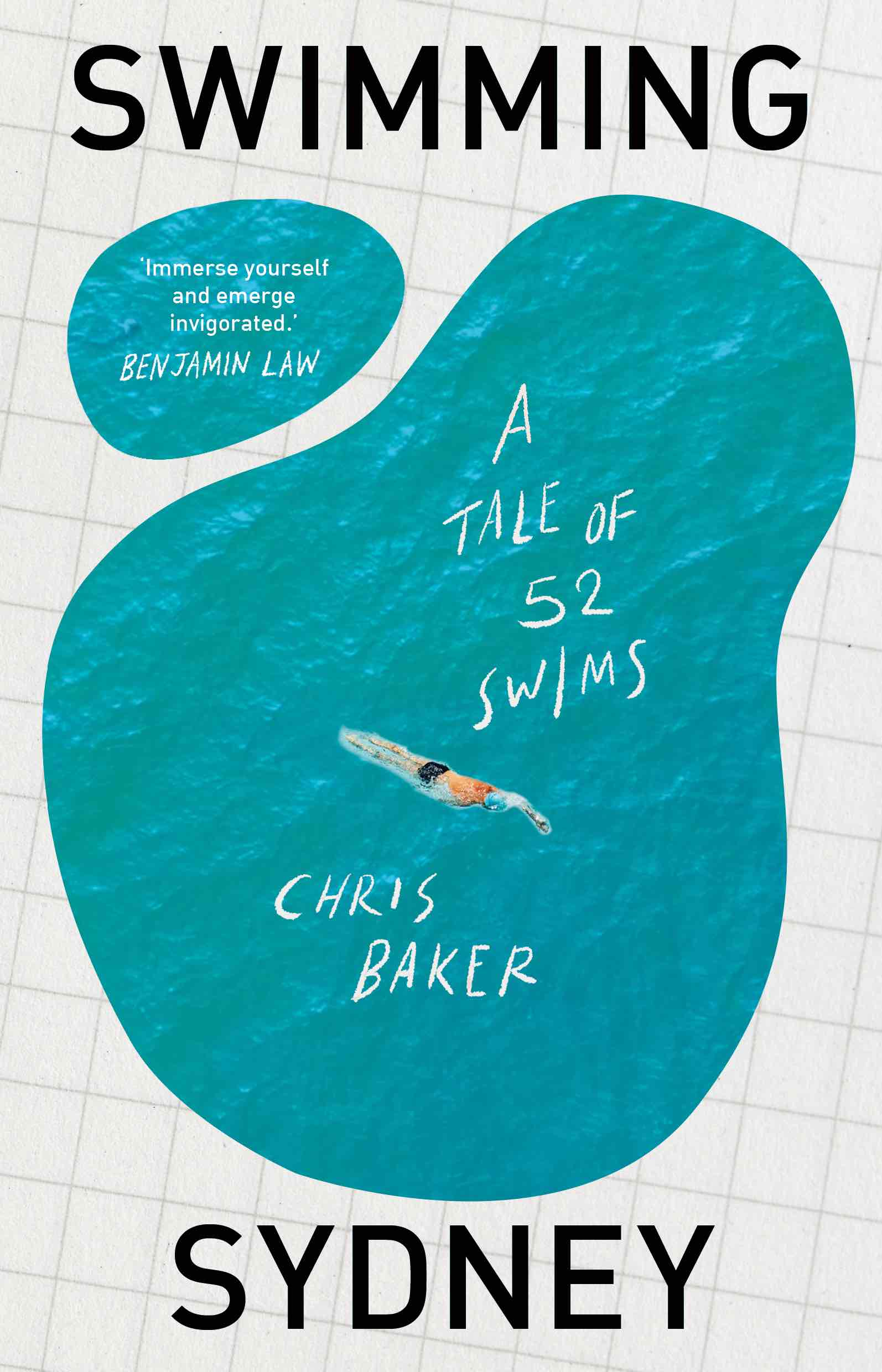
Swimming Sydney is CHRIS BAKER’s tale of 52 swims in and around Sydney that take place over a calendar year. From Palm Beach to Cronulla, Mount Druitt to Bondi, he swims at iconic beaches, municipal pools, harbour baths, tidal rock pools, bushland lakes and a backyard pool.
Taking his weekly plunges, Baker reflects on friendship, history and family, and how swimming can help us better understand ourselves.
Read on for an extract …
INTRODUCTION
 One evening, when I was about ten years old, I watched a film on television called The Swimmer. Based on a short story by John Cheever, the film portrays a day in the life of Neddy Merrill, an athletic, middle-aged businessman who decides to ‘swim’ home via his neighbours’ suburban pools.
To my prepubescent eyes, the film was wonderfully baffling. It featured a tanned and taut 53-year-old Burt Lancaster in the title role, sporting nothing but skimpy bathers and his extraordinary, oversized grin. As he progresses from pool to pool, Neddy encounters one martini-guzzling neighbour after another. He slaps a lot of backs, occasionally takes a sip from a highball himself, does a lap of a pool and then moves on.
The film resonated with me for many years. Its details, and indeed its general plot, were lost to me over time, but its mood and the image of Burt Lancaster ‘swimming’ home was forever chiselled into my memory. During my boyhood, I’d talk about The Swimmer with my brothers. Lolling on a pontoon moored in salt water, or dangling legs into a chlorinated backyard pool, we’d joke about what it would be like to jump fences in suburban Sydney and make our way home via its pools. How long a swim could we thread together? Which parts of the city would have the most pools, or the best pools, to follow?
Later in life, when I spoke to friends my age who also liked to swim, I was surprised that the film had had a similar impact on them. Few of us had seen the movie recently, but we all agreed that it had lingered in our childhood consciousnesses as something strange and memorable.
Not long after I decided to write this book, I was able to see The Swimmer again. Serendipitously, it had been scheduled at the Art Gallery of New South Wales as part of a retrospective of films that were made in 1968. I was surprised and delighted to see a near-full auditorium for the Sunday afternoon screening, especially since it was a glorious early-autumn day that was not unlike the one that unfolds in the movie.
Within a few minutes of the movie’s opening, I was awoken to the fact that it was a cinematic swimming myth.
True to my fuzzy memories, Lancaster swims many a pool and gatecrashes the odd pool party. But, more poignantly, this strange film takes us on the odyssey of a man who is profoundly damaged and ‘swimming’ towards a personal reckoning. With each pool he traverses, his armour of nostalgia, privilege and delusion is gradually washed away, and he loses his emotional buoyancy. He and his booze-addled neighbours are representative of Homo americanus, white, rich and privileged in so many ways, yet utterly indifferent to the social and racial fault lines that are building in their country in the late 1960s.
Despite some dated psychedelic visual flourishes and an overwrought score by Marvin Hamlisch, The Swimmer played strongly to the contemporary audience, likely tapping into the politics of our times. Its white, middle-aged protagonist who represses unpleasant facts, and the strong women who call his bluff, seem to presage the Era of Trump and the #MeToo movement. More significantly, I think The Swimmer, like all myths, taps into something profound about the human condition and asks some remarkable questions. Can swimming be an initiation, a meditation, an expiation? Is swimming a metaphor for our individual navigation of life’s emotional tides? Can a swim wash away the past and cleanse us emotionally?
This book is a love letter to both the act of swimming and the city that boasts more aquatic pleasures than just about any other urban centre in the world.
Perhaps because I am now about the age that Burt Lancaster was when he swam his way through this film, these questions seem particularly pointed. Yet watching the movie made me think of boyhood as well as middle age, leading me to reflect on family, on friends, on struggles, on pleasures. It made me think of place as well as time, and of the many swims that I have done in Sydney. For me, swimming is Sydney. After a swim at one of Sydney’s beaches or pools, I feel like I’ve had a mini holiday, renewed in spirit and reacquainted with the city’s beauty and generosity. Swimming is the greatest joy of living in this city, and the one I have been most delighted to return to after living half my working life overseas.
Whether shared or solo, my swims in Sydney are more than the pure motion of gliding through water. They speak of place, people and stories, and they give me a strong sense of belonging.
This book is a love letter to both the act of swimming and the city that boasts more aquatic pleasures than just about any other urban centre in the world. It is also a celebration of why we Sydneysiders take to the water, and of what it means to be buoyant in the many senses of the word. Swimming Sydney looks at how swimming and the healing element of water can help us to better understand ourselves, our city and our island nation.
The 52 swims of this book take place over the course of a calendar year. As I follow the seasons, I swim from Palm Beach to Cronulla, from Mount Druitt to Bondi. These chapters take us to iconic beaches, municipal pools, harbour enclosures, hidden rivers, tidal rock pools, bushland lakes and a backyard pool. They are also springboards for stories past and present, personal and universal. Some are enriched by
First Nations’ knowledge of Sydney’s waterways, others muse on how swimming informs popular culture. They recount Olympic champions and surfing legends, extol the benefits of cold-water swimming for depression, evoke the submarine invasions of Sydney Harbour, and visit a site reputed for its apparitions of the Virgin Mary.
Taking my weekly plunges, I swim with the many tribes of Sydney: a septuagenarian aqua aerobics class; a six-month old baby learning to swim; a Saturday-morning LGBTQIA+ swim squad; asylum seekers finding refuge in a Western Sydney pool; a cancer survivor at Bondi Icebergs.
Whether splashing, paddling, floating or doing serious laps, I muse on race, identity, mental health, nudity, literature, cinema, real estate, ancestors, climate change, sexuality, class, urban design, spirituality, mortality and family.
Intensely personal stories also surface. I write of my two grandfathers – one working class and one patrician – who never met each other but whose fates were both entwined with the harbour, one of them drowning in its waters. I recall my boyhood swimming lessons and reflect on the reckless coastal rites of passage of Sydney teenagers. I describe the respite that swimming in rock pools gave to my mother while she suffered from dementia, rejoice at a barefoot beach wedding, and commemorate a friend whose ashes I scatter in the Pacific.
More than a city guide or a sports book or a collection of meditations and reminiscences, Swimming Sydney is a valentine to the beautiful obsession of swimming in the world’s most beautiful city. It is a book for everyone who loves swimming, who loves Sydney and who understands that storytelling is the best way to navigate life’s emotional currents.


0 Comments