



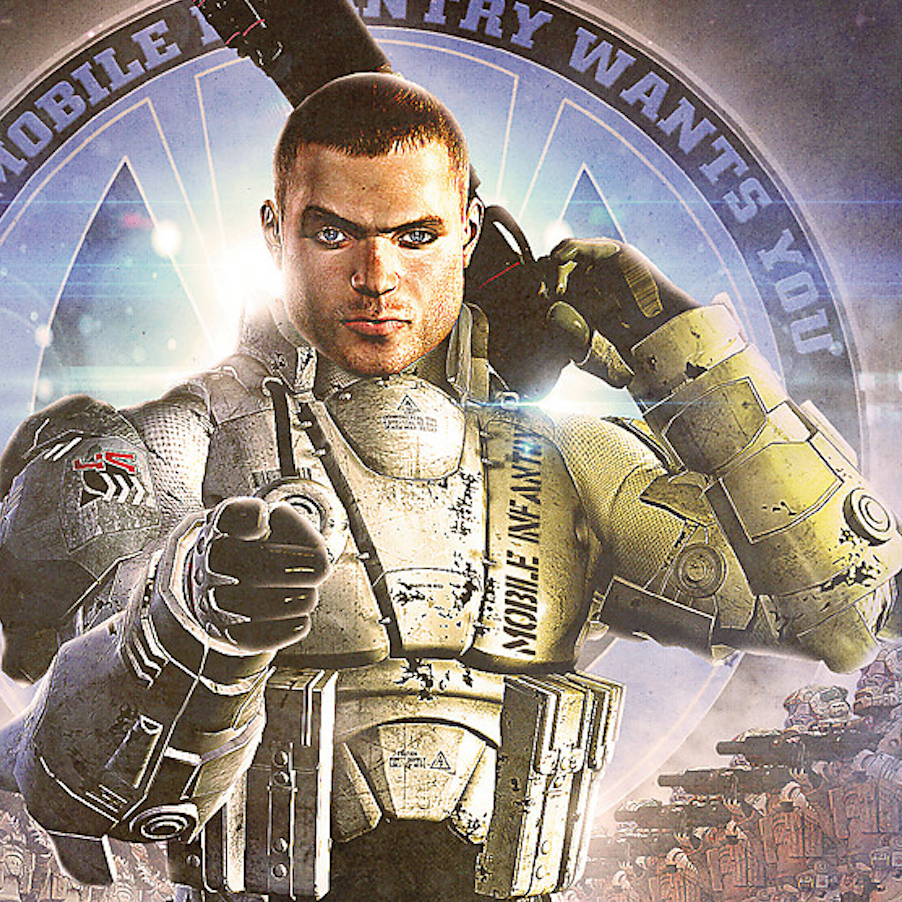
Space Opera is one of the oldest subgenres of science fiction which has continued to thrive. GRANT HANSEN looks at the political nuances of the genre and the various books that have defined it.
Genres don’t just happen. Anyone considering the commitment required to produce creative content has at least a passing interest in its marketability. And the obverse of that coin is that anyone considering investing in a piece of creative content – be that a novel, a film or a streamed series – likes to have some basis for thinking it will be worth the time. The past remains our best guide to the future, even if not all swans are white.
So it is that while crime may be at historic lows in Australia and Scandinavia, crime fiction has never been so rampant. And so it is with science fiction – as the pandemic grinds on, some of us have been bingeing the sci-fi offerings on streaming platforms and there is nothing like a streaming platform to clarify the elements of a genre.
After all, if you have unlimited freedom to make stuff up why not have a go at your own private Utopia – or Idaho.
Clearly the times also suit the dystopian and post-apocalyptic genres; the ability to switch in some zombie action being an obvious bonus. Thus, it is possibly surprising that one of the oldest (and arguably most optimistic) of sci-fi sub genres – Space Opera – continues to thrive. And one reason for this may be that Space Opera is ideally suited to giving the author unlimited flexibility in world building. Historical fiction – or at least worthwhile historical fiction – cannot safely change known events without attracting the taint of fraud (historical fantasy is a different matter) and this inevitably limits what you can just make up. Crime fiction has to respect geography and the limits of forensic science. But once you are out of the gravity well, hopefully powered by FTL tech (but maybe in a generation ship) the stars are the limit. Strange then that the genre also tends to be intensely political. After all, if you have unlimited freedom to make stuff up why not have a go at your own private Utopia – or Idaho.
Terminology is far from settled so a word on definitions is appropriate. By Space Opera I am referring to a type of speculative fiction which is primarily set in Space – i.e. not here – and where developments in technology and changes in human society are by no means constrained by hard science. It is characterised by space flight, alien contact, and human colonisation of the solar and or other planetary systems.
Within these parameters pretty much anything goes – from the relatively recognisable Star Wars universe to the brilliantly imagined and entirely unprecedented universe of Iain M Bank’s ‘Culture’ series.
A Danish silent movie Himmelskibet made just after World War I may well be the first example of the Space Opera genre in the last century. The make-up does make the actors look distinctly zombie like, but it ticks all the boxes – space travel, life on a spaceship, encounters with aliens on Mars and even a human-alien romance. And there is a strong anti-war message. The genre began as it meant to go on.
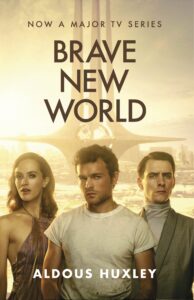 Himmelskibet is something of an outlier however – one has to remember that before World War II there was no such thing as a functional rocket, and terrestrial flight was still a novelty. Pre-World War II sci-fi, if it involves aliens tends to have them invading Earth – think H G Wells’ The War of the Worlds – and more generally tended to engage with the social effects of terrestrial technological change – as in Aldous Huxley’s Brave New World.
All that changed once the prospect of escaping our gravity well was realised. The 1940s saw authors with scientific or engineering backgrounds such as Isaac Asimov and Robert Heinlein start to push the envelope of what could be imagined. But the futures they imagined were very different.
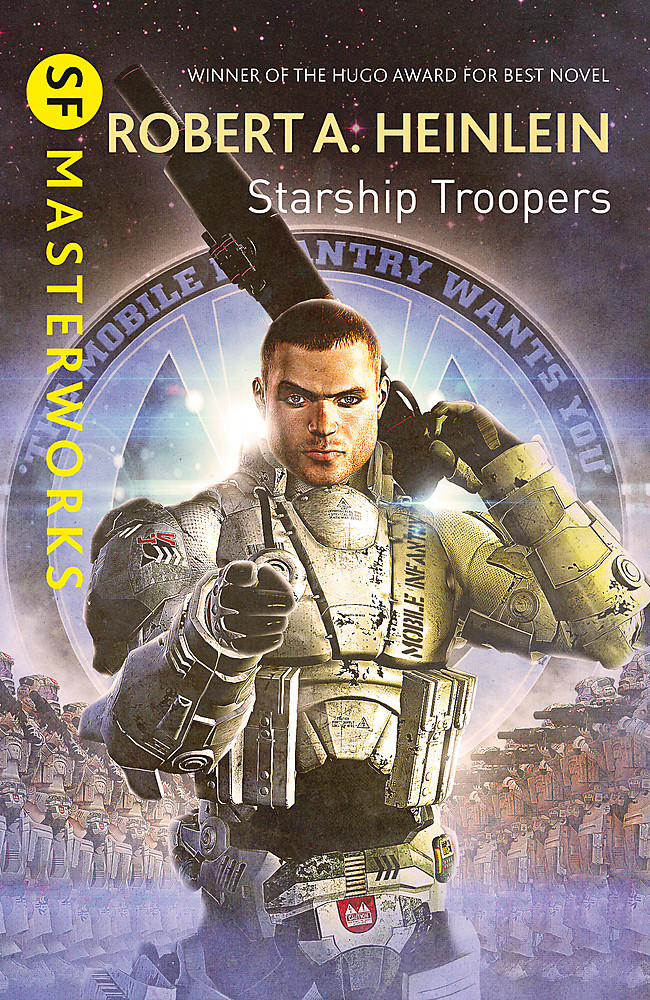
Robert Heinlein was an engineer and ex US Navy. He started as a Democrat but by the mid-50s would have been very comfortable in the libertarian wing of today’s GOP. An unabashed eugenicist (but not a racist) with not-so-latent authoritarian instincts, he was a master of ‘indirect exposition’, heavily influenced by Rudyard Kipling, and also had a good grasp of the possible mechanics of space flight, general relativity, and colonisation of our solar system. His Starship Troopers is a classic of the genre though probably for all the wrong reasons. It is set in a society where military service is a pre-condition of voting. It translates the US Marine boot camp trope to outer space and a dastardly alien threat. Verhoeven’s film takes liberties but gets the spirit right.
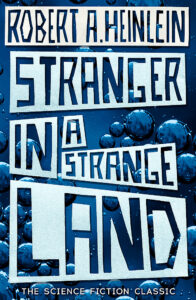 Heinlein had a large output of variable quality. These days he is usually remembered for Stranger in a Strange Land which is premised on time travel and remains of interest for its head-on assault on the social mores of the US Mid-West. Orphans of the Sky about a devolving multigenerational space flight and Farmers in the Sky about the human colonisation of Ganymede are some of his more interesting young adult works and if nothing else will take you straight back to the 1950s, so another kind of time travel. Isaac Asimov on the other hand was a definite Democrat. His ‘Foundation’ series, reminiscent of the decline and fall of the Roman Empire set in the far distant future, created a template for one type of Space Opera. No aliens, few women, and big geopolitical issues.
Arthur C Clarke is rightfully famous for his 2001: A Space Odyssey which was immortalised in the Stanley Kubrick movie. Clarke’s vision of the future was technocratic rather than ideological and his science is impeccable.
Ursula Le Guin is as good as it gets when it comes to speculative fiction …
I fondly remember ‘Star Trek’ from the late 1960s – a series that managed to distil that brief period of American optimism before foreign wars and domestic inequality delivered us to the current precipice. James Blish wrote Spock Must Die! which is probably the most respectable tie-in effort out of hundreds. Blish also wrote the ‘Cities in Flight’ series set in a world where the Americans and Soviets were still locked in a Cold War (but which the Soviets were winning) and the ensuing colonisation of space. They Shall Have Stars is an attack on MacCarthyism.
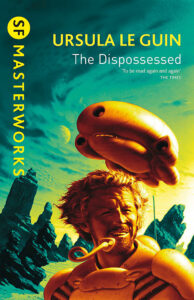 Ursula Le Guin is as good as it gets when it comes to speculative fiction and her career was launched by a trilogy of novel’s set in the Hainish Universe which qualify as Space Opera: Rocannon’s World, Planet of Exile and City of Illusions. The theme explored in later books set in this universe are present at the beginning. How does an advanced spacefaring civilisation interact with planet-bound natives? Do they interfere in practices they find abhorrent? In The Left Hand of Darkness an envoy from the Ekumen (a league of advanced spacefaring human cultures) encounters a people who have no knowledge of war and who also assume gender only when they go into kemmer – and the gender assumed is not consistent. In The Dispossessed Le Guin gives us a well-thought out anarchist society and contrasts it with the capitalist and patriarchal society on the parent planet it circles. The Hainish novels are set in a universe settled from the planet Hain and each planet gives Le Guin the opportunity to explore permutations of what it is to be human.
C J Cherryh is one of the most intriguing and influential writers to come out of America in the ’70s. Her knowledge of anthropology, social history and languages is deployed to create alien worlds of compelling believability. Her ‘Merchanter’ novels are loosely connected. Her Downbelow Station is a template for the near contemporary ‘Expanse’ series while the ‘Foreigner’ series is a favourite of cat lovers and Nipponophiles everywhere. The ‘Chanur’ series posits what a lion pride would look like if it had achieved FTL space travel. In Cyteen – set in the Merchanter universe but in that part of it controlled by the authoritarian Union – she explores a society where citizens are surveilled even as they exploit lab-bred human clones called azi. The Union is in a hurry to expand and so the azi cannot be raised by parents – instead they live in barracks and are given ‘tape’ and the resulting personality types are both useful and unstable.
Cherryh’s Merchanter universe is complex and endlessly fascinating. In contrast, the ‘Star Wars’ series is pretty much a Space Western. Its political economy makes no sense – whose interests exactly does the Empire serve? Why would you blow up a planet? The various aliens are just like us, weird looking. Inevitably there are hundreds of tie-ins of various types, including novels, but they are mainly of interest as exemplars of how a hard-run franchising operation works. What is lacking is a genuine attempt to imagine real alternative modes of human society.
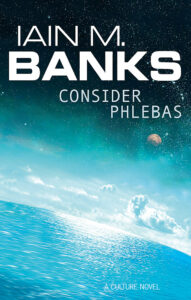 That is not a complaint that could be levelled at Iain M Banks’– ‘Culture’ series which includes Consider Phlebas, Transition, Hydrogen Sonata and Excision. Banks is fascinated by the prospect of a post-scarcity society managed by AIs called Minds where the long-lived citizens’ biggest challenge is creating their own meaning. His Culture civilization is a post-scarcity Utopia and its dilemmas revolve around whether being good should be compulsory. As with Le Guin, a major theme is how the culture interacts with less technologically advanced civilisations.
Of the more recent contributors to the genre, Ann Leckie’s ‘Ancillary’ series is probably the best. Tightly plotted it has strong female characters, (and purely female pronouns) AI and a galactic empire with an immortal and multi-cloned ruler. Ancillary Justice, Ancillary Sword and Ancillary Mercy are in the best tradition of Space Opera and deliver a complex view of a post-gender imperial society.
An honourable mention should be given to ‘The Expanse’ series. This nine-book epic takes the mechanics of space travel seriously and is capable of nuanced treatment of the contending forces in its world, with plenty of shades of grey. Its weakness is the character of the protagonist who is a bit of a goody two shoes who nevertheless often uses violence to resolve problems. The TV series is something of a hoot and diverges from the novels.
His evil world government adopts a very straightforward approach to population control …
On the other hand, Neal Asher’s ‘The Owner’ series can’t be accused of nuance. Asher is British but he writes, I am pretty sure, for a GOP audience. And a post-Trump GOP audience at that. His dystopian vision of an environmentally degraded future Earth whose ruling elites are abandoning it for space somehow coexists with an obvious hatred of Green politics and strong traces of climate change denialism. His evil world government adopts a very straightforward approach to population control when all it really needed was to educate women and make contraception freely available. That said, his baddies are so evil you do keep reading for the pleasure of their inevitable comeuppance.
I recommend a roughly chronological approach to the reading of the genre. The grittiness and conservatism of the ’50s is replaced by the optimism and experimentation of the ’70s and then the long arch of neoliberalism and its demise in a welter of identity issues. The compromised but contrasting universes of the ‘The Expanse’ and the ‘Owner’ say something of the corrosive effect that the last decade of hyper polarisation has had. The problem is not the genre itself – it’s the audience.


0 Comments