




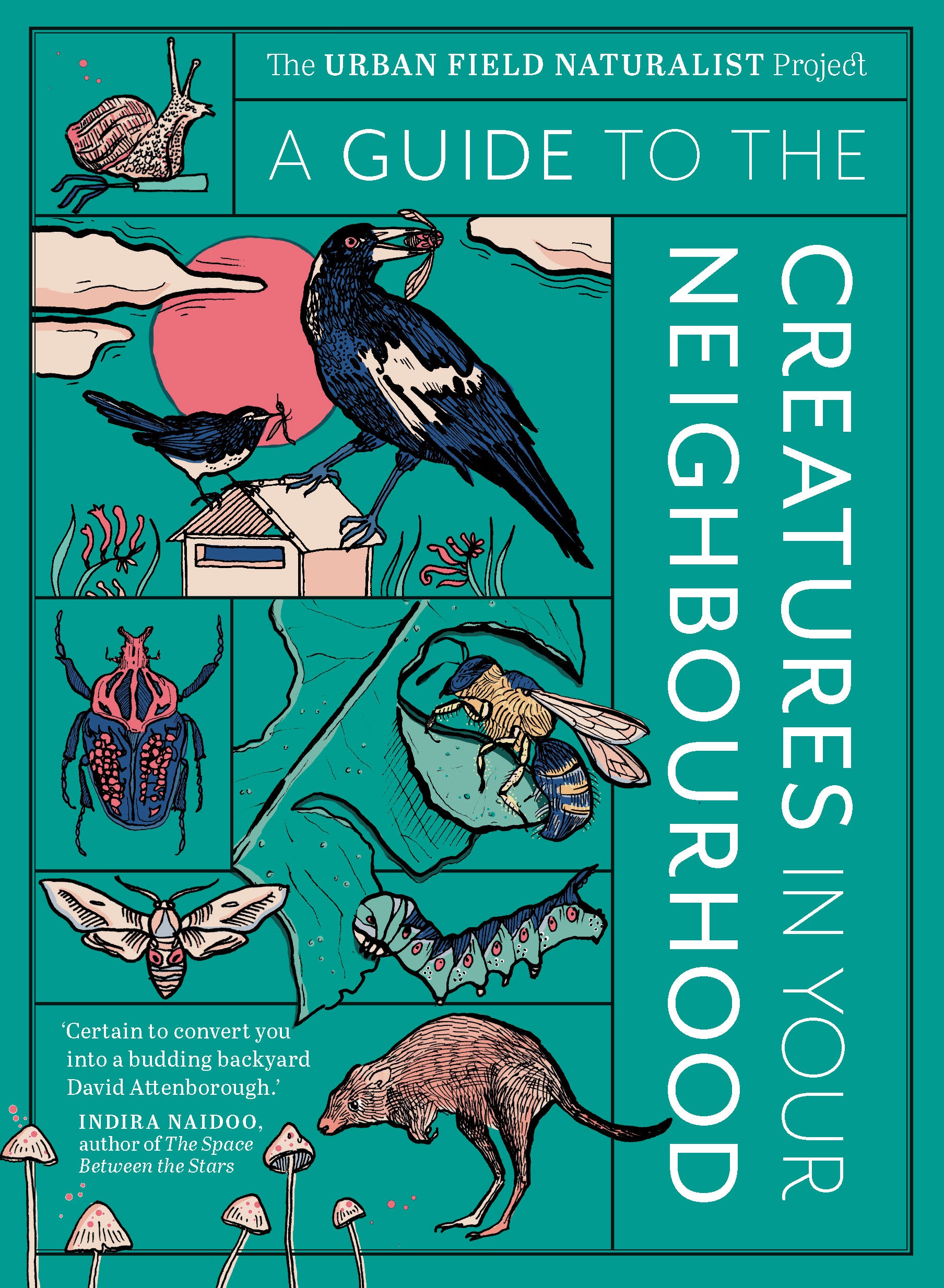
Did you know crows can identify humans by their faces? Or that ibises can ‘see’ with the tips of their bills?
In A Guide to the Creatures in Your Neighbourhood, The Urban Field Naturalist Project amaze us with fascinating facts about cockatoos, magpies, spiders, possums and other animals just outside your doorstep. In this extract we learn about Snails – The Unseen and underappreciated.
While it’s sometimes hard to appreciate when they’re munching on lettuce and other delicate plants, the snails in our gardens are getting up to some pretty remarkable things. Studies around the world have shown that snails are capable of learning about new food sources and threats and adapting their behaviours accordingly. They also seem to be tuned in to their social environments, and in some cases if they are either isolated or overcrowded they can become stressed in ways that impact on health and growth, while also inhibiting their ability to remember things.
Snails and slugs belong to the mollusc group known as gastropods (literally ‘stomach foot’), which all have a large foot with a tongue-like rasp they use to scrape up their food. In addition to their well-known terrestrial counterparts, there are many marine and freshwater species of gastropods, including abalone and limpets.
FUN SNAIL FACT
Despite appearances, snails are incredible travellers. While most of us are more familiar with garden-snail-sized gastropods, other tiny snails from around the planet – some only one millimetre long when fully grown – have been documented travelling in a range of fascinating ways. Some of them ‘fly’, carried by winds or storms high in the air. Others travel around on birds, tucked in their feathers or even attached to their legs. Even more surprisingly, some travel inside birds: after being eaten they survive the journey through the bird’s digestive system. In all of these cases, snails are aided by their ability to seal themselves up inside their shells behind a protective layer of their own mucus. In this way, snails have made their way all over the planet, including to most remote island archipelagos.
SNAIL SEX
Most of the world’s land snails are hermaphrodites, meaning they have both male and female reproductive parts. When two snails meet and have sex, both can be impregnated. Many (but not all) snails lay masses of eggs and can produce lots of offspring. This has perhaps contributed to various cultures around the world associating snails with sex and reproduction — and perhaps also to the view that escargots are an aphrodisiac.
SNAIL STORIES
According to Greek mythology, the marine snails called nerites take their name from an attractive young man who managed to anger the gods – stories differ as to who he angered and how – and was turned into a snail for his troubles.
In Native Hawai‘ian stories, land snails are powerful ho‘ailona (omens). They are said to sing in the forest at night as a sign that everything is pono (righteous, correct and good).



0 Comments