




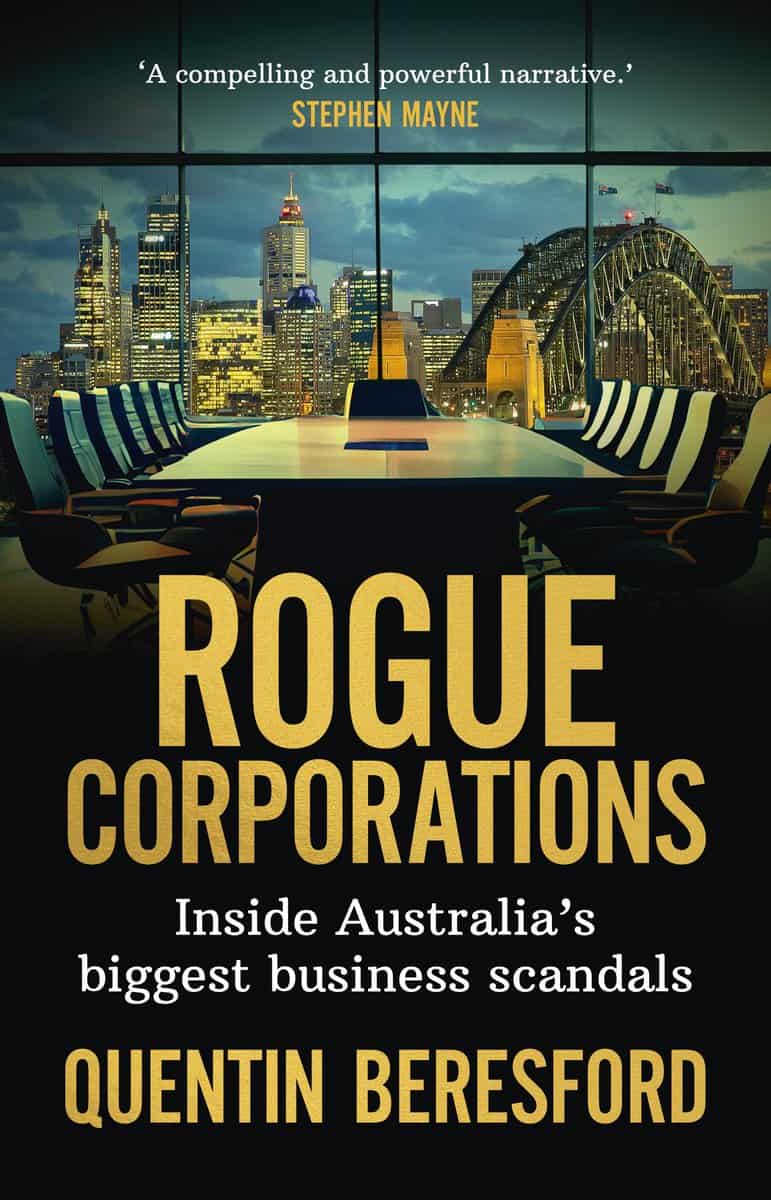
In Rogue Corporations QUENTIN BERESFORD takes us inside corporate Australia’s highest-profile scandals and the factors that drive them. Quentin explores a path towards higher ethical standards from organisations.
Read on for an extract.
ABOUT THE BOOK
 Crown Resorts, the Bond Group, James Hardie, HIH Insurance, Geoffrey Edelsten’s Allied Medical Group, 7-Eleven, and Rio Tinto, the list goes on…
Australia has suffered from a continual sting of business scandals. Ever since corporate cowboys like Alan Bond and Christopher Skase wrought so much damage during the 1980s. Since then, hundreds of thousands of Australians have been affected. With many left traumatised when corporations collapse due to gross mismanagement and profits being put before people.
Award-winning author Quentin Beresford takes us inside corporate Australia’s highest-profile scandals and the factors that drive them. Including the rise of celebrity CEOs, timid regulators, inept boards, the murky links between big business, governments, banks, media and lobby groups. Quentin explores a path towards higher ethical standards from organisations. It’s a wild ride into the heart of corporate Australia.
EXTRACT
1
RIPPING OFF MEDIBANK AND MEDICARE: THE RISE OF CORPORATE MEDICINE
Investigative journalist Adele Ferguson, who has had a long and distinguished career exposing corporate abuse of power, interviewed experts in the medical profession who were talking publicly for the first time.The cost to the public purse from these rip-offs is simply staggering: $8 billion a year, or 30 per cent of Medicare’s total annual expenditure.And they could get away with fraud on this scale because the scheme operated largely on an honour system: doctors were trusted to bill correctly.In October 2022, the ABC’s 7.30 program aired a report on fraud in Medicare, Australia’s widely supported universal health scheme. She exposed a rotten underbelly in some of the nation’s corporate medical practices: billing dead people, fabricating medical records, billing for unnecessary services. Some practices were making hundreds of thousands in additional income. But as Ferguson’s report showed, some medical practices ‘see Medicare as a money pit, and they can just help themselves’.
One of federal Labor’s most cherished reforms has been rorted from its very beginnings in the mid-1970s (as Medibank), its integrity undermined by the simultaneous rise of corporate medicine.Little had been done over the decades to learn the lessons about the fraudulent practices that developed and drove a significant section of the modern medical business model.The flamboyant medical entrepreneur, a one- time darling of Australian media, was known for his gaudy tastes in cars, buxom young women and colourful clothing.Federal Health Minister Mark Butler didn’t waste any time setting up an independent inquiry into Medicare, which, at the time of writing, remains in progress. However, Ferguson’s exposé was a case of déjà vu. And no figure was more central to either the rise of corporate medicine and its ethical failings than Geoffrey Edelsten. He was a fixture of the 1980s fast money social set. Edelsten revolutionised medicine in Australia with his concept of 24-hour medical ‘super clinics’ in the mid-1980s. But Edelsten’s innovative corporate medical business model was driven by greed – profits came before patients. And, in turn, the greed drove his fraudulent behaviour. He was willing to rip off the public to enrich himself. The lack of enforceable regulations allowed the culture to flourish.
Edelsten is an intriguing character. Conveniently, perhaps, he liked to refer to himself as an enigma. From the time he gained notoriety for his ground-breaking super clinics, Edelsten was in the forefront of the celebrity model of entrepreneurs. with a fixation on projecting his lavish lifestyle. Edelsten was especially known for his passion for high-end cars. He gushed at the joy his stable of cars brought him: a Porsche, a Lamborghini, a Ferrari, two Maseratis, a Rolls-Royce Corniche. Two sides to Edelsten became fused in the public mind: the show-off and the disruptive innovator.
Creating a new medical business model
For a noted show-off and fraudster, Edelsten came from a very conventional background. Born in 1943, he was the grandson of Jewish European refugees fleeing anti-semitism, and the son of successful small business owners. Esther and Hymie built Melbourne’s first lingerie chain. Obviously possessed of entrepreneurial flair, they were otherwise a conservative, private couple who winced at the publicity their son attracted.
One clue to Edelsten’s personality came from his oldest friend, David Wolff, who had known Edelsten since childhood. He had always known his friend as a charming person – ‘shy, unassuming, polite’. Why then did he court so much publicity, Wolff was asked by journalist Jane Cadzow, who was writing a profile on Edelsten. ‘Without sounding too harsh,’ Wolff explained, ‘it’s egomania.’
Both Edelsten’s talents and flaws emerged in the early 1970s, when he and a fellow medical graduate, Tom Wenkart, together set out to revolutionise medicine. They had burst onto the business scene seemingly out of nowhere. At medical school they were known as ‘whiz kid doctors’.4 They shared similar personality traits: intelligence, charm and ambition. Edelsten claimed that he was the ideas man behind their partnership while Wenkart was ‘the fine detail partner’.5 Together they ‘wanted to focus on financial growth’ through medicine. But whereas Wenkart preferred to stay out of the limelight, with the consequence that little is known about his personal life, Edelsten craved attention.
Doctors were offered the opportunity to rent ‘typewriter-like terminals’ from IBM linking them, in turn, to a $3.5 million computer at the IBM centre in Sydney.It was essentially a system of health screening made possible by technological advances in testing and analysis, journalist Margaret Rice argued: ‘the new tools of diagnosis made a utopian dream – preventing illness by catching it before it started – seem possible’.With the equipment installed free of charge, along with a nurse to oversee the process, doctors started signing up in droves.Their new medical technology company, Preventicare, was ground- breaking and showed the best of entrepreneurial innovation. Some claimed it was a world-first. Doctors were able to courier pathology tests to specialists who would provide results at the doctor’s computer terminal within hours, rather than the weeks such test results typically took.
The technology was ‘a thing of the future’, gushed one doctor at a seminar dedicated to the new approach. GPs could also store their patients’ records on the computerised system. Six hundred signed on in the first year of operation. The system had the significant advantage of efficiency by enhancing the role of the general practitioner at the centre of diagnosis and treatment.
In her 2004 study of medical fraud, Kathryn Flynn, a PhD student and later lecturer at Wollongong University, found that Preventicare stimulated overservicing through Edelsten and Wenkart’s offer of inducements to general practitioners of computers and nursing staff.They wanted to sign on doctors across the country and they saw the opportunity to install their computer screening system in factories and pharmacies.Despite the glowing reception it received, Preventicare went into liquidation after 15 months, although Wenkart revived the company several years later.However, a few ‘old school’ medical practitioners believed Preventicare would increase the use of both medical and pathology services; that, in the name of efficiency, doctors might be tempted to ramp up their use of testing.
As a consequence, a spike occurred in the number of pathology tests. But overservicing is a problematic concept because medicine is an inexact science and, as a consequence, the term is ambiguous. Edelsten and Wenkart sparked what turned into a decades-long debate about what constitutes medical fraud. Wenkart went on to found Macquarie Health and build it into a medical empire. He was never found to have engaged in overservicing. In their joint business venture, Edelsten and Wenkart had big plans for the future. However, they encountered a headwind: the company had grown so quickly that it had liquidity problems purchasing the expensive equipment. And private health funds baulked at paying out for rising services. Even before the introduction of Medibank in 1975, the private health industry was worried about the rising incidence of overservicing. Edelsten claimed that he sold out his share to Wenkart for several
million dollars.
Years later, Wenkart explained that while Edelsten was hard- working and dedicated, he nevertheless upset fellow doctors: ‘He was colourful, he was extreme, he was not liked by the profession in general and certainly not by its conservative leaders.’ Edelsten, he elaborated, wasn’t popular with his creditors either because he was a ‘very slow payer’ and was ‘pretty flippant about cash flow’ with a tendency to over-extend himself. Wenkart got the impression that up-market auto dealers gleefully rubbed their hands when they saw him coming. If Edelsten had his chequebook with him when he walked into a showroom, he was likely to drive away in a fancy new vehicle: ‘He’s got a manic streak, there’s no argument.’
ABOUT THE AUTHOR
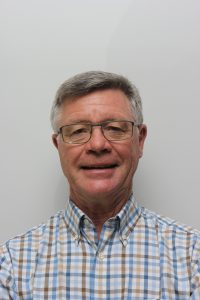
Quentin Beresford is an Adjunct Professor at Sunshine Coast University. He is also the author of The Rise and Fall of Gunns Ltd, Adani and the War over Coal and Wounded Country. Wounded Country won the 2022 Queensland Premier’s Award for a work of state significance. All of Quentin Beresford’s novels have been published by NewSouth.



0 Comments