


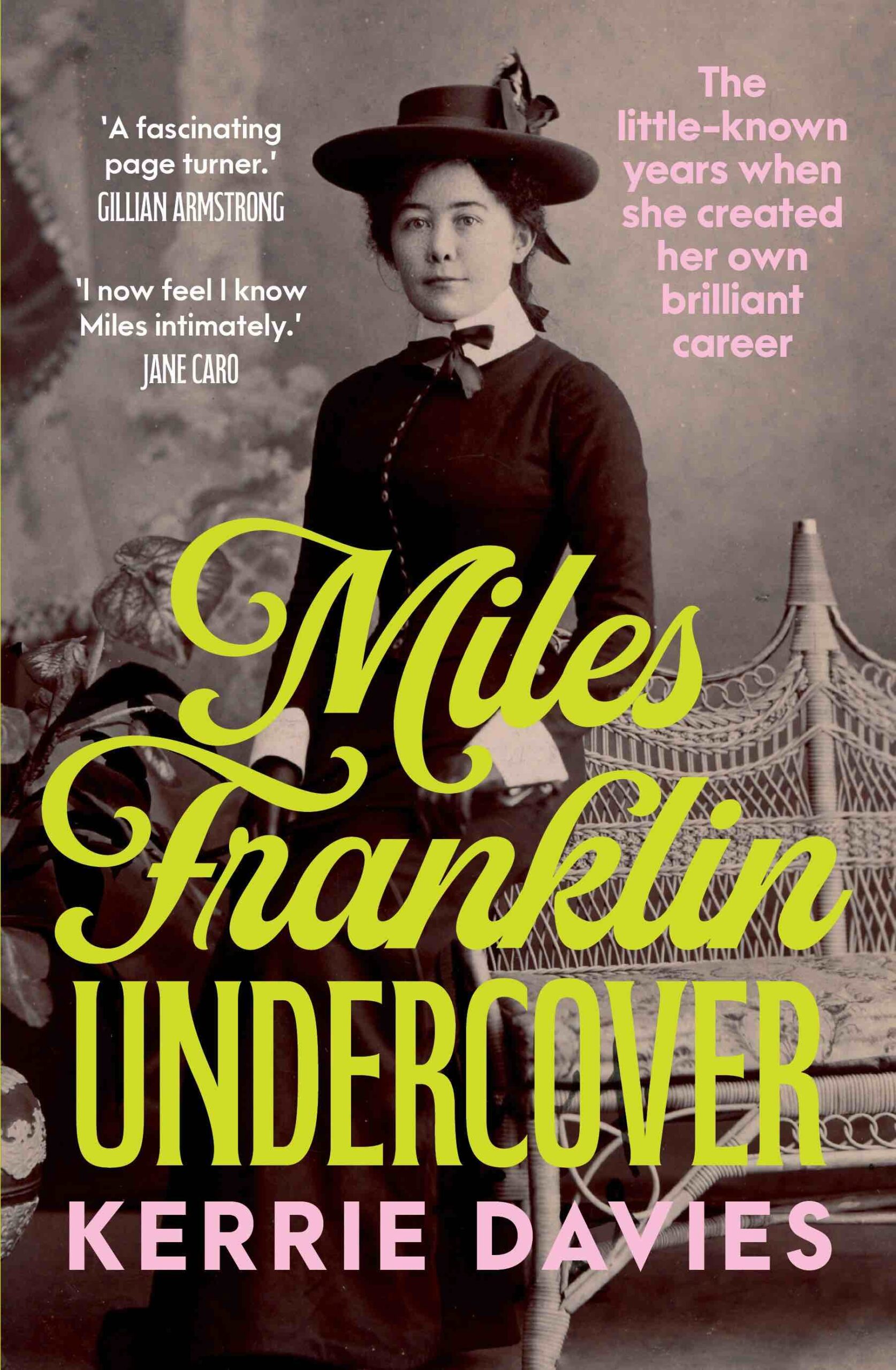
ABOUT THE BOOK
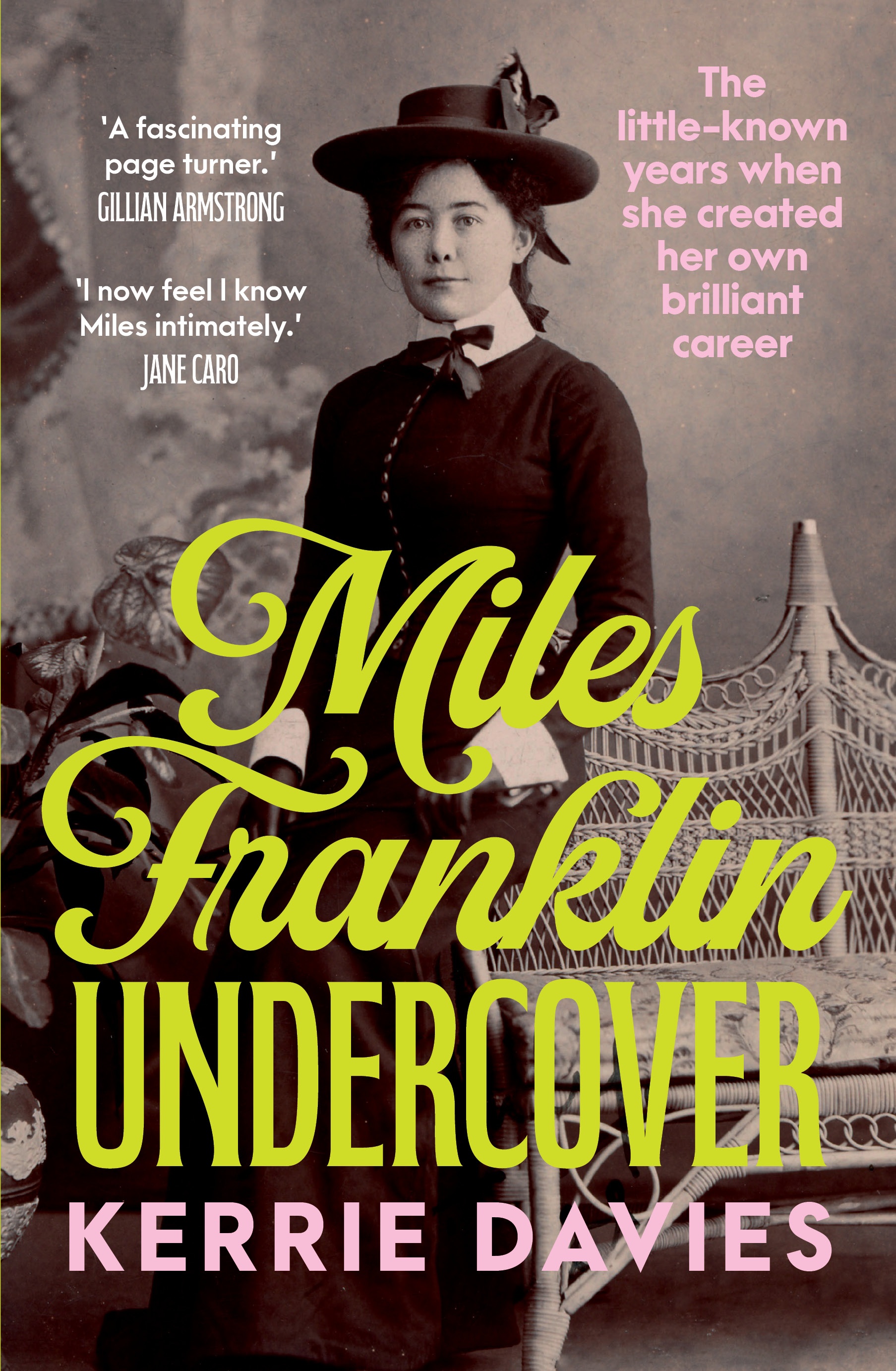
After the success and celebrity of her coming of age novel My Brilliant Career, published when Miles Franklin was only 21, she disappeared. This is the story of the decade that made her second career as a fearless advocate for working women.
‘There is a theory that any woman can be rescued from the shoals of failure and despair by finding some man to ask her in marriage, but before I could be happy in love I should at least need to realise myself.’
She dazzled Australia with her rebellious novel My Brilliant Career, inspiring generations of young women chafing under conventional expectations. Only 21, Miles Franklin was lauded as the Bronte of the bush, and feted by the rich and influential.
But fame can be deceptive. In reality, the book earned her a pittance. The family farm was sold, her new novels were rejected, and she was broke. Just two years after her debut, Miles disappeared.
In this real-life sequel to My Brilliant Career, author Kerrie Davies uncovers a little-known period in Miles’ life, from the servant’s quarters of Sydney and Melbourne’s wealthy houses to volatile Chicago, in the turbulent years after her early success. Davies draws on a never-before-published manuscript and diary extracts from Miles’ year undercover as a servant, intimate correspondence with poet Banjo Paterson, and archival sources from Australia and Chicago.
Miles Franklin Undercover is a powerful story of a young woman’s enduring resilience, and her determination to always be her own heroine.
**********
Chapter 17
The publisher’s home in the Blue Mountains was his retreat after a week working at his office above the bookstore in the city that still smelled like a stable, from the former coach-house next door. Uninterrupted by questions and meetings, he had space to think in the mountains.
A new manuscript had been sent there, from Miles Franklin. He knew her name now. She’d been the sensation of 1901; her original submission of My Brilliant Career to his firm had been dithered over while he was on business in England. By the time he’d returned, her agent had sold it to an English publisher. He had been so annoyed he’d written ‘serious mistake’ on Miles’ submission letter in the file.
Now here was his chance to redeem that mistake. Her manu- script had arrived addressed to him, George Robertson, and she’d written an anxious letter:
Dear Mr. Robertson,
Re some stuff I’ve written . . . Will you read it? If despatched next week will you be there, as I want it to fall into no hands but yrs.? It is intended for a satirical skit . . . takes the form of a take off sequel to ‘M.B.C.’
He had to keep a steadier eye on spotting raw local talent, as well as his stars like Paterson, whose new book would be a Christmas cracker.
He took out the manuscript. He frowned at the title: The End of My Career. No matter, that could be changed, although he’d heard she was still upset about the editing of My Brilliant Career and the question mark that had gone missing, without her consent, in its title. So he’d need to be delicate and persuasive. The sales for My Brilliant Career had not reflected its celebrity, so perhaps people preferred to talk about her, rather than read her book. But the book was never properly distributed in Australia by the English publisher—that was their ‘serious mistake’, not his – and the drought meant new books were a luxury for many outside the cities.
The haze of the Blue Mountains sky appeared in the distance outside his window. He settled into his study and began to read.
Above Stillwater’s paddocks, haunted by shapes of trees, the starscape seemed brighter as a celestial wanderer streaked across the southern sky. In the cities, crowds strained to see its small glowing head and wispy tail; they whispered that comets herald coming change.
‘No need to fear’ the news reassured. ‘Do not be afraid’, an astronomer soothed.
The year was closing. A literary comet, A.B. Paterson, published his new book, Rio Grande’s Last Race and Other Verses, in time for seasonal shopping. It was an anthology of poetry, rather than the intended novel draft from which Miles had retreated, while at the same time retreating from him.
He could see where she had tried to cleave people in two to mask their inspiration, but the mask was made of chiffon. He could see straight through it.
The Herald was loyal to their correspondent and championed the anthology’s Boer War poems, ‘for the war has changed us all’. But Paterson was annoyed by the review in the Melbourne Age, which reduced him to a folksy popularist – ‘a favourite among the extremely horsey section of the Australian public’. Their critic had been searching for depth in the rivers of his rhyme: ‘Occasionally the writer drops the banjo, letting the reader see more of his serious self and understand something of the longing which the successful rhymester feels.’
Paterson longed for what he did not have. But, to his relief, his book was briskly selling at bookshops across the country ahead of Christmas. It was splashed across advertisements, in reviews and on shelves. In the festively decorated shops in Goulburn, Miles could not avoid seeing it or reading about it. His was a constant stream of success, but Miles reminded herself that she would have her own glory soon. Two books in one year would be truly glorious. See how he matched that.
At the Blue Mountains retreat, Miles’ manuscript was on the publisher’s desk. He looked at the marks he had made on its pages. He could see where she had tried to cleave people in two to mask their inspiration, but the mask was made of chiffon. He could see straight through it.
There was Rose Scott. Making her a widow helped, but her high-profile guests were a giveaway. Her alter ego, who was the elegant and serene hostess of garden parties and who hosted Sybylla in Sydney, did not compensate. Rose Scott did not like to be made a fool of.
The glamorous war correspondent and poet character who asked, ‘What do you think of a poet as a lover?’ and figured in the slap scene was obviously inspired by her romance with Paterson. Was this a clue to what had happened? There were rumours. Gossip. Writers talked.
Miles had included another Australian writer, blurring recognition; he was generous, kind, married and had a sister. Maybe that was a fusion of Paterson and the poet Lawson, who had championed My Brilliant Career, but he could not risk Paterson. Apart from being the biggest author in his stable, Paterson was a lawyer down to his polished boots. Robertson had no wish to be confronted by Paterson’s lawyerly writing.
He ticked off more threats. The demanding lord was most likely the former governor-general, Lord Hallam Tennyson, who had so publicly praised Miles, and whose father was the famous poet, Alfred Tennyson. Lady Hobnob was no doubt Tennyson’s wife.
And the whole book wallowed in sex. Even if he – and Miles as the author – weren’t sued for libel, and possibly gaoled with hard labour, the book would at the very least be banned.
He put the manuscript to one side, disappointed.
If he published this sequel, it would be the end of his career, as well as hers.
**********

ABOUT THE AUTHOR
Kerrie Davies is the author of A Wife’s Heart, that created national discussion about the iconic poet Henry Lawson and his marriage. She has appeared at the Sydney and Brisbane Writers Festivals, and the National Folk festival, Canberra.
A former journalist for Vogue and the Sunday Telegraph, Kerrie is Senior Lecturer at the School of the Arts & Media, UNSW Sydney, a 2024 Visiting Fellow at the State Library of New South Wales, and writes for the Conversation.
0 Comments