



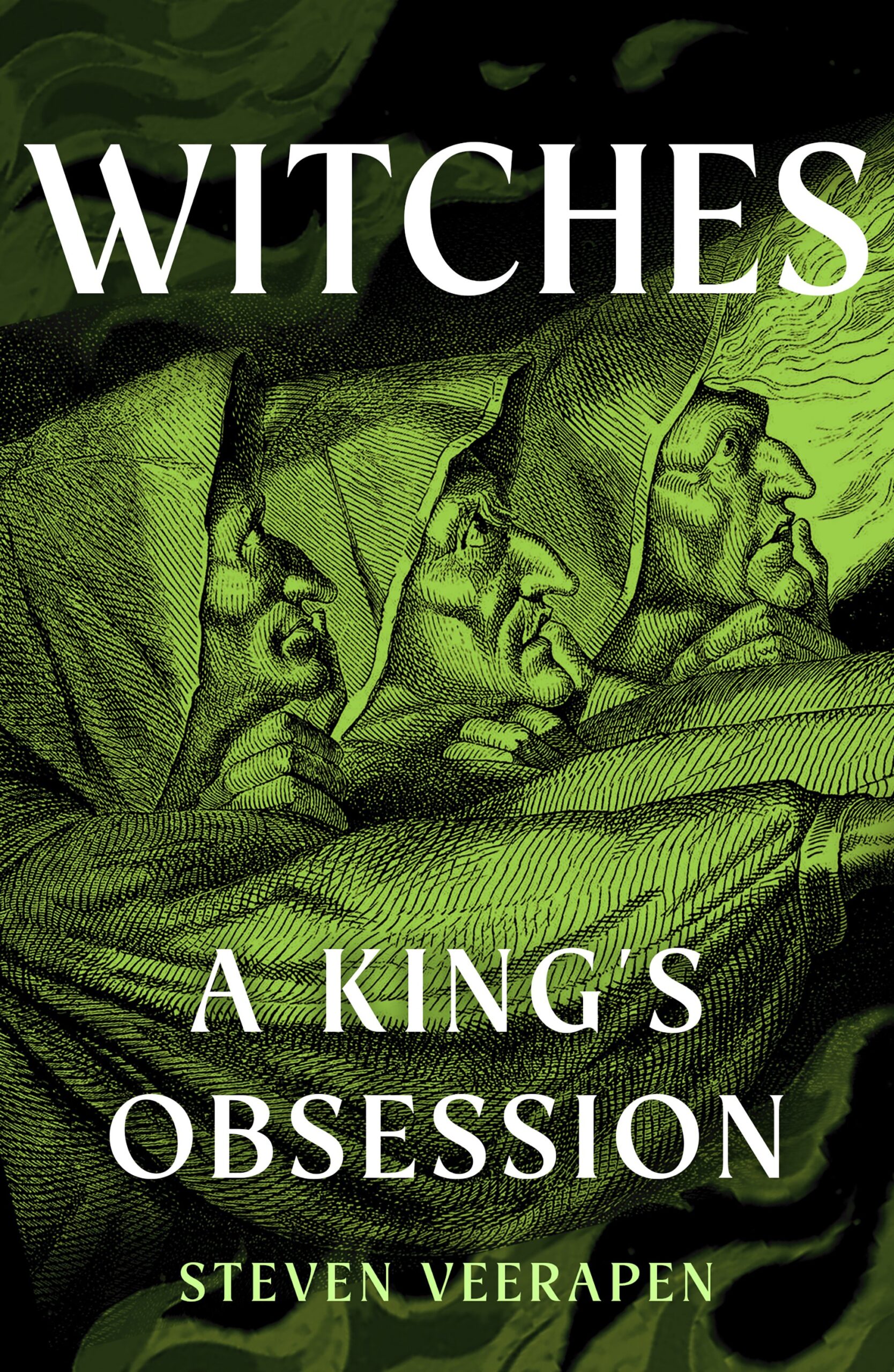
Witches: A King’s Obsession by STEVEN VEERAPEN is a new cultural history on witchcraft, tracing both origins and lasting stereotypes across the sixteenth century and throughout the mass hunts organised by King James VI of England.
Read on for an extract from chapter 1.
ABOUT THE BOOK
 Witches – whether broomstick-riding spell-casters or Wiccan earth-worshippers – have been culturally relevant for centuries. For centuries, too, belief in the potency of witchcraft has been debated, accused witches have been hunted and punished, and film and TV productions have brought the witch and the witch-hunter to big and small screens.
But where did our perception of witches – good and bad – come from? What motivated wide-scale panics about witchcraft during certain periods? How were alleged witches identified, accused, and variously tortured and punished?
Steven Veerapen traces witches, witchcraft, and witch-hunters from the explosion of mass-trials under King James VI and I in the late sixteenth century to the death of the witch-hunting phenomenon in the early 18th century. Based on documents and the latest historical research, he explores what motivated widespread belief in demonic witchcraft throughout Britain as well as in continental Europe, what caused mass panics about alleged witches, and what led, ultimately, to the relegation of the witch – and the witch-hunter – to the realm of fantasy and the fringes of society.
**********
EXTRACT
Chapter 1: The Origins of Evil
Witches were a persistent problem to Heinrich Kramer. Trained as a Dominican, having risen to Prior of his local order in Sélestat, and having achieved the title of Master of Sacred Theology for his scholarly endeavours, he found himself elevated to the position of Catholic Inquisitor – not in his native France, but instead with responsibility over considerable Holy Roman territories, including the County of Tyrol, Salzburg, Moravia, and Bohemia. Given his fiery nature and obvious ambition – he attached himself to the influential Archbishop of Salzburg and through him had a connection to the Holy See – it was a role he relished and intended to make use of.
Kramer was a man determined to make a name for himself, and he sought to do it by entering a battle against those antithetical to the Catholic orthodoxy.
There were, Kramer believed, devilish creatures in the world who formed themselves into sects and held assemblies; they were flagrantly worshipping Satan and, in return, wielding fantastical powers. The Church had been too preoccupied debating these people’s existence and the reality of their powers to do anything useful about them. What was needed was a purge. In short, he wished for a new, active belligerence against witches. As an Inquisitor and a scholar, he was well placed to encourage just that.
Heinrich Kramer (also known by the more ominous name of Heinrich Institoris) was, however, not an original mind – indeed, the definition of invention was, and continued for centuries to be, more akin to breathing fresh life into what was old, lapsed, and worthy of vigorous revival.
The concept of witchcraft and witches was ancient, drawn from a conglomeration of primitive, pagan, and traditional beliefs (such as the night-riding, blood-sucking female striga).
Even the diabolic pact, which became such a feature of early modern beliefs, had found expression via St Augustine who, though he denied the ability of humans to shapeshift, nevertheless acknowledged the delusive power of demons: ‘All arts of this sort [he was speaking of prophesying or divination] . . . are therefore nullities, or are part of a guilty superstition, springing out of a baleful fellowship between men and demons and are to be utterly repudiated and avoided by the Christian as the covenants [pacta] of a false and treacherous fellowship.’
Demons, evidently, were thought to be at work on the weak, sparking in them false notions of their own power. Just prior to the high medieval period, in the tenth century, the Benedictine chronicler Regino of Prüm had voiced scepticism not in the existence of witches as people who attempted magical acts but of their actual power to do harm. His Canon Episcopi stated:
“Bishops and their officials must labour with all their strength so that the pernicious art of sortilegium [sorcery, or physical acts – brewing potions or uttering incantations – with the aim of producing magical results] and maleficium [the broader form of evil magic intended to harm, whether by thought or deed], which was invented by the devil, is eradicated from their districts, and if they find a man or woman follower of this wicked sect to eject them foully disgraced from the parishes.” (1)
“It is also not to be omitted that some wicked women, who have given themselves back to Satan and been seduced by illusions and phantasms of demons, believe and openly profess that, in the hours of night, they ride upon certain beasts with Diana, the goddess of pagans, and an innumerable multitude of women, and in the silence of the dead of the night to fly over vast spaces of earth, and obey her commands as of their lady, and are summoned to her service on certain nights.” (2)
Yet the rather reasonable – if one can overlook the misogyny – approach was not, and would not be, universally shared. The Roman Catholic medieval world was not born in a vacuum. Th e people who lived under its considerable territories inherited a vast, colourful array of superstitions, mythic figures, and religious customs from the cultures and belief systems which preceded Christianity. And the Catholic Church, much as it might have liked to, could not wipe out centuries of lingering beliefs and practices, some of them tailored over time and place to fit a Christian framework, others more nakedly belonging to pre-Christian tradition. It could, though, engage in the same kind of process, repackaging some beliefs as its own (an obvious example being the overlaying of Christian holidays onto former pagan festival days) and proscribing others as either demonic or delusional. What once might have appeared to be useful pagan spirits might, over time, be transmuted into witches’ familiars.
The Church had reason to worry. If the Christian God didn’t appear to be answering prayers, an individual might, for example, try their luck with a pagan deity or some other folkloric sprite.
The Church might then encourage them back into the fold by providing ritualistic alternatives – appeals to the saints, for example – or otherwise denounce the un-Christian deities and sprites as demons. Depending on time, location, and the perceived spread of anti-Christian practices – and depending on the perceived numbers of people betraying God – the Church and its more militant leaders and agents might, of course, turn to more severe measures of control and repression.
By the late 15th century, when Heinrich Kramer was active (having been born in around 1430), witchcraft was largely understood as a form of heresy: a belief or set of beliefs contrary to established, orthodox Catholic doctrine. It is notable that Pope Lucius III issued the decretal bull Adbolendam (‘To Abolish’) in 1184, with a view to ‘abolishing divers malignant heresies’ such as the anti-papal and anti-Catholic Waldensian movement. In time, this led to a formal, episcopal Inquisition – which laid the groundwork for future medieval Inquisitions, empowered to torture and kill.
**********
ABOUT THE AUTHOR

Steven Veerapen was born in Glasgow to a Scottish mother and a Mauritian father and raised in Paisley. Pursuing an interest in the sixteenth century, he was awarded a first-class Honours degree in English, focussing his dissertation on representations of Henry VIII’s six wives.
Following his Ph.D., he began working on the ‘Simon Danforth’ trilogy of murder mysteries set in Scotland during the 1540s, in addition to writing an historical fiction about the life and death of Henry, Lord Darnley. Afterwards, he turned to popular nonfiction, writing studies of the relationships between Mary Queen of Scots and her brother, Moray, and Elizabeth I and the Earl of Essex. He is currently working on the Jack and Amy Cole series of Elizabethan spy novels. When not writing, he teaches English Literature at the University of Strathclyde.
Steven is fascinated by the glamour and ghastliness of life in the 1500s, and has a penchant for myths, mysteries and murders in an age in which the law was as slippery as those who defied it. He is the author of The Wisest Fool: The Lavish Life of James VI and I and his latest book Witches: A King’s Obsession and lives in Glasgow.



0 Comments