



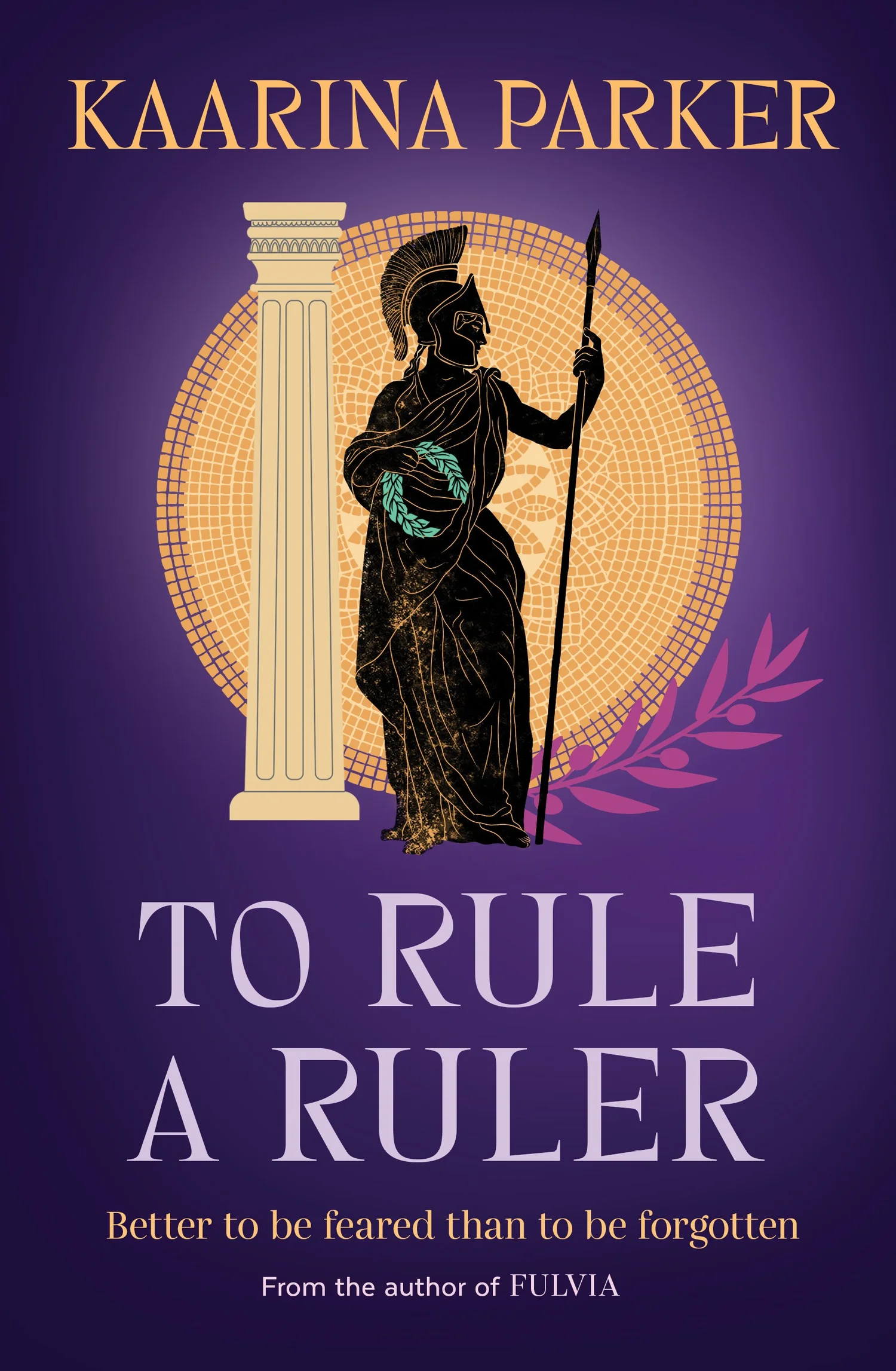
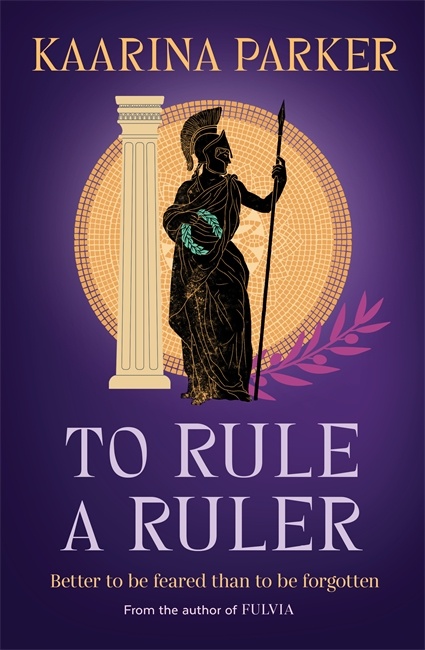
To Rule a Ruler by KAARINA PARKER is the conclusion to her ‘Fulvia’ duology. Following the life of an influential aristocratic woman in the Roman Republic, Ruler brings her epic story of ambition, legacy and birth of empire to a close.
Read on for an extract.
ABOUT THE BOOK
 ‘I lived forty glorious years in the heart of one of history’s most powerful civilisations … I knew men in my life who would become gods and women who deserved to. Magnificent as they all were, I am not a mere footnote in their stories. Mine is a history all its own.’
Fulvia Flacca Bambula is now a wealthy young widow, with more than gold to her name. In the wake of the death of her husband, the populist politician Clodius, she has captured the love and loyalty of the people for herself, while harnessing the force of one of ancient Rome’s most violent criminal gangs.
As civil war erupts, the clever and ambitious Fulvia takes advantage of the unrest to establish her own authority. And finally, the men who rule Rome begin to understand just how formidable she has become. There are those who fear her and those, like Julius Caesar, who see her potential.
When Fulvia is reunited with Marcus Antonius, an old friend appointed by Caesar as his general, she sees a man who could rule all of Rome – with her help. They marry, and when Caesar is assassinated Fulvia and her new husband make a perilous bid for ultimate power. As they battle to gain control of an empire, their opponents are legion: Caesar’s killers, Brutus and Cassius; the wily young queen Cleopatra; the great orator Cicero, and the cold and calculating Octavian. Fulvia must face down these ruthless political players, protect her children, and fight to keep the loyalty and attention of Marcus Antonius. The odds against her are almost overwhelming, but Fulvia’s warrior spirit has been forged by tragedy and condescension, and now she will fight for the legacy she knows she deserves.
Whatever the cost.
**********
EXTRACT
Nestled deep in the heart of the Aventine district, built into the side of the eponymous hill, there was a temple, a sanctuary surrounded by wild flora and creeping vines that obscured it from view. But the women and slaves of the Aventine knew how to find it. I left Damio at the roadside and descended alone into the grove. I was as familiar with the cracked contours of the overgrown path as I was my own skin. My patronage of the Bona Dea temple had gone on for ten years. It was a role I initially took on out of necessity; I had once needed a favour from the head priestess, and she named her price. But even after I had what I wanted, I found myself drawn back to the verdant sanctuary. It was an ancient and mysterious cult, and to be involved was more of a privilege than a burden. Each time I visited, I noticed some new way that my money had been put to use. The once cracked and crumbling temple walls shone bright in the afternoon sun, fresh Luna marble plucked from the slopes of Carrara reinforcing its old foundations. There was not one chip to be seen in the vivid orange and red paint that covered its facade, and the vines that snaked down around its columns were lush and green.
Usually I would stop and allow myself a moment of pride to see such an ancient site restored by my hand (or, at least, by my gold).
But this day I came with a purpose urgent enough to draw me immediately out of the sun and into the cool and damp depths of the temple itself.
‘Lady Fulvia.’ One of the younger priestesses bowed as soon as she saw me, her white robes trailing along the stone floor. ‘How can I assist you?’
‘Where is the damatrix?’
‘She has gone to the grove to gather herbs. I can send someone to tell her you are here?’
‘No need. I will tell her myself.’
I found Valeria deep in the gardens, picking wildflowers with more vigour than was probably necessary. Ten years I had known her, the leader of the cult of the Bona Dea. We had advised each other, provided support to one another. Her wisdom and knowledge were wells from which I was privileged to draw. That day, her grey hair was piled messily atop her head, her veil pulled back to drape over her shoulders. She turned when she heard me approach and drew herself to standing with a lithe grace one might not expect from a woman her age. Her gown was marked with dirt at the knees.
‘You’ve heard.’
‘I have. It’s true then?’
‘It is. I attended the birth myself.’
I pretended not to notice that her hands were shaking or the ochre of dried blood that stained her nail beds. ‘What happened?’
‘The gods were cruel.’ She sounded exhausted. ‘It was a long and difficult labour. The child would not come forth. The obstetrix wanted to ease the way with surgery, but Pompeius forbade it. The babe suffocated, and Julia died from the exhaustion of trying to deliver it.’
It was said that Pompeius truly loved his young wife, though I always took this to be a fantasy concocted to support his shaky alliance with her father. But clearly there was some truth to it. If he had allowed the midwives to perform surgery, the child may have lived, but Julia would have died in excruciating pain. It was a choice many men made without hesitation, for what is a wife’s purpose if not to bring forth children? But clearly Pompeius had cared enough for his young wife to spare her that suffering.
‘I always heard that he was devoted to her. I am glad he showed her that mercy.’
Valeria’s tone was even, though her words were sharp. ‘A true mercy would have been to wait longer before impregnating her.’ Julia’s first pregnancy had been four years earlier, when she was only thirteen. It had ended in a miscarriage so traumatic that some said she may never conceive again. She had, but at the steepest cost.
‘Would that have made a difference?’
‘Undoubtedly. Many girls are so young when they have their first blood, their bodies cannot sustain pregnancy, cannot withstand the workload of birth.’
I thought of my own daughter, only ten but fast approaching the age when she might be expected to marry. I would not allow such a thing to happen to her.
‘Why do more people not know of this?’
Valeria sighed, a weary sound that carried the weight of each of her seventy years.
‘It has been my life’s work to make them understand. But men are impatient. And women, well, what choice do most of them have? Julia certainly had none.’
That was true enough. Julia’s marriage was a contract between two titans. Her children would have been the solid ground upon which the alliance between Julius Caesar and Pompeius would stand. Now that solid ground had turned to shifting sands. It was no secret that Pompeius yearned for an excuse to war with Caesar, to put the younger man in his place and prove his own superiority once and for all. Now, with Julia dead, there were no ties left between them. And so war they would have. I looked to Valeria. Her face told me that she understood.
ABOUT THE AUTHOR
 Kaarina Parker was born in Aotearoa, New Zealand. She has a BA (with Honours) from the University of Melbourne in history and feminist film theory and a Master of Creative Writing from Auckland University of Technology. She has a particularly for the extraordinary, largely uncredited, women of the late Roman Republic.
Kaarina also has an established career as a fashion model, and is a voice for diversity in the fashion industry in Australia and New Zealand. To Rule A Ruler is her second novel, the thrilling sequel to Fulvia, published in 2025.
Visit Kaarina Parker’s Substack
Follow Kaarina Parker on Instagram
Read more on the publisher’s website

0 Comments