



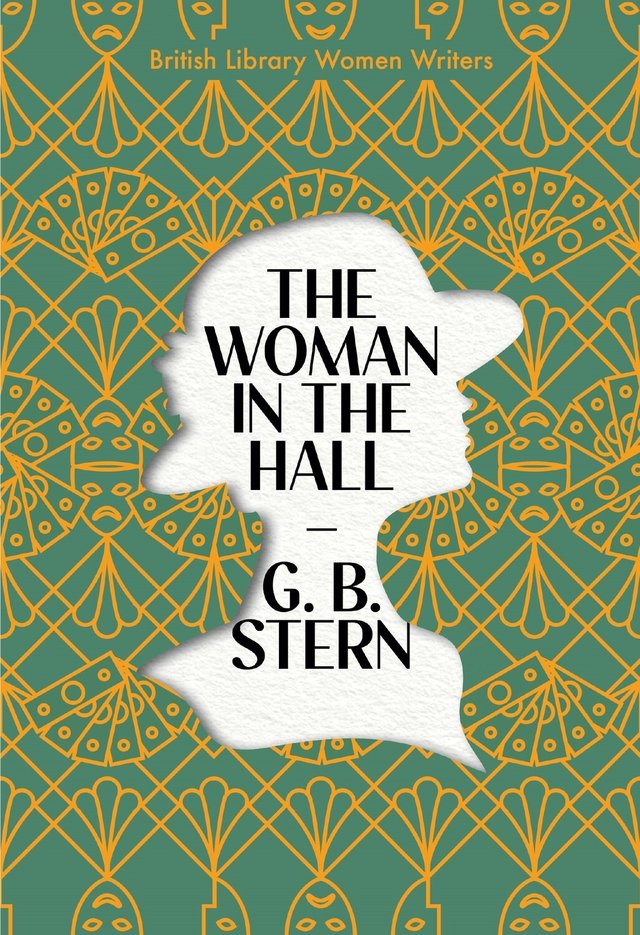
The Woman in the Hall is a classic mystery thriller by G B STERN, a prolific writer working from the 1910s to the 1960s who was best known for her ‘Matriarch’ series.
Read on for an extract from the 2026 re-release.
ABOUT THE BOOK
Lorna Blake is a woman able to create her own reality: a swindler with nerves of steel, gifted manipulator and devoted single mother to two daughters. When her eldest needs lifesaving treatment she cannot afford, Lorna begins a risky but thrilling scheme; taking her daughters to the hallways of London mansions to beg with tales of a husband at turns dangerous, deserting and dead. But as years pass and Lorna continues to wring pity and pounds from wealthy strangers, her victims start closing in.
Acted out in the hallways of London mansions and across several continents, The Woman in the Hall is part psychological drama, part cat-and-mouse chase, as well as a darkly comic portrait of how the figure of a single mother could wring pity from 1930s society.
**********
EXTRACT
Kathy and Jay had been running too fast, down on the hard sand, and Kathy had fallen over and was crying loudly – Both mothers rose quickly and went to the rescue.
‘I’ll remember what you told me and think it over,’ Mrs Anderson promised.
And Molly sat on in the sand-hole near by, where she had rolled comfortably a few minutes ago to eat her sun-warmed greengages. She looked dazed as though she had received a shock, her funny determined face white and strained.
So it was not over. It was all going to begin again. Visiting.
For they had never had any governesses, she and Jay.
But Molly remembered that strange excited voice when her mother made things up, so different from her usual indulgent comfortable voice, a little helpless, a little amused at its own helplessness. And Molly remembered, too, that there had been a governess, though not theirs. (‘You’ll be all right, then? Miss Gardiner will meet you at the station and put you on your train. I do hope you’ll find that your husband …’)
She had been eight, not ten as she was now. They were not living in Huntingdon Terrace, nor in Highgate, nor in Barnes, where they had moved after Highgate. It was before they had begun to move about. They had lived as long as Molly could remember at The Nook, Woodgrange Road, Putney. And Jay was terribly ill. They were afraid Jay would die, she and Mummy. So many children, when they were like Jay, died in one’s stupider story-books. She was in a nursing-home not far away. Susan had said: ‘You’re mad not to let her go into hospital. Much better looked after and much cheaper. They’ll take the skin from your ears in those private homes and not say thank you.’ But Jay had screamed herself into a fit at the word hospital and clung to Mummy and prayed and pleaded not to be sent to one, as though it were as bad as prison and the same thing. ‘Must have read some nonsense somewhere,’ said Susan. ‘Or picked it up chattering with people she shouldn’t have been.’
Anyhow, Mummy had given in to Jay and sent her to this small nursing-home, which, she had assured Susan, could not make charges like the big West End places. Susan snapped: ‘You’ll see.’ And now the account for the first three weeks had come in.
‘It’s those injections, more than anything else,’ Lorna had cried wildly, sharing her dismay with Susan, who as usual showed forbearance and tenderness, having been in the right. ‘She must have them, of course, but – ‘
‘Wish I had it to lend you,’ Susan said. And Mummy had kissed her and had tried to be cheerful at lunch and to make a fuss of Molly, though once she had said, as though thinking aloud: ‘Money. How does one earn a lot of money quickly like that? It isn’t as if I were clever – ‘
‘Aren’t you clever, Mummy?’ in surprise.
‘No, my pet,’ half-laughing, half-crying, and a kiss, and then a smother of kisses as though she were not only Molly but Jay as well. All that long afternoon Mummy could settle down to nothing, not even for a nap, as Susan suggested, for she had not been sleeping at night. She tried to sew a little, and she tried reading.
Molly, at Susan’s suggestion (‘Take her mind off it’), had been allowed to paint the dolls’-house roof. She cared nothing about dolls; dolls were stuffed and silly; but roofs and walls and doors, building matters, achieved a certain solid status in Molly’s play world. Every now and then she came and stood on tiptoe at Mummy’s shoulder as she turned the pages, and saw that the book was full of photographs, and spelt out: ‘Lionel Lovett. De Reszke. Mrs Patrick Campbell. John Barrymore – Do you know them all, Mummy? Was any of them your best boy?’ Susan had a faded photograph in the kitchen, and always told grocers and butchers and people that it was her best boy who had been killed in the war.
‘No, lambkin, I’m not as grand as that. And you’re my best boy.’ So Molly had gone back to the dolls’-house, squatting there disconsolately and blobbing the paint listlessly over herself, the floor and the roof, for she had not been allowed to do this when she wanted to, while Jay was at home, and now it was no fun.
Suddenly her mother had slammed down the book and jumped up and cried in a loud voice which Molly hardly recognized: ‘I will. I will. I’ll try it. She can’t eat me.’
She picked up the book and swiftly read over a certain page as Molly and Jay used to have a last frantic early morning look at their history for the day, to make sure they knew it, before they got to school. Then she ran upstairs and came down again in a raincoat with her hat pulled on anyhow over her hair all untidy and no gloves; Mummy couldn’t surely be going out without gloves? And she stared at Molly, her eyes screwed up like Miss Thompson in the junior drawing-class, getting what she told them was “a perspective” and “vanishing-point.” How they had giggled over “vanishing-point”; when Nora was in the lavatory and Doris came in asking where she was – ‘She’s at vanishing-point!’ they chanted in chorus, triumphantly.
‘Come on, Molly, leave that. You’re coming out with Mummy. No, just as you are; you needn’t go upstairs again. I’m in a hurry.’
Molly was wearing an old gym tunic, very worn and shrunk and much too short for her now, but Susan had said it would be good enough to get smeared all over, with paint. And black wool stockings with holes in them. ‘But, Mummy, where are we going?’
‘Visiting. Visiting a nice lady.’
‘Must I go?’
‘Yes. Yes, it may help.’
And when they were out in the street, she stood still, dropped Molly’s hand and stared at her in the same frightening way she had done before. ‘She does look a pathetic little object,’ she murmured. And Molly had hard work not to cry. Her mother had never before called her “she” when there was no one else there.
A long jolting journey by bus, and then a wait in the rain, and another journey into a beautiful part of London, with flower-boxes, and big shining motor-cars in front of nearly every door. Molly wanted to stop every minute and admire something, but her mother pulled her along. They stood outside a front door and rang the bell. It wasn’t a sort of Susan who opened it, but a stern man in a black coat.
‘Is Baroness von Soll in?’
‘Would her ladyship be expecting you?’
‘No, but she’ll see me. Please tell her Mrs Blake is here and that it’s very urgent.’
The man stood like wood. ‘The Baroness only sees people by appointment.’
‘I must see her.’
‘She is engaged at the moment.’
‘Mummy,’ gasped Molly, tugging at an unresponsive hand, ‘let’s go away. Let’s.’
‘Will you tell the Baroness that I’m a friend of Mr Lionel Lovett, the famous actor? I have a message from him.’
The man hesitated; then, leaving them standing on the doorstep, he disappeared.
‘Is it a new game?’ Molly tried piteously, for the last time that day, to bring experience into familiar range.
‘Hush, baby, hush. But no wonder,’ soothing her, ‘you’re tired and hungry.’
They had had lunch as usual, lunch and tea; and she had never been “baby” but “Molly” right back along her eight years of memory. Bewilderment thickened.
**********
Yet now, two years after, squatting desolate in the sand-hole in the hot swimmy sunshine, a gritty half-eaten greengage tightly clenched, how surprisingly bits of cheerful ordinary school life provided an answer to what had then been all a choking fog: rehearsals for the Midsummer Night’s Dream and Miss Collins drilling them in their parts, saying her emphatic stresses: ‘The best way to get integrity into your performance, indeed the only way, Molly Blake, is to think yourself right into Bottom. Be Bottom, even before your entrance. Do you see what I mean?’
‘Oh yes, Miss Collins.’ That was easy. ‘Miss Collins, what is integrity? How do I get it?’
The headmistress twinkled. ‘You either have it or you haven’t, child.’
**********
The manservant came back.
‘The Baroness will see you.’
They followed him through the hall, through a vast drawing-room grandly furnished all in white, with one enormous dark blue rug before the fireplace. Their steps clattered on the parquet. He opened the door for them into a smaller room, stood coldly aside for them to enter, then vanished.
At first it was not as bad as Molly had dreaded. The Baroness was quite an old lady, and listened with a kind and encouraging air while Mummy just quietly told her all about Jay’s illness and the expensive treatment, and how her tiny income was at its lowest ebb just now because by the terms of her lease she had recently had to re-decorate and put their tiny house into repair. Molly heaved a sigh of relief. She could not define exactly what she had feared and expected; but there had been painters sitting on swings outside their windows and workmen hammering at their walls for weeks and weeks, and the Baroness, who spoke funny English, rolling her “r’s,” said yes, she had suffered from much the same thing in her own house last year: ‘a trremendous expense,’ and she enquired how old Jay was and how old Molly was, and would Molly like a piece of cake? No, thank you. And then Mummy said: ‘You can’t imagine how I hate asking, I’ve never done it before, but when it’s for the children – ‘ ‘Yes, yes, when it is for our children – ‘ ‘You do see? I knew you would. I’ve lost touch with dear Lionel ever since he settled in America, but he used to tell me you were the most golden-hearted woman he had ever met, and how wonderfully you had helped him that time in Rome when the tenor was jealous and wanted to get him out of the company. So when I didn’t know which way to turn, I heard a voice speaking to me out of the blue: ‘She’ll help you. Go to her and quite simply tell her the truth. There’s no shame in it, and you need never do it again, but just this once, for Jay’s sake.’ So I came.’
Nothing about the book. And Molly had heard no voice saying all that, but perhaps Mummy had better ears. Anyhow, the Baroness had said: ‘Let her have the treatment and send the bills to me, I will see that they are paid.’
Mummy said gently: ‘You are too good and generous to wish me to thank you, so I won’t say anything more.’ And the Baroness said, ‘No, please, I understand.’ And Mummy said: ‘Yes. You understand.’ And as they could not keep on telling each other they understood, Molly hoped she and Mummy were soon going.
And then a dreadful thing happened. Her mother got terribly excited and began to laugh and cry all over the Baroness’s hands with their sparkling rings, and poured out a further tale, messy and incoherent, which she said she had never told anyone before, but there was a hope now, just a hope, that if the Baroness would help her, and she could go up to Liverpool that very evening, her husband was sailing in the morning, they had been separated for years, she might never see him again, but his father and mother were rich, they would be seeing him off, they had never acknowledged her, that was the trouble, she was not a Roman Catholic, it wouldn’t be fair to tell his real name; no, not Blake; Blake was only a name she used so as not to – yes, she would tell it, she could trust her kind, kind friend: Inglefield. Neil Inglefield …
Molly could hardly believe it was her own mother speaking; her nice, funny, unfussy mother; even her face had slipped out of its familiar cosiness; the lines were deeper, the eyes rounder and bulged a little. She used wide distraught gestures that did not seem to have anything to do with what she was saying. Once, when she told about showing them their grandchild, she drew Molly towards her in a suffocating embrace, then pushed back the hair from her forehead so that the Baroness could see her more clearly: ‘Isn’t it a dear, innocent little face!’ she exclaimed, and, not waiting for an answer, had rushed on with more and more about going to Liverpool: Surely if Neil’s mother and father could see Molly, if she took Molly up with her, she might be just in time, just in time. If she could say: ‘This is your grandchild. And her sister, your other grandchild, is dying,’ perhaps it might mean a regular income, a help at least towards bringing up the children, educating them, giving them a chance – oh, it might mean everything, might make all the difference in the world if she had the fare for herself and Molly to set out this very evening. Tomorrow would be too late … ‘I could show you all the papers, only there isn’t time.’
And in the end, the Baroness sent for her bag and took out a lot of notes, actual money this time, not a promise, and gave them to Mummy. She said it was their return fare to Liverpool; but perhaps she just wanted them to leave, perhaps she hated this scene as much as Molly, and felt as helpless and hot.
Mummy, having got the money, became quiet again and said: ‘Thank you and God bless you. You don’t know what you’ve done.’ And then they followed the manservant out, as they had followed him in; and Mummy, when they were out in the street once more, smiled at Molly and said, ‘Wasn’t that a pretty room, Mollykins? The white one with the blue rug?’
Molly imagined that directly they got home they would pack all in a hurry and set off for Liverpool. But when they got home, there was no sense of hurry nor of a journey impending; no one brought out a rugstrap, nor started folding underwear. Her mother rang up the doctor, and Molly heard her say that it was all right about further injections; they were to be paid for. And then she had a long talk with Susan; Molly was shut out, but it all sounded gay and laughing. And Susan called back over her shoulder, coming out: ‘Well, I’d have done it myself, if I’d the nerve. It isn’t as if they hadn’t got plenty to spare.’ And seeing Molly huddled on the stairs, still in her shrunken gym tunic with smears of paint on it, and one of her stockings coming down, twisted and wrinkling, she remarked with a shade of compassion in her tone: ‘You do look a young scarecrow, I must say. Run along up to bed, now.’
‘I can’t,’ explained Molly forlornly. ‘We’re going to Liverpool.’
‘Oh, you are, are you?’ Susan stood for a moment as though not quite knowing what to say. Then went on into the kitchen, and Mummy came out from the sitting-room and said she was going to put Molly to bed for a treat and tell her a story. ‘Cheer up, Jay will get well now.’
‘But aren’t we going?’
‘Going where?’
‘To Liverpool.’
‘Not this time, pet.’
Up till that moment, all that had happened had seemed a nightmare jumble, but at least a nightmare that no one could help. But now Molly knew that her mother herself had actually made it all happen, and could have stopped it, and didn’t. Her mother had asked for their fare to Liverpool and got it, and they were not going to Liverpool. Perhaps she had never meant to go.
She tucked in the sheets and sat on the edge of Molly’s bed and told her a fairy tale. She told nice fairy tales.
The next day Molly was hardly surprised when informed that Mummy was going to take her out again. Visiting. Mummy made it sound like a treat; but when Molly came downstairs in her prettiest frock, an embroidered tussore, and a floppy hat with buttercups round the crown, her mother looked at her critically, shook her head and commanded her to get back into the old gym tunic she had worn yesterday.
‘But it’s much too tight,’ whispered Molly, her throat dry with apprehension.
‘Never mind. Put it on. And the same stockings.’ And in the hall, just before they started, she changed Molly’s sailor-hat for an old green floppy tam belonging to herself, which hung on a peg and was usually worn for weeding in the garden in the rain.
They took a bus to another rich part of London, and this time there was a maid at the door who said no, they couldn’t possibly see Miss Betty Phillimore herself, but Miss Phillimore’s secretary. And Mummy said that would be no good, and could she write a note? ‘Well, really, I’m not sure,’ said the prim maid. ‘Please. It’s terribly important.’ ‘Miss Phillimore isn’t in.’ ‘Then I’ll wait. But I have to see her; it’s a matter of life and death.’
The maid, perplexed, brought her an envelope and a pencil and a piece of paper, and admitted grudgingly that Miss Phillimore might have come in just a moment ago.
Molly, standing first on one leg and then on the other, watched while her mother scribbled about three frenzied pages. It was funny how soon you got used to a routine of awful things. Only yesterday morning she had known nothing about Visiting, and strange thresholds with antagonistic servants barring the way. But now she felt no surprise any more; it just had to be endured. At least Jay had been spared from doing this. If Molly could have used metaphor, but she never did, she might have expressed her belief that Jay was glass, brittle and thinly clear and lovely, and she herself a strong bit of clay, solid as a flower-pot. Mummy planted mignonette in flower-pots; they never got broken.
Once they were allowed to see Miss Phillimore, it was even easier than yesterday, and Mummy did not have to cry so much nor kiss Molly so wildly; she only said pathetically: ‘She’s all I’ve got,’ and didn’t mention Jay. She left out all the true part about treatment for Jay and the house-painters taking the money, but this time her wicked, cruel husband, Neil Inglefield, Molly’s father, was plotting to kidnap Molly, and their only sanctuary lay with an uncle who lived in the wilds of Ireland, so that they had to cross from a place called Holyhead, a long way and a big fare. ‘I hardly dare ask you, only directly I read what you’d done for Oliver Bell, I knew you’d understand and be sympathetic. There are some people I’d rather die than ask.’
As hope survives at the very bottom of the box, there remained a hope in Molly’s heart that yesterday had been a mistake, and today they really would use the money to travel to a place called Holyhead to cross for the wilds of Ireland. She hoped and waited until she had to go to bed, and that was the end of it. She asked no questions, for she knew the answer: ‘Not this time, pet.’
And she was grateful when her mother made no offer of a bedtime fairy tale. Her mother was still wholly unfamiliar, in a mood abstracted yet jubilant, and wandered restlessly from room to room, humming an old tune: ‘Rhoda, Rhoda ran a pagoda, selling tea and syrup and soda.’ Jay and Molly had always liked the words of that tune with its suggestion of playing at shop.
Susan came in to switch off the light. She appeared ready to chat; curious, maybe, to hear Molly’s point of view: ‘Your mother’s struck oil, she remarked.
Molly remained reticent. And Susan departed after one or two more tries: ‘She’s not half pleased, too; money for jam. Mind you, I think she’d better not have mixed you up in it. Not that I’m one to preach at anyone for liking a gamble. She’s always been the best joke I know, Miss Lorna has. Always. And pulled it off every time – except Mr. Marcus; and then would have but for that there Young Neil – Well, you are a Miss Sleepyhead. Mind you don’t forget Rabbits and Hares directly you wake up, for luck the first of the month.’
You dreamt of someone called Young Neil. He was chasing you round and round the Baroness’s white drawing-room, and when you slipped on the parquet and were caught, he kissed you and laughed: ‘Don’t be afraid, we’re going for a ride in a pagoda.’ And Susan, in the dream, rode in front of the Lord Mayor’s chariot with the coachman whom she claimed as her best boy. And that-there-Young-Neil sat with you behind on all the custard cushions and he picked up a trumpet and shouted through it: ‘Isn’t it a dear innocent little face’ …
She woke slowly, her mouth sick with hate for the dawn. ‘Jay!’ – And then a quick gabble: ‘Rabbits and hares! Oh, rabbits and hares!’ But too late: she had already said ‘Jay.’
Nothing happened on Wednesday or Thursday. Molly was not deceived; the lull did not mean that the good times had come back again. On the third day, when she was summoned with a jolly air to come out Visiting with Mummy, Molly put on her old gym tunic without being told.
Acknowledgement: The Society of Authors as the Literary Representative of the Estate of G B Stern.
ABOUT THE AUTHOR
G B Stern (1890-1973) was a prolific writer best known in her lifetime for her series ‘The Matriarch’: a lightly autobiographical saga of two cosmopolitan Jewish families, struggling through the aftermath of the 1928 financial crash. She was also a playwright and saw several of her books adapted onto screen, including The Woman in the Hall in 1947.


0 Comments