


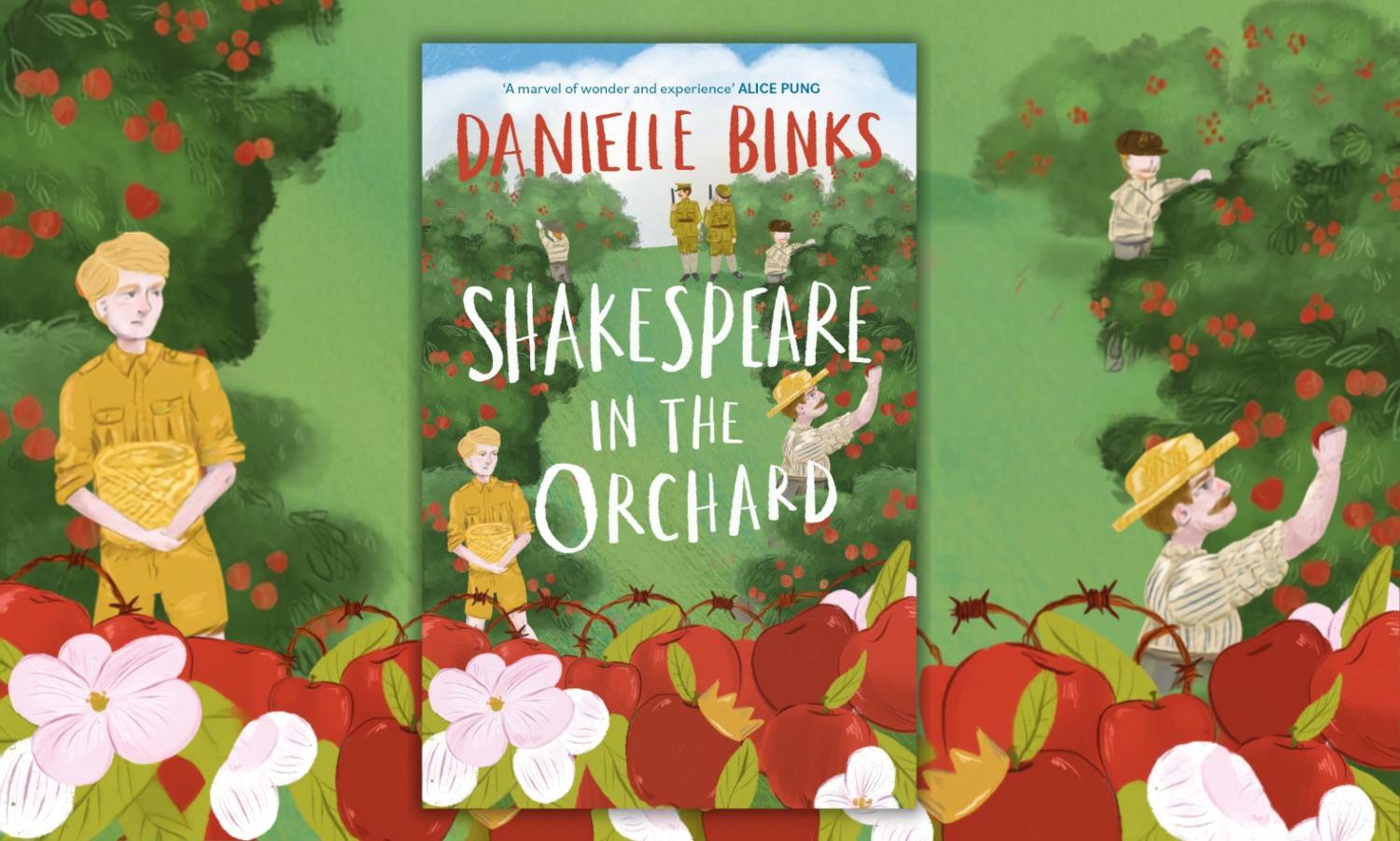
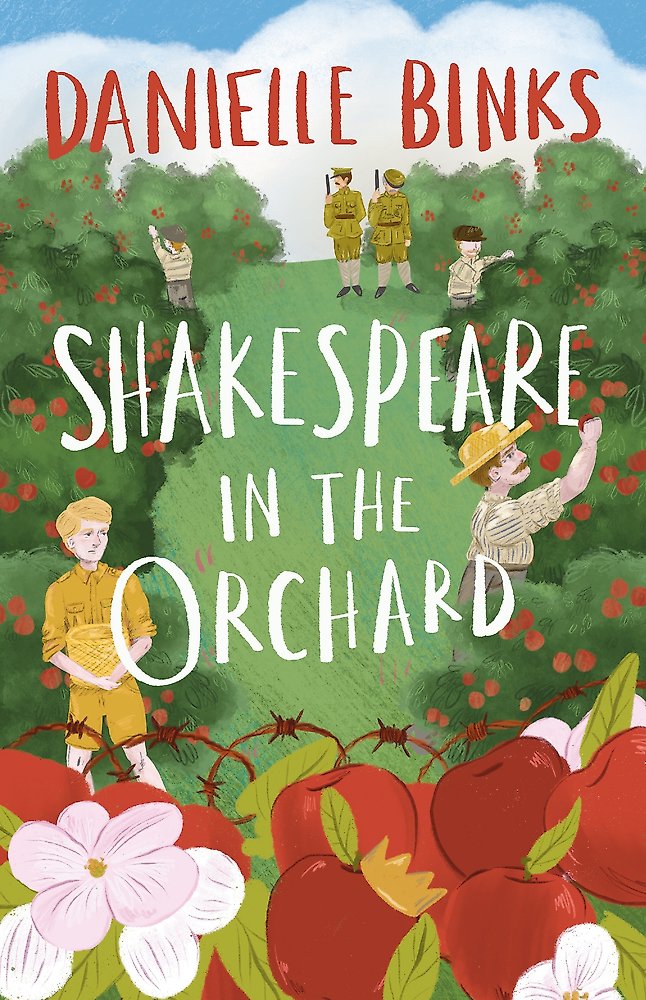
Shakespeare in the Orchard by DANIELLE BINKS is a coming-of-age story inspired by true events in Australia in World War I. As war and conflict separate the citizens of Langwarrin, can Shakespeare bring them together.
Read an extract below.
ABOUT THE BOOK
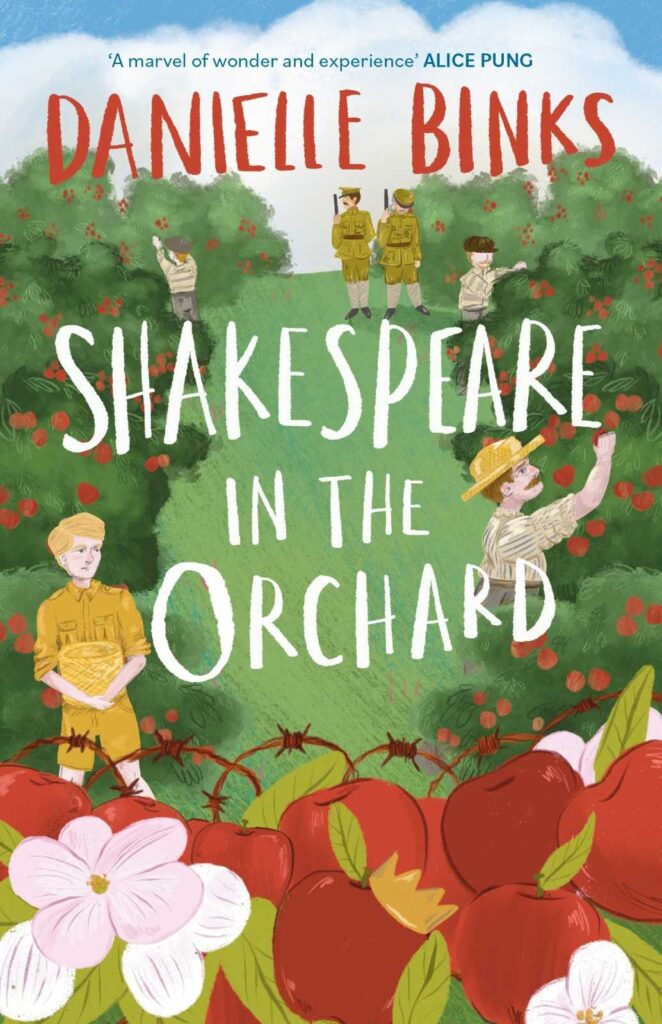 Langwarrin, Victoria, 1914. The whole world is at war. In Langwarrin on the Mornington Peninsula, fourteen-year-old Jack Thorning is the best marksman in military cadet training. His brother, Matt, taught him everything he knew, after their father died. But now Matt has joined the war effort, and it’s up to Jack to hold down the home front and help his mother run the family orchard.
When a group of ‘enemy aliens’ are sent to Langwarrin to be held prisoner at the military base, tensions in the town run high. For Jack and his best friend, Walter, the war feels closer than ever.
Like the rest of the town, Jack and Walter want nothing to do with the German prisoners. But as the war progresses, the inmates at the camp are put to work doing manual labour on the farms around Langwarrin, including Jack’s family orchard, and Jack begins to see that the prisoners are people, too.
What could Jack possibly have in common with the people responsible for keeping his beloved brother at war?
**********
EXTRACT
CHAPTER TWO
‘Did you hear about the Tommy who shouted down the dugout steps?’ Walter asked Jack as they made their way home from the white timber school along North Road.
Jack shook his head. ‘No – what’d he say?’
‘Nine!’
Both boys stopped walking and turned around to look at the interrupter: Anna, Walter’s eleven-year-old little sister, and their reluctant charge on the walk to and from school.
‘Nine!’ she declared again.
‘Quit it, you little turncoat!’ Walter made to grab at her arm, but she danced away from him. Her straw hat flopped off her head to hang around her neck by its string tie, her wavy black hair – the same colour as Walter’s – flying as she side-stepped his swiping.
When she raced ahead, her boots kicking up dust, the boys turned to one another in weary acceptance and the knowledge that after cadet-training they did not have the energy to go chasing after her. The girls only had mandatory nursing training and knitting after school for the war effort. Cadets was a damn sight more taxing.
‘Go on: what’d the Tommy say?’ Jack prompted.
Walter waved him off. ‘She ruined it, but he shouts down the dugout steps, “Oi, any Germans down there?” and the reply comes from deep within the trench, “Nein!” and the Tommy goes, “Nine, eh? You can bloody we’ll share amongst yer, then!” and throws his Battye grenade down!’
Jack laughed and Walter smirked, pleased with himself. ‘You can put that in your letter to Matt – he’d get a kick out of it!’ He elbowed him, and Jack nodded back. Walter had been taught to shoot by Matt too, and looked up to him the same way Jack did – Walter didn’t have any brothers, let alone an older one in the 2nd Brigade. No, Walter Maberly was plagued by sisters – two older and married, three younger (Anna, plus a baby and toddler still at home) – it was rotten luck.
Jack’s mother had been pregnant once before Matt, and once after Jack was born – but neither baby survived, and they each had a little engraved rock by the creek that ran down the back, beneath a paperbark tree. Jack wasn’t even sure if they’d been boys or girls; they were just ‘the babies’ and as much property markers as family to him. His father was buried with more dignity and a proper gravestone at the Frankston cemetery.
‘The Murphy twins are joining up,’ Walter suddenly declared, and the sentence made Jack stop in his tracks, his boots crunching beneath him and his hand whipping out to pull his friend to a halt. Walter windmilled his arms in exaggeration, and Jack knew this was an imitation of that American actor Charlie Chaplin, whom Walter had seen at the Elsternwick theatre when he went to visit one of his sisters in Melbourne. Jack had never seen a moving picture before, but Walter had acted out most of the twelve-minute feature about Chaplin’s tramp getting drunk in a bar, making Jack cackle over all his contortions and pulled faces. But this was no laughing matter.
‘Where’d you hear that?’ he demanded.
‘Mrs Murphy came into the Post Office this week and saw Dad hanging one of them Enlist posters – then she started bawling all over the shop until Mum had to come from out back with a strong cup of tea and settle her.’
The Maberlys ran the Langwarrin Post Office, and Jack could picture the notice board that ran the length of one side of the little brick store. It used to be filled with wanted ads for workers and labourers, Flower Day celebration announcements, livestock and produce for sale, and, in the leadup to the Royal Melbourne Show, all manner of competitions and entry-date specifications … but there was no Show scheduled for next year, since the showgrounds in Ascot Vale had been taken over for military use. Now the board was filled with notices about war rations, postal-date estimates for getting letters and packages to Europe, Africa and the Middle East, and large Government-issued posters urging enlistment for the war effort.
Without prompting, Walter described the poster in question. ‘It says Always Huns, and has two drawings: one of an Attila the Hun character with shaggy hair, fur vest and shield giving a blood-curdling roar,’ he mimicked the chest-beating posture in question before continuing, ‘and beneath him, today’s Hun: a fat Jerry with curling whiskers and one of them spiked helmets, his eyes all menacing,’ and he pulled the requisite face, bulging eyes and all. ‘Capped off with: “Protect our women and children, join the Australian Army,”’ said with a hand over his heart.
Jack shook his head at his friend’s theatrics, and then they both continued walking the dirt path, slowly.
‘Mum got the whole story out of Mrs M – how the boys said they were turning seventeen soon, which was practically nineteen and, besides, the recruiters down the Langwarrin barracks told ’em that if they got their parents’ written permission they could join as buglers or trumpeters – get themselves over there and hit the ground running once they turn nineteen if the war’s still going on by then.’
‘What’d their mum say to that?’
Walter shook his head in dismay. ‘Well, she was crying down at the Post Office to anyone who’d listen, what do you think?’
Jack winced, and Walter continued, ‘They told their mother that either she could give her blessing and they’d write to her, or they’d forge her signature, run away and do it anyway.’
‘They weren’t at cadets today,’ Jack observed. ‘No, they were not, which made me think of it.’
Jack gave a low whistle of disbelief. The Murphys’ father was a labourer, and he’d already signed up back in August – as soon as The Argus newspaper bulletin went up outside the General Store on a sandwich board: BRITAIN AND FRANCE AT WAR WITH GERMANY, with the third line down reading, AUSTRALIA PLEDGES FULL SUPPORT.
Mr Murphy had put his tools down and signed up the very next day.
‘Can they even play the bugle? Or the trumpet?’ Jack suddenly thought to ask.
Walter guffawed. ‘No, but they’re Irish.’
‘What’s that got to do with anything?’
‘They’re all raised on fiddles and pipes and whatnot.’ Walter waved the thought away. ‘I’m sure they’ll pick it up.’
Jack wasn’t so sure about that; maybe they could learn to hold a note for the bugle, but eventually they’d be swapping it for a rifle, and he’d spent two years watching them barely learn to shoot straight in cadets.
Furthermore, both boys had been held back in their schooling because neither had passed his written or oral test for the inspectors during his first year of learning; that’s why they were sixteen and still in Jack and Walter’s class, bigger than every other kid, and always made to sit at the back so as not to obscure the blackboard.
‘Anna! Home!’ Walter suddenly bellowed, breaking Jack’s musings – she was way ahead of them, dangling off a white-painted fence, talking sweetly to a little friend of hers who was playing in their front yard.
Since the war, town had been quiet: with many of the younger men gone even the public bar at the end of the main street was subdued, and many of the local kids were still being kept home to do chores and work now so many families were low on helping hands. Anna came skipping back toward the boys, her white pinafore dusty from all her running.
‘Bye, Jack!’ she said and blew him an exaggerated kiss – which had Walter rolling his eyes and giving a much less enthusiastic wave to his friend.
As Jack set off for home, he couldn’t help feeling envious at the thought of those Murphy twins heading off to adventures unknown – maybe to meet up with their father and fight Huns with him.
For a moment he pictured the three of them: stout, with shocks of red hair and freckled features, posing with their slick Lee-Enfield rifles, about to storm an enemy trench … and then the image changed, and became Jack and Matt, the two of them taller and slimmer, sandy hair just visible from beneath their matching slouch hats, dimpled grins and guns at the ready. The picture helped Jack eat up the distance to home, swift-footed as he dreamed of being with his brother in arms again – his greatest hero and role model.
ABOUT THE AUTHOR
 Danielle Binks is a writer, literary agent, and lecturer in Creative Writing at RMIT University who lives on the Mornington Peninsula. She is the author of Begin, End, Begin: A #LoveOzYA Anthology, which won the 2018 ABIA Book of the Year for Older Children.
Her young-adult novel The Monster of Her Age, which won the 2022 Indie Young Adult Book of the Year; and Six Summers of Tash and Leopold, which was a CBCA Notable Book of The Year for Younger Readers 2025. Danielle is also teaching Fiction & Young Adult Writing in the Associate Degree of Professional Writing and Editing at RMIT University
Follow Danielle Binks on Instagram
Read more about her books on the publisher’s website.
0 Comments