




Read an extract from Vector: A surprising story of space, time, and mathematical transformation by Robyn Arianrhod.
ABOUT THE BOOK
Vector takes readers on an extraordinary 5000-year journey through the human imagination. The stars of this book, vectors and tensors, are unlikely celebrities. Yet mathematician and science writer Robyn Arianrhod shows how they enabled physicists and mathematicians to think in a brand-new way. They inspired James Clerk Maxwell to usher in the wireless electromagnetic age; Albert Einstein to predict the curving of space-time and the existence of gravitational waves; Paul Dirac to create quantum field theory; and Emmy Noether to connect mathematical symmetry and the conservation of energy. Today, you’re likely relying on vectors or tensors each time you pick up your mobile phone, use a GPS, or search online.
In Vector, Robyn Arianrhod shows the genius required to reimagine the world – and how a clever mathematical construct can dramatically change discovery’s direction.
BACK TO THE BEGINNING
It was some time about five thousand years ago that people living in the area around present-day Iraq began to write down information by scratching wedge-shaped signs into clay discs or sheets. These strange signs are known as ‘cuneiform’ script, and the economic and administrative power of being able to record and control the exchange of tangible things such as goods and land must have seemed amazing. But it took another thousand years – and the help of computational tools such as fingers, pebbles, and eventually abaci and tables – for abstract number systems and the rules of arithmetic to develop.
The inventors of this cuneiform mathematics lived on the fertile plains between the Tigris and Euphrates Rivers – an area that the Greeks, a thousand years later, would call Mesopotamia (or ‘between two rivers’). It hosted a number of linked cultures, so the term ‘Mesopotamian’ is still generally used to describe the ancient mathematical and other cultural innovations developed in this agriculturally and intellectually rich region. Of course, it was not the only place to move from simple counting to sophisticated numerical arithmetic. But we know so much more about Mesopotamian mathematics than that of other early cultures, simply because so many of those remarkable clay documents survived.
Some of the earliest of the more sophisticated numerical and mathematical tablets, dating from nearly four thousand years ago, contain multiplication tables. It might seem surprising that such things have been around for so long, but of course you need to be able to add and multiply to carry out basic economic tasks. Historians have gained insight into the nature of those early tasks, because these functions, too, were recorded on clay tablets. Tellingly, some of the oldest of these documents contain tables giving lists of the lengths of the sides of various square or rectangular fields, each matched with their areas – the kind of tabular layout that would later morph into mathematical matrices. Simple lists of information would morph into vectors – but more on all this mathematical morphing later, for it will show us how mathematicians went from simple accounting lists to modelling such complex things as electromagnetic waves, for example, or the qubits that underpin quantum computers. Meantime, these ancient tables were vital for working out potential grain harvests, seed requirements, the amount of labour needed to work the fields, and the wages and taxes to be paid – the kinds of things that any large society needs in order to create and distribute food and other necessities.
In the earliest of these advanced Mesopotamian societies, the estimates of field sizes needed for the economy to run properly didn’t need to be exact. Surveyors could mark out fields with pegs and ropes, and then measure their sides, but they didn’t have to worry about making the land parcels exactly rectangular because the state owned it all anyway. From about 1900 BCE, however, things began to change, and soon ordinary folk could own land, too – and this meant that surveying needed to become more accurate, because land disputes were soon to begin their long history.
(By contrast, many First Nations people practiced the old way right up until colonisation disrupted the balance.) And so, hundreds of years after the earliest multiplication tables had helped accountants calculate the areas of approximate squares and rectangles, Mesopotamian surveyors worked out how to make perfect 90Æ corners – which suggests they may have discovered ‘Pythagoras’s theorem’ a millennium before Pythagoras.
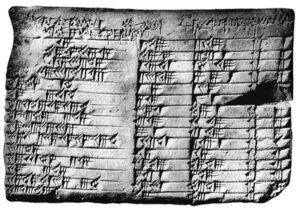
Generations of schoolchildren have chanted this ancient rule: ‘the square of the hypotenuse equals the sum of the squares of the two adjacent sides.’ Pythagoras lived in the sixth century BCE, but cuneiform tablets dating from around 3,700 years ago – most famously those labelled Plimpton 322 and Si.427 – contain compelling evidence that the rule is much older than its Greek namesake. The Plimpton 322 tablet (fig. 0.1) has been broken, but the surviving fragment lists 15 pairs of numbers relating to the diagonal and the shorter side of a right-angled triangle. The choice of numbers used, and the headings in the table’s columns, suggest that this was probably a list of implicit, sexagesimal ‘Pythagorean triples’, as they are now called – a set of integer (whole number) triples that surveyors could choose from. For example, (3, 4, 5) is a Pythagorean triple, because 3²+4²=5². The tablet Si.427 supports this interpretation, for it is a plan of the private subdivision of a land parcel into rectangular and triangular fields – each with perfectly rectangular corners and dimensions that fit Pythagoras’s theorem.
P’s position vector r, with components of magnitude rx and ry. The magnitude of r — the length of the arrow, representing the distance from O to P — is denoted by |r| or r, and it is found from the components using Pythagoras’s theorem.
A thousand years later, ancient Greek-speaking mathematicians were interested in measuring a range of angles, not just 90Æ, because they wanted to survey not only the earth but the stars, too. Along with mathematics, astronomy is the oldest science. After all, a vast and dazzling night sky is a wondrous thing. Since they had no way of measuring the distance to the stars, these ancient Greek astronomers figured out that you could pinpoint them by measuring their angles – and so they also discovered two key things.
First, trigonometry. Which is not to say that earlier cultures didn’t have some form of angular tabulation and ‘trigonometric’ calculation, too – historians are still debating and interpreting cuneiform texts. But the oldest extant, explicit trig table survives in Claudius Ptolemy’s extraordinary 1,850-year-old compilation of Greek mathematical astronomy, Almagest.
Second, the Greeks developed the idea of representing positions in space with coordinates – a brilliant innovation that has a lot to do with the emerging idea of a vector
IMAGINING NEW DIMENSIONS, AND NEW WORLDS
You may remember from school that you can represent the direction from the origin O to a point P on a coordinate grid by drawing an arrow, as in figure 0.2 below.
This is an example or model of a vector – it’s a ‘position’ vector, representing P’s position in terms of its direction and distance from O. But the idea of something that encodes more than one thing – something beyond a single number – is actually quite sophisticated, and this story will take us through how it all came to be.
It took a very long time to create the idea of a single symbol having both magnitude and direction.
ABOUT THE AUTHOR
I write about culture, science, mathematics, and scientific history. In science, I’m especially fascinated by the elegance and power of mathematical physics, and by the physicists and mathematicians that offer a human face to the scientific process. So in my science writing, my goal is to offer readers accessible but profound conceptual insights through compelling stories of scientific discovery. I also write about culture more broadly – scientific, literary, and social.


0 Comments