





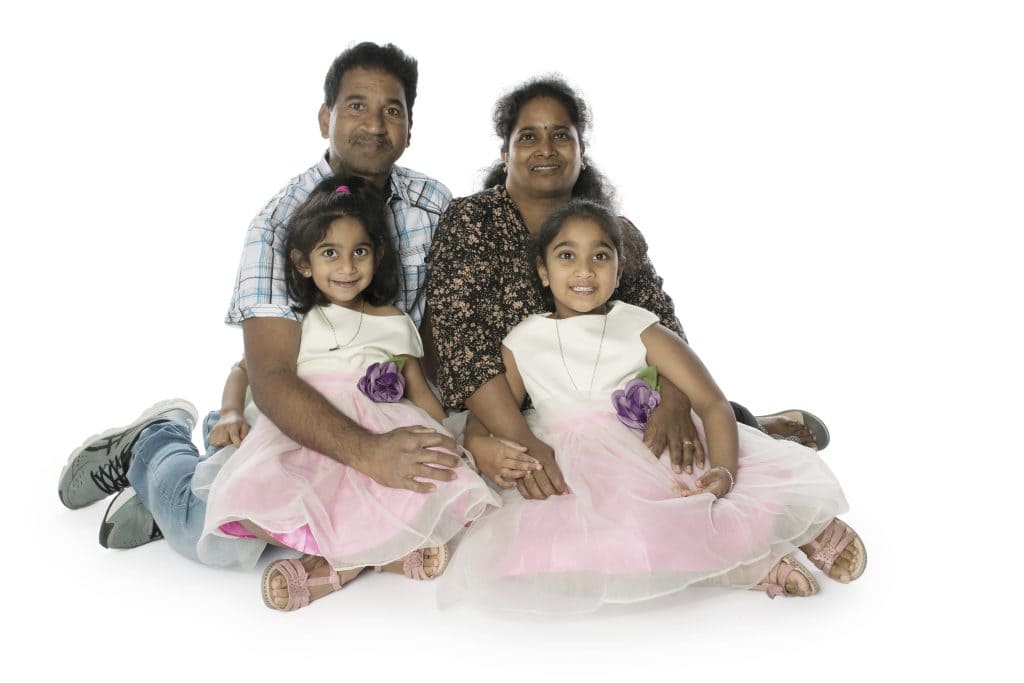
Home to Biloela tells the dramatic inside story of the Tamil refugee family which became a cause célèbre all around Australia, and the epic fight by a small rural community to set them free.
It was dawn in the small rural town of Biloela. Loud thumps on the front door signalled the start of a four-year odyssey that would catapult Priya and her family into the heart of a national debate.
Read on for an extract.
THE CHILDREN
When Priya and the family were shifted to the Melbourne detention centre from Biloela in March 2018, I was especially worried about the children. When they arrived, I thought they were the only children there, but barely 10 days after they arrived from Biloela, a pregnant Vietnamese woman who had been taken into detention gave birth. Mother and daughter would live in the Melbourne detention centre for the next two years. That infant, baby Isabella, would become Kopika and Tharnicaa’s beloved playmate for the next year, but only after I reported on the fact that the families were being kept apart by guards, only seeing each other through windows.
The government’s assertions that they had got the children out of detention were clearly untrue, but when I first started reporting on the children in the centre, the media staff from Home Affairs and ABF would attempt to insist – via their answers to my official questions – that the infants and children were actually not living in the detention centre, because they were held in a part of the centre called, highly euphemistically, a ‘residential precinct’. But that area was also called an APOD – an ‘alternative place of detention’.
The speciousness of this argument was almost amusing. There was nothing alternative about it. It was like renaming Alcatraz a ‘seaside residential precinct’ and therefore pretending it was not a prison. Lawyers would tell me that, by using the term ‘APOD’, the government could convert any kind of building into a detention centre, including hotels and motels—something they subsequently and regularly did.
In the APOD the families had no freedom of movement and were, in fact, even more isolated from the medical office in the main centre than most of the other detainees. To take their children to see a nurse, Priya and Nades would have to get a guard to arrange a van, and then multiple guards would escort them through multiple gates. If they had been allowed to simply walk it would have taken two minutes. They also had to go through this process every time they had a visitor.
***
While Simone had dealt with asylum seekers before, the environment at MITA was entirely and disturbingly new.
‘I remember walking out of there and ringing Angela and crying, because of just the absolute lack of decency, just treating people like prisoners. The likelihood that any small mistake would be seized upon and used as a way to stop you from visiting.’
While Simone didn’t see Priya and the girls on her first visit, she did see baby Isabella in the visit room, which was the only place her mother and the baby could see Paul, Isabella’s father. Simone was shocked to see a tiny baby in detention.
‘I saw her and she was a brand-new baby, on my very first visit, because I remember that was another shocking moment. And I was thinking, What the fuck is happening here? Why is there a newborn? What is this place?’
***
To visit the family, Simone had to start an online account with ABF, then go through approximately nine pages of detailed declarations for each family member she wanted to visit. There were PDFs to attach, and she had to register proof of her ID to even get the visit approved.
It is impossible to know where she made a mistake in her first application, because there was never any explanation.
She was by no means the first visitor to be flummoxed by the system. Her experience demonstrates that if an Australian-born English speaker with high computer literacy struggles, then of course others will, too.
Over the years I observed two groups for whom these strictures made visiting if not an impossible then at least a highly unpredictable venture – those without the necessary computer skills, and asylum seekers who didn’t have enough ID.
The former were seriously disadvantaged when it came time to go through multiple complex online steps, and the latter, if they were still one of the thousands of refugees on temporary visas, were often hamstrung by a lack of recognised documentation – a very common problem for persecuted minorities and people who have had to flee conflict.
If an applicant gets past the online process, then they get the chance to experience the true conditions of detention.
If you got past the metal detector, next was a drug test. This system was introduced early in 2018 and has also been highly successful in keeping visitors out.
Upon arrival, you push a button on an intercom set into a 6-metre-high metal fence topped with razor wire. You provide your full name, state your reason for being there, and are hopefully allowed in. The reception area itself resembles a worn-out 1990s corporate building. Only upon sighting the large metal detector surrounded by uniformed guards does it become clearer where you are. The next part of the process is often far more difficult than the exhausting online application.
First, you need to make sure you have brought enough ID to be allowed to register for your booked visit, even though the department has gathered all of that from you already. Then you are put through the metal detector and a drug-testing process.
The metal detector is turned up so high that it pings at even the suggestion of an underwire bra. A hip replacement is enough to send it into space.
I became very aware of the detector’s sensitivity because I had sustained multiple fractures in my right leg a decade earlier, and the plates and screws in my knee tripped the detector like a cheap car alarm. Guards that knew me would end up yelling at the ones that didn’t, ‘It’s just Rebekah’s leg!’ Eventually I would have to get a letter from my GP that I carried in my wallet for the next three years, stating that I have the metal in my leg, so that my visits would not be declined. Other guards would mutter to me that it was dialled up too high on purpose. My leg never set off the detector at the airports.
If you got past the metal detector, next was a drug test. This system was introduced early in 2018 and has also been highly successful in keeping visitors out.
The guard asks for your permission to take a test and, upon your approval, swipes a plastic wand with a testing strip across various points of your clothes. The paper swab is then processed in a scanner. Like the metal detector, this machine seems to be dialled up to its peak.
Every week I would see the most improbable people test positive for that most unlikely of substances, fentanyl – a powerful synthetic opioid analgesic similar to morphine, but up to a hundred times more potent.
One week it would be the senior Salvation Army chaplain testing positive for trace amounts of fentanyl; the next it would be a nun or retired local mayor. While I may have been occasionally amused at the situation I found myself in – having to explain to a senior church member that they had tested positive for fentanyl, the drug implicated in Michael Jackson’s untimely death – the reality of testing positive was a denied visit. Which meant the person detained did not see their family member, friend or chaplain.
Again, certain guards muttered about the machine’s problematic proclivities and many of us developed techniques to avoid getting a false positive. I had read about problems with the same machines used in prisons overseas and saw that hairspray, perfume and drycleaning fluid had been indicated as possible contributors to a positive test result.
To dial down the likelihood of a positive test, I kept several changes of clean clothes separate and made sure I hadn’t taken anything for drycleaning. On visit days I changed into clean clothes at the last minute. One day, after I had been at the hairdresser, I did test positive.
At that stage, guards would carry out a second test. On the day I failed I was lucky enough to be dealing with a reasonable guard and explained that I thought it was hairspray on my shoulders and asked that he test a different area instead. I passed and was allowed in.
Another day I had a firm discussion with a guard who went to swipe the bottom of my shoes.
‘Why would you test there? My shoes walk through God knows what on the street to get in here.’
He capitulated but I knew it was a matter of time until someone would be less reasonable. After that I also left clean shoes in my car, meaning I had a complete change of clothing set aside just to get into detention.
I was able to drive to MITA for my visits, but as usual, it was those who could least afford it who were messed around the most. People who had travelled hours by public transport would be told by the guards, after testing positive, that they probably touched something on the train or the bus, before they had to turn around to take the same lengthy journey home, without seeing their family member.
It wasn’t just getting yourself into detention that was made difficult. If Simone had wanted to bring the kids a toy or some fresh fruit, she wouldn’t have been allowed. By 2018, any food allowed in needed to be non-refrigerated, in commercially sealed, expiry-dated wrapping.
One Christmas Eve I tried to bring a colouring book for one of the children and was told that the item didn’t meet the criteria. Another day, a particularly zealous guard told me the baby food I was wanting to take into one of the toddlers was not allowed. I had read the rules extensively and knew that the food met the criteria. There was some back and forth before another senior guard, who knew me and knew by this stage that I was a journalist, simply looked at the zealot and shook his head. I was let through with the food.
ABOUT THE AUTHORS
Rebekah Holt is a journalist and writer. For five years, she was the only journalist to gain regular access to the country’s onshore detention centres. Her reporting has appeared in Crikey, SBS, The Age, The Guardian, Radio NZ and The Saturday Paper.

0 Comments