



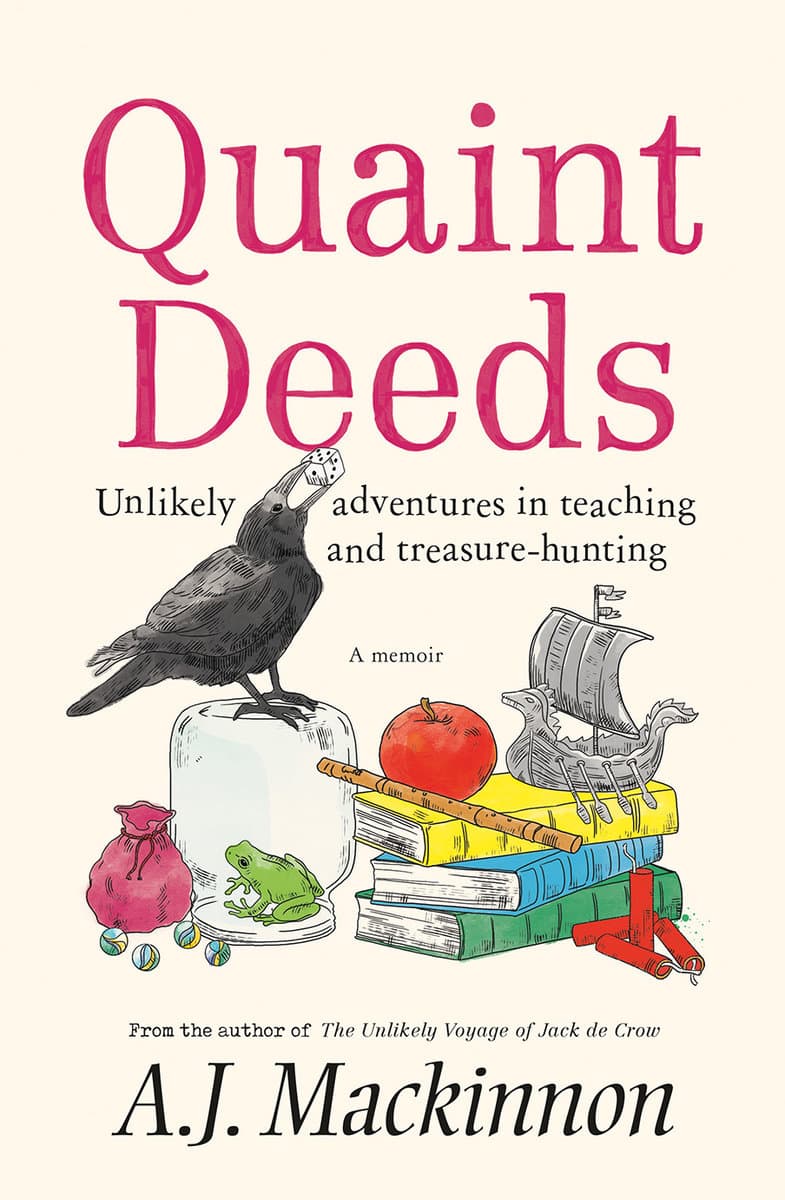
A J ‘Sandy’ Mackinnon is best known to readers as a much-loved travel writer. But between eccentric voyages, he has taught at schools in Australia and the UK for almost 40 years.
In Quaint Deeds he recalls the ups, downs and unexpected detours of a teaching life. Along the way, he shares the lessons his students have taught him, often in the most unlikely moments. Whether playing pranks, experimenting with home-made fireworks, or searching for buried treasure in the English countryside.
Read on for an extract.
‘Destiny guides our fortunes more favourably than we could have expected. Look there, Sancho Panza, my friend, and see those 30 or so wild giants, with whom I intend to do battle ...’
‘What giants?’ asked Sancho Panza.
‘The ones you can see over there,’ answered his master, ‘with the huge arms, some of which are very nearly two leagues long.’
‘Now look, your grace,’ said Sancho, ‘what you see over there aren’t giants, but windmills, and what seems to be arms are just their sails, that go around in the wind and turn the millstone.’
‘Obviously,’ replied Don Quixote, ‘you don’t know much about adventures.’
—Miguel de Cervantes, Don Quixote
One of the students who made the greatest impression early on was, like me, a new arrival. Huw Davies had come from the Welsh valleys to start in Third Form, or Shell, as it was mysteriously called. (English private schools are full of such arcane slang. Tell Davies, that pie-job in the Shell, he has to report to Biggers for a leftie. That sort of thing. You get used to it.) He was a dark-haired boy with a white face, huge black eyes and the air of a border collie ready for adventure.
In the very first week of term, I had cornered him and four other new students and asked if they wanted to help me explore some of the surrounding countryside that coming weekend. Ooh, yes sir, thank you sir, we’d love to sir, they chirruped like baby gerbils, but come that Sunday, all but young Huw had found better things to do. I assumed that Huw would also want to duck out of the prospect of a walk now that his friends had absconded, but he turned up after chapel in a pair of enormous boots, a poacher’s jacket several times too large for him and a bundle of Ordnance Survey maps.
‘I’ve had a look at the map, sir,’ he said, ‘and I think we could make it to Whittington Castle and back before lunch.’
‘Good-oh,’ I said breezily, ‘I’ll follow you.’
Huw, I had discovered, took an adventurous approach to rambling, choosing to use rabbit tracks, badger runs and holes in hedges rather than the well-marked footpaths that seam the English countryside.He was small and nimble enough to duck under barbed-wire fences, skim across soggy pastures and scramble through holly hedges like a graphite otter, and his sturdy poacher’s jacket protected him from spikes, thorns and nettle stings.I, in contrast, felt about as agile as a Black Angus in gumboots and was frequently two hundred yards behind attempting to disentangle myself from a strand of barbed wire while Huw was perched cheerily on a distant stile calling out, ‘This way, sir!Three hours later, I was up to my knees in the cloying mud of a ploughed field and Whittington Castle for all I knew was still several leagues to the west. Mind the nettles now!’
‘We should be able to see the castle any minute now, sir. If only we could get up higher, isn’t it?’ Huw was lilting. ‘Climb a tree, like.’
‘My dear Huw, I seem unable even to move from this spot, let alone shinny up a tree. I’m stuck.’
It was true. Both boots had sunk deep into the winter mud and any move I made to extricate one foot simply sent the other gurgling deeper into the mire. Huw was dancing from tussock to tussock a few yards away, anxious to help but unable to get closer without risking getting stuck himself.
‘Perhaps if I weave a rope, sir,’ he suggested hopefully. ‘Didn’t they make hemp rope out of nettles, sir? In the olden days, sir?’
‘I’m not sure we have time to set up a cottage industry, Huw.’
‘Or how about carving some duckboards. I’ve got my Swiss Army knife with me, sir.’ He pulled from one of a dozen pockets a shiny red knife.
‘Again, dear chap, I don’t think we have the requisite time. I’ve sunk another bloody three inches in the last minute.’
Perhaps it was hearing a teacher swear that did it, but as I watched, Huw’s eyes opened wide in alarm and he started backing away. ‘Hell’s bells,’ he said. ‘Sorry, sir, but I need to find that tree!’
Now I really was cross. The boy had no sense of the urgency of the situation. Then, glancing over my shoulder at a strange whickering noise, I realised he had a better grasp of the situation than I had. Approaching rapidly from behind was the largest black stallion I have ever seen. It was coming at full gallop across the field, pausing now and then to rear up in a Hi-Yo Silver pose, scream defiance and thrash its forelegs around like a ninja helicopter.
A strangled glance over my wrenched-up shoulder revealed a set of teeth resembling an ancient piano keyboard and a pair of eyes red with imperious wrath.The stallion plucked me from the bog with one heave of its coal-black neck, shook me crossly as it trotted over to a nearby stile, and dumped me over the fence in a startled heap.Huw, all his Boy Scout instincts abandoned, was haring across the field to a lonely ash tree as I tried vainly to wrench a congealed foot from the fudge-like grip of the mud. Suddenly, I felt hot sulphurous breath on my neck and my collar seized in a mighty grip. Then it galloped off as sharply as it had appeared, presumably patrolling the boundaries of its domain to see if there was any further riffraff to be seen off the premises.
A few seconds later, Huw reappeared with eyes like saucers in his pale face. He picked me up, dusted me down, said ‘Gosh’ and ‘Sorry, sir’ a lot and in general behaved with the abject shame of a young squire who has just abandoned his knightly master at the first ford crossing. I eventually calmed him down by relating what I had seen in a glimpse while being tossed over the stile – namely, the tower of Whittington Castle rising above the landscape just three fields away. ‘So, let’s get on, young Huw, and hear no more about it.’
Huw glanced down, evidently still ashamed. ‘But, sir –’ he started.
‘Now, now, none of that,’ I said briskly. ‘We’re going to have to hurry. Lead the way.’
‘It’s just that …’ he said.
‘Yes?’
‘Won’t you be needing your boots?’
I, too, glanced down. Both boots were missing, left behind in the quagmire when the stallion had uprooted me.
‘Ah, yes, quite. Good observation. Just duck over and fetch them for me, there’s a good chap.’
And while my new squire trotted off to excavate my footwear from the bog, I sat down again and seriously started shaking.
*
On the way back, we paused for a breather in a little copse. Whittington Castle had been a charming place for a lunch-stop, a quiet ruin half surrounded by a ruffled moat where a swan couple drifted in silence in the winter sunshine. We had clambered over the crumbling stonework and Huw had surprised me by producing a packet of squashed jam sandwiches from one of his countless pockets. ‘I made enough for two, sir.’
A nearby plaque announced that this castle had been the stronghold of one Fulke FitzWarren in the tenth century. Again, Huw seemed remarkably knowledgeable. ‘A Robin Hood figure, he was, Mr Mackinnon. King John hit him with a chessboard, he did, when Fulke won the game they were playing – and the King banished him from his castle and took away his lands. But Fulke didn’t give up, not a bit of it, sir. He rode around the land with his men, harrying the sheriff and the abbots and the King’s men, and finally won his castle back.’ As he chatted on happily of kings and knights and holy saints and noble outlaws, I pondered on the Welshman’s natural love of story, romance and scholarship, harking back to a time before the uncouth Saxons had come tramping over the fields with axe and fire. If Huw was a taste of what was to come in the way of Ellesmere pupils, I suspected I would be happy here.
Now in the little copse, Huw left off being the dreamy poet and scholar and reverted to poacher mode with a thump. His eyes lit upon a number of pale ashen things lying in the undergrowth. Wood pigeons. Eleven of them, dead as dodos but evidently freshly slain. Huw picked one up and cradled it in his hands, trying to ascertain how it had died. He stroked the lovely dove-grey feathers and admired the purple-green sheen on the neck. Then his eyes lit up in holy delight. ‘I’ve had a brilliant idea, sir! I’m taking four of these beauties back to school, sir, and I’ll present them to Mr Pebmarsh. He can make a pigeon pie, sir! That will be a grand gift, won’t it?’
I was none too sure about this. Mr Pebmarsh, Huw’s housemaster, was a man I had then barely met but he had struck me as a neat, fastidious little man more at home in a library, museum or tea shop than as a putative poulterer. His closest connection to fowl was a tendency to turn turkey-cock red when affronted by a blotted textbook, dog-eared essay or slopped tea-saucer. With his immaculate suits and pernickety turn of phrase, I couldn’t quite see him up to the elbows in pigeon feathers. Nevertheless, Huw could not be dissuaded from employing another four pockets of his jacket to carry four fat corpses, and we wound our way schoolwards, arriving home just as darkness fell.
It had been a delightful day, but after a long, hot bath, a stiff drink and a good night’s sleep, the wood pigeons had faded from my mind. Until Morning Assembly, that is. After the usual business of assembly – announcements for the day, congratulations on a good start to the school year, commiserations for the loss of a rugby match against Grimslade – the otherwise genial Headmaster’s voice took on a sterner note. He wished to invite Mr Pebmarsh up to the stage to talk about something very serious and most disappointing that had occurred over the weekend.
A fortnight after the pigeon incident, a flagstaff appeared projecting out of a window high up on the third floor of the North Pole wing.
Mr Pebmarsh strutted up onto stage and from the way the hall fell silent I could gauge the nervousness of all present. I would learn later that Mr Pebmarsh was a brilliant teacher of History and high-achieving students considered themselves lucky to have him as their A-Level master. But his insistence on immaculate standards, his sharp tongue and his scathing wit put some of the more oafish offside, and there was that year an undercurrent of dislike from a small and boorish coterie among the students. Now, even these were silent as the little red-faced man strutted onto stage, lips pursed, looking angrier and icier than I have ever seen anyone look before or since.
Ten minutes the lecture lasted, ten minutes in a voice no louder than the hiss and sweep of a whip thong slithering across the floorboards before the deadly crack. It was difficult to believe, he said, that such uncivilised behaviour could exist in such a community – clashes of personalities between masters and students were, of course, inevitable, but one hoped one could always sort out differences with a civil word – that never in 20 years of dedicated service to Ellesmere had he been on the receiving end of death threats – impossible to believe that this outrage could be anything but some sort of sick threat – four bloodied and verminous corpses deposited on his doorstep overnight – a sickening and disturbing sight – immediate confession from the perpetrator or perpetrators expected – sad and sorry day … and so on.
No one dared move. But out of the corner of my eye, I could see Huw Davies, newest of new boys, shrinking, shrinking, shrinking inside his school blazer that was already two sizes too big for him, his face the colour of feta cheese and his dark eyes like saucers of watery ink. He was beginning to gulp and hiccup. Only his ears were red as maple leaves. Of course, he had not found Mr Pebmarsh at home the night before but had left the birds on the doorstep, confident in the obvious nature of the gift – plump fresh pigeons for the making of a good poultry pie. And had inadvertently started his school career by issuing a death threat to his housemaster. That and, for no apparent reason to anyone not in the know, suddenly vomiting unexpectedly all over the hall floorboards at the very first assembly of the new year.
Despite that shaky start, Huw went on to thrive at Ellesmere. Within weeks, he was establishing himself as a gentle eccentric who pursued his own quiet path, and he won the hearts of all who took the trouble to know him. A fortnight after the pigeon incident, a flagstaff appeared projecting out of a window high up on the third floor of the North Pole wing. Watchers below in the Quad would gaze in puzzlement as a green and white flag sporting the scarlet Welsh dragon would flutter up the flagstaff and back down again at intervals.
Huw had contrived it such that every time someone opened and closed his study door, the flag would shoot up the pole and down again – Huw’s quiet salute to his beloved Wales. Huw was one of the first to come to the newly formed Philosophy Club; indeed, in five years, he never missed a single session. Mind you, I don’t think I ever heard him say a word either – he was content to sit and listen intently to the ideas sparkle and shift around him, gazing all the while at the flame of the candle that he always took upon himself to light to signify the start of the meeting. Then, at the end, he would always be the last to leave. He would snuff out the candle, thank me for the evening and invariably add, ‘Interesting, all that,’ before vanishing down the darkened corridors with his light poacher’s tread. He took up very little room in the world, did Huw Davies.
ABOUT THE AUTHOR
 A J Mackinnon was born in Australia in 1963 and travelled as a boy on P&O liners between Australia and England, developing a love of slow travel. He started his teaching career in 1984 and has worked in various schools around the world. A J has shared his passion for English Literature, mathematics, drama, art and philosophy with countless students over the years.
A J Mackinnon now lives in the Victorian High Country of Australia. He continues to love his teaching, his garden and various other creative projects. He is the author of the international bestseller The Unlikely Voyage of Jack de Crow and The Well at the World’s End. His forthcoming book is Quaint Deeds.


0 Comments