




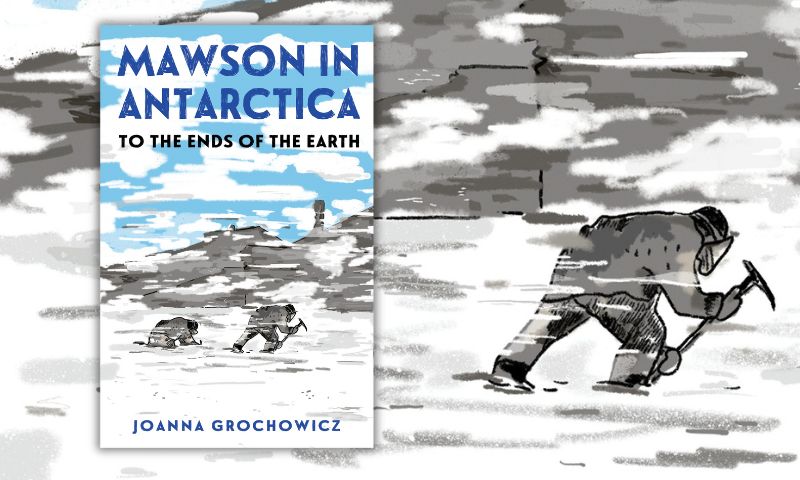
We caught up with author JOANNA GROCHOWICZ to discuss, Mawson in Antarctica, a narrative non-fiction that looks at Douglas Mawson, an Antarctic explorer who was famous for one of the most extraordinary feats of endurance in the history of polar exploration.
What can you tell us about your latest book Mawson in Antarctica?
This is a homegrown adventure about an Aussie battler who triumphs over adversity. There’s danger and desperation in this true story but also hope, friendship, humour and excitement.
When Mawson sets sail from Hobart in 1912 his principle goal was to map as much of the unknown Antarctic coastline lying directly below Australia as possible. As soon as Mawson and his men make landfall, they realise that nothing about life in their new home, the windiest place on earth, will be easy or remotely pleasant.
Tragedy strikes in the spring. A routine sledging journey goes horribly wrong in one of the most remote stretches of Adelie Land. Having lost his two companions, his tent and most of his food, Mawson must find a way to not only survive the next few days on his own but to complete a journey of several hundred kilometres back to safety.
His ordeal pushes Mawson to the absolute limits of physical and mental endurance. Yet he realises that if he does not survive, the truth of what happened to his companions and the precious scientific results of his mapping survey, will be lost.
What were some of Douglas Mawson’s greatest achievements?
Mawson had already been to Antarctica once before as part of Ernest Shackleton’s Nimrod expedition. During that time he was among the small group who made the first ascent of Mt Erebus – at 3794m, the highest active volcano in Antarctica. It was a tremendous achievement given none of the men had climbing experience. Along with another Australian, Professor Edgeworth David, Mawson also reached the South Magnetic Pole and in so doing, completed the longest unsupported sledging journey at that time. By the time he led his own expedition he had clocked up a lot of miles hauling heavy sledges.
What was involved in your research process for this book?
I first visited Tasmania back in 2018 and was entranced by Mawson’s replica huts in Hobart. The story of Mawson’s Australasian Antarctic Expedition really captured my imagination. I had written books about Captain Scott, Roald Amundsen, and Ernest Shackleton and here was an Australian polar great who was active in exploration at the same time, who had an incredible story of daring, determination and true grit.
I started my research by reading absolutely everything I could find on Douglas Mawson and the AAE. I then tracked down Mawson’s Antarctic diaries which were an excellent reference. My research really came together when I started combining what I had learned about Mawson with the diaries of all the other men who went on the expedition. I found Frank Hurley, Cecil Madigan, Belgrave Ninnis and others kept excellent personal accounts of the expedition. These were really useful in getting a true sense of what life was like on the ice. They often were suffering a terrible time while based in Cape Denison but also they managed to have loads of fun.
What were some interesting facts you learned about Mawson’s expedition during your research?
It was fascinating to find out more about the other amazing individuals who accompanied Mawson on the expedition – lesser known figures but men who went on to have incredible lives. Frank Hurley is a wonderful character who I have written about previously. After the AAE, he would go on to accompany Shackleton on his Transantarctic expedition aboard the Endurance. But Mawson gave the Australian photographer his first big break. Frank Bickerton was an extraordinary individual who had had many adventures already and many lucky escapes. Madigan and Ninnis were also very entertaining in their writing. What was particularly interesting was the way friendships (and feuds) developed within the group. At times tension ran high – not surprising given the lack of privacy and personal space within the hut.
What kind of obstacles did Mawson face in his journey?
Mawson’s men were an enthusiastic bunch but they were woefully lacking in any real-world experience in polar environments. Much of their on-the-job learning came at a cost – getting lost in blizzards, falling down crevasses, suffering frostbite and having to travel with debilitating snow blindness. It all contributed to the process of acquiring valuable survival skills of course but the extent to which the men lacked knowledge was also a source of considerable stress for their leader.
From the very beginning the weather posed a terrible challenge to achieving their goals, and they never got used to it. Hurricane-force winds were a constant feature of their new home. Any outside work had to be attempted amid gusts and gales strong enough to send men and equipment flying through the air. Even routine tasks like checking scientific instrumentation was perilous and highly unpleasant.
The remoteness of their location – because they failed to get their radio relay system working – meant that they were essentially cut off from the rest of the world. This made teamwork the driving force of their achievements and the tight bonds of friendship between these youthful and enthusiastic amateurs would remain in place for a lifetime.
During his dash for survival, Mawson finds himself entirely alone, inadequately clothed, with very little food. But that was just the beginning of his travails. Exhaustion, exposure, fatigue, hunger, frostbite and extreme chafing all conspire to make his journey back to base a living hell. When he finds himself dangling in a crevasse, contemplating the bottomless chasm, the temptation to surrender is almost too great. Despite all the obstacles, he manages to find the necessary strength inside of himself to overcome them.
What is it about polar exploration that fascinates you?
One thing I love about writing polar adventure stories is demonstrating to readers how resilient human beings are when adverse conditions push them to the brink. The polar environment is incredibly harsh and unforgiving and it really does highlight an individual’s strengths and failings. You can certainly tell the true measure of a man when you separate him from all that is comfortable and predictable and transplant him into a place where every day is a struggle for survival. Antarctica reduces people to their essence.
What was the most enjoyable or challenging part of writing this book?
Mawson was a highly accomplished explorer but an intensely private man. He kept excellent records but often his personal papers were lacking in a lot of detail about how the men lived day to day. That is when being able to access the writings of the other expedition members became very valuable. Douglas Mawson was obviously a product of the Edwardian era when men largely kept their emotions under control! But the other men often let fly in their diaries, venting their anger and frustration and sharing on the pages of their diaries the sentiments they could not rightly express in real life.
ABOUT THE AUTHOR

Joanna Grochowicz is a polar historian and author. Fast-paced and exquisitely written, her books of early Antarctic exploration reveal in fascinating detail the human aspirations and tragedies that have shaped our understanding of the polar regions. Drawing on diaries, letters and expedition narratives from archives and personal collections around the world, Grochowicz brings to light new and often overlooked elements of heroic age exploration. Realistic portrayals of historical figures and the interplay of personalities lend her work a grittiness and authenticity that is not often present in historical writing for children and young adults.



0 Comments