




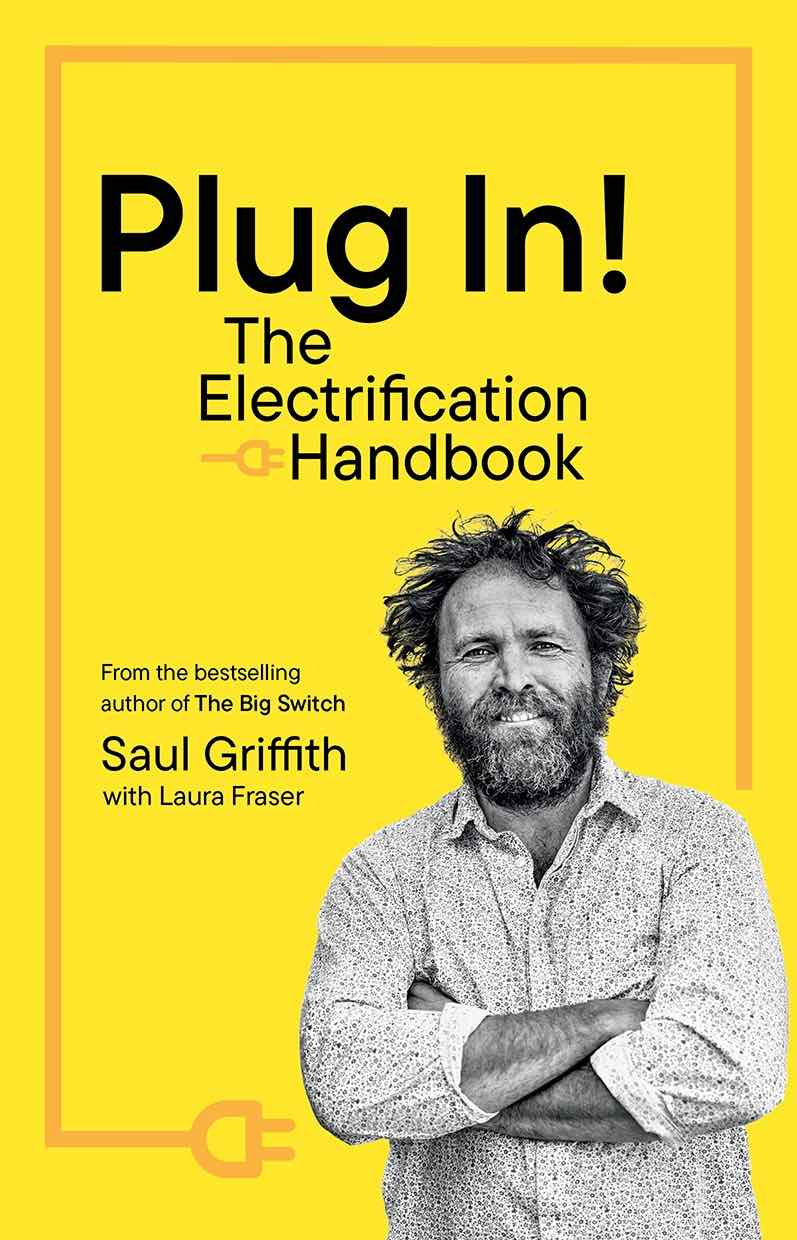
We all know that renewable energy is the future, but how can we ditch coal and gas in our own lives and homes? Plug In! is full of pro tips and essential information for your electrification journey.
Energy expert Saul Griffith’s new book, Plug In!, aims to help you make the switch.
Read on for an extract from the book.
**********
Rewiring Your Life
At this point, it has become glaringly clear to anyone paying attention that not only is climate change real, it’s a crisis. Wildfires are spreading, coral reefs are dying, food systems are stressed and our way of life is threatened. It is long past time to act. The situation is urgent.
That’s the bad news. But the good news is that there’s something all of us can do about it that will actually make our lives more comfortable and save us a lot of money. The best thing to do to help our planet, our kids’ futures, and – it turns out – our wallets, is to make a handful of good decisions over the next ten to twenty years. It’s about the next car you own, your next cooktop, what to do when your water heater needs replacing, how to heat your house, and where you buy your electricity from. We just need to plan well and replace any outgoing fossil-fuelled machine with an electric one.
In other words, we need to electrify everything in our lives.
Sometime in the 1970s, the environment was dragged from the realm of scientific evidence to the battleground of partisan politics. Democratic President Jimmy Carter put solar panels on the White House and Republican President Ronald Reagan pulled them down. Environmental action and clean energy have been framed as grim austerity. Self-interested billionaires fund think tanks that continue to attack climate science and spread misinformation. Opportunistic politicians conflate climate solutions with partisan identity politics. I can’t change those things.
What I can do is tell you a true story about the near future, because most of it is happening today. We can rewire the whole negative narrative. The data is clear: eliminating polluting fossil fuels will reduce people’s energy costs, which will reduce their cost of living. If you electrify the machines in your immediate world, your life will be better. If your whole community does it, tens of millions of dollars a year that would have fled to petrostates, multinationals and offshore investors will stay in the local area. That means more local jobs and local wealth. Your car will accelerate faster. Your pasta water will boil in half the time. Your home will be cosier in winter, and your showers will be just as hot. And even as the temperatures rise, you’ll keep cool in the summer, for cheaper.
Electrifying everything is common sense, not a political stance. Both sides of the political spectrum in Australia already know they can win votes by helping consumers buy rooftop solar. They can now add batteries to this agenda, and electric appliances and electric vehicles too.
My motivation is to help us solve the climate crisis as fast as possible, because every fraction of a degree counts. But this Electrify Everything movement could be the start of something bigger – a new social contract, with healthier air, cleaner living and revitalised, local economies. I founded Rewiring Australia in 2020 to accelerate Australia’s clean energy transition, focused on policy, regulatory, finance and community solutions. Already we have more than seventy-five groups around Australia affiliated with Rewiring Australia as part of our Electric Community Network. These overlap with the full political spectrum of electorates: 43% Labor, 25% Liberal, 12% National Coalition, 2% Green and 13% independents. In my more hopeful moments, I like to think that as communities electrify, they might get into the habit of working together to solve other problems, using evidence-based solutions and caring about one another.
As an entrepreneur and inventor with a PhD in engineering from MIT, I guarantee that electrification will not stop the economy or make your life uncomfortable. It will mean more jobs, more comfort and more resilience in a world facing climate and trade shocks. It is much more than just an answer to our climate woes; it is the pathway to a more prosperous, and – if we get it right – fairer economy.
This transition to clean energy is far simpler than the media would have you think. Basically, it just means not buying any more fossil-fuelled machines and buying electric ones instead. This simple statement reduces to roughly half-a-dozen decisions in your life. These decisions determine about half of the average person’s carbon and methane emissions, and are as simple as which vehicle you drive and which appliances you use in your home.
The other half of your emissions come from living in a society that provides schools, healthcare, roads and other shared public infrastructure, including our export industries, which generate income for the national coffers. All these things create carbon emissions, but they don’t have to. Eventually we’ll electrify just about the whole economy and the country will save money, because machines will be more efficient and energy cheaper. This is what economists like to call “increased productivity”. An electrified industry will make clean steel, aluminium, nickel, copper and lithium, which will become electric cars and appliances, for use in electric homes using zero-emissions electricity. It’s really that simple.
Why is electricity so much cheaper and efficient? Basically, when you burn fossil fuels to do something, the laws of thermodynamics mean that up to three-quarters of the energy is lost. When you do the very same tasks with electricity, very little energy is lost. Efficiency improvements in the late twentieth century emphasised making fossil fuels slightly less bad – the “reduce, reuse, recycle” slogan – meaning less inefficient. The emphasis now needs to be on electrifying everything and doing away with those inefficiencies altogether. The updated version of this slogan might well be “rewire and recycle”. Electrification can give us the good life, more efficiently, at lower cost. Recycling the metals that power electrification will give us a genuine, science-based shot at creating a sustainable or “circular” economy.
So, let’s look at what you can do today, right from your kitchen table. The great majority of your emissions come from the infrastructure of your life. These are the big decisions you make from time to time that set the patterns of your energy use, such as how you heat your home, cook your food and get around. These decisions, which you make only occasionally, like when you buy a new car, have a huge impact on how many carbon emissions you contribute to the climate crisis. “Rewiring” is the simple act of electrifying these big energy users and powering them with clean, zero-emissions electricity.
Rewiring your life comes down to five big decisions, representing fewer than ten purchases in your lifetime. Each of these decisions comes up only every ten years or so. These are all the machines and appliances in your life that use energy and generate carbon emissions when you use them.
I want to propose that we start to think of these domestic investment decisions as national ‘infrastructure’, something you more likely associate with roads and sewers and bridges and tunnels. Our team at Rewiring Australia is starting to have some success convincing Treasury officials of this change in definition. Instead of governments investing taxpayer dollars in a few massive energy infrastructure projects such as nuclear power stations, imagine if they invested our tax money in millions of household infrastructure projects? What if every house in the bottom 20% of household income had government-furnished solar and battery systems lowering their cost of living? That would do more to reduce emissions, and faster, than a few nuclear plants or for that matter Snowy 2.0!
There are other emissions associated with things that you buy, such as meat, and infrastructure you rely on, such as roads, but those emissions are not necessarily directly under your control.
If you are a renter or live in strata, you might feel it’s impossible to make some of the decisions we are talking about, so we’ll also discuss those special circumstances, what you can do, and what policies we should demand of local and federal governments to make electrification work for everyone.
It might offend some people that my answer to decarbonising your life is to buy new things, even if they’re electric. You can’t wake up tomorrow and create “post-capitalism”. But you could wake up tomorrow and make an investment that locks fossil fuels out of your life and locks in lower bills and cleaner air. If enough people follow your lead, we will be almost halfway to solving the climate emergency while creating the demand that solves the other half. We all need things in order to live, and we would all like to live the good life with no apologies. Every home will need a new water heater, stovetop and car at some point in the next two decades. We need to ensure those replacements are not burning more fossil fuels. These everyday decisions, whether they are made tomorrow or in five years’ time when your hot water system breaks down, are the impactful ones.
Thinking more broadly, the same principle applies to other material things. I love good tools that work well, appliances that last and cars built to go the distance. We can trade up from fast and unthinking consumerism to more thoughtful materialism. Let’s own material things we really value and keep them longer. As Aldo Gucci purportedly said, “Quality is remembered long after price is forgotten” (although I’m recommending long-lasting quality, not Gucci-level luxury).
We all own a lot of stuff, and not necessarily high-quality stuff, as evidenced by the piles left out on council collection days. If you buy good things and take good care of them, you will find your life is less cluttered, produces lower emissions and is cheaper to run. As another famous adage has it: “We aren’t rich enough to buy cheap things.” But we could all afford to have good things if we prioritised creating a future-focused finance system that lets everyone electrify.
For now, let’s focus on the emissions outcomes, the things you can directly control – the five big decisions – and on how you can influence the emissions you don’t control.
The Five Big Things
You need to electrify the big energy users in your life. These are your transportation, water heating, space heating and cooking. These four things make up about 90% of your daily direct energy use. To make this economical – to save you money – you also need a source, or sources, of clean electricity. For many people, much of this can come from rooftop solar panels and perhaps a battery for storage. Together, the Five BigThings are:
- Electrifying your home with solar and batteries
- Electrifying your driving
- Electrifying your water heating
- Electrifying your space heating
- Electrifying your cooking
The other things in your life that use energy are almost certainly already electric – your coffee machine, fridge, microwave, lightbulbs, computers, tablets and mobiles, televisions, air fryer, stereo, toaster, maybe even your toothbrush.
Some of these changes are easy, and others are a little harder. Personal and cultural factors can play a role. Very few people have an emotional relationship with their water heater, and likely not everyone in your house even knows what it currently runs on. So changing the water heater is for most people an easy change. Some people, however, have a very emotional relationship with their car, whether it be nostalgia, or a preference for their idea of a really cool ride. Similarly, a lot of people have visceral ideas about how food “should” be cooked, and doing things differently can touch on emotional and cultural sore points. We’ll take a look at these later in the book – but recall that we’ve only been driving cars and living in suburbs for around 100 years, and cooking with gas for about the same, yet humans have been living fulfilling lives in vibrant communities, cooking great food, for thousands of years.
My mother grew up in a household that cooked on a coal-fired oven. We embraced gas; now it is time to embrace electrification. Things change. Things get better.
Just to be clear, I am not telling you to go off-grid and become an energy survivalist! We should all stay connected to the grid but we should make as much energy as we can, as locally as we can: on our houses, on our public and commercial buildings, alongside the local railway line and above the car parks where all the EVs will sit. The grid isn’t perfectly carbon-free today – far from it – but it gets cleaner every day. This means any electrified asset you buy today is appreciating in a climate sense – it gets cleaner every year, as the grid inevitably moves towards zero emissions.
**********

ABOUT THE AUTHOR
Saul Griffith is an engineer and entrepreneur specialising in clean and renewable energy technologies. Saul has founded a dozen technology companies across 20 years in Silicon Valley. Saul is the author of 3 books including `Electrify’, and `The Big Switch’.
Saul has recently turned his attention from Otherlab, his independent Research and Development lab, to policy work and writing, including founding Rewiring America and Rewiring Australia, non-partisan organizations dedicated to electrification and decarbonization and the associated policy and regulatory implications of meeting our climate goals.


0 Comments