



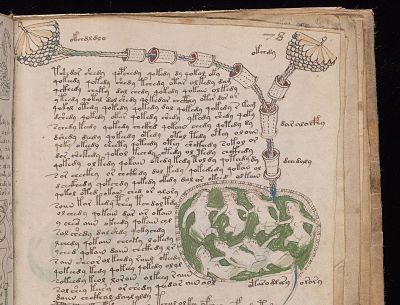
The mystery behind the Voynich Manuscript has led to many unsuccessful attempts to decipher it. AKINA HANSEN looks at the history and enigma surrounding this work.
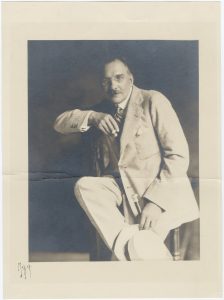
The Voynich manuscript is referred to as the world’s most mysterious book. It was rediscovered in 1912 by a Polish rare books dealer called Wilfrid Voynich and its text has since baffled and eluded scholars, linguists, and cryptologists alike.
Since its rediscovery, the origins and content of the manuscript have been the source of many theorisations. The Voynich manuscript is not written in any known script or language – so it is referred to as ‘Voynichese’.
It’s widely accepted that the manuscript is written in what’s called a substitution cipher. This is a type of code where letters of an alphabet are swapped for made-up ones. The difficulty with the Voynich manuscript lies in the fact that the language in which it is written has yet to be deciphered.
This has in turn led to a litany of claims about its origins and creator – from being credited to Leonardo da Vinci to Roger Bacon – yet every theory has consistently received scepticism or has been debunked by various scholars.
Chemical analyses of the parchment were conducted in 2009 and indicated that the oak gall ink and the mineral and botanical pigments on the manuscript were consistent with medieval recipes. Additionally, Carbon-14 analysis of the manuscript dated the text to between 1404 and 1438 – therefore ruling out the likes of da Vinci (born in 1452) and Roger Bacon (died in 1292) as possible authors of the work.
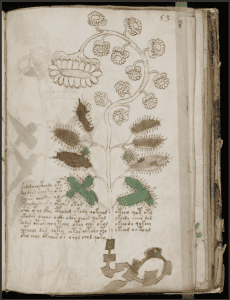
The book contains 246 pages of bound parchment made of calf skin, and its script runs from left to right in short paragraphs with earthly and majestic illustrations interspersed throughout – these include dragons, plants, planets and naked figures. Going off the illustrations, scholars have suggested the manuscript appears to be divided into six sections: herbal, astronomical, biological, cosmological, pharmaceutical, and recipes.
Since 1969, the manuscript has been kept at the Beinecke Rare Book & Manuscript Library at Yale University. But the events leading to it’s arrival at the university are just as enigmatic and hazy as its contents.
 The little we do know from historical records is that the manuscript was in the possession of Emperor Rudolph II of Germany during the late 16th century. According to a letter written in 1665 by Prague scientist Johannes Marcus Marci to alchemist Georg Baresch of Prague, the Emperor purchased it for 600 gold ducats under the belief that it was the work of Roger Bacon. From there it appears to have been passed on to Rudolph’s court chemist and pharmacist Jacobus Horcicky de Tepenecz, whose signature is detected with ultraviolet light on folio 1r of the manuscript.
The previously aforementioned 17th-century alchemist Georgius Barschius went on to own the manuscript. But its trail from then till 250 years later goes cold until it was rediscovered by the bookseller, Wilfred Voynich, who purchased the manuscript in 1912 from the Jesuit College at Frascati in Italy. The manuscript was then purchased from Wilfred’s widow by an antiquarian bookseller named H P Kraus, who then donated it to Beinecke Library in 1969.
Over the last century there have been many attempts to decipher the manuscript, yet each attempt has been debunked or highly scrutinised. The executive director of the Medieval Academy of America, Lisa Fagin Davis, worked at the Beinecke Library and has been critiquing theories surrounding it since she was a PhD student at Yale in the 1990s. Her expertise has allowed her to objectively review ongoing proposals, which she has consistently debunked or scrutinised.
In 2017 historical researcher and television writer Nicolas Gibbs claimed to have solved the mystery of the manuscript. He theorised that it was a woman’s health manual, that each character within its script represented a medieval Latin abbreviation, and that he had translated two lines of the script. Despite his claims, his work was met with scepticism and most experts agreed his theory was unfounded – with Lisa Fagin Davis arguing that his translation didn’t result in Latin that made grammatical sense.
 In 2019, a University of Bristol academic Gerard Cheshire claimed that the script was written in a proto-Romance language – an ancestor to all Romance languages (Portuguese, Spanish, French, Italian, and Romanian) – which was a late variety of spoken Latin during the classical period of the Roman Empire.
Lisa Fagin Davis argues that Cheshire’s theory is unsound since the proto-Romance language was a non-literary language that existed 1000 years prior to the creation of the Voynich manuscript – which has been attributed to the 15th century through radiocarbon dating.
Finally, in 2016 science professor Greg Kondrak and graduate student Bradley Hauer proposed that the manuscript was originally written in Hebrew, before being encoded. However, their method involved relying on Google Translate to decipher the script, and therefore Fagin noted this resulted in a loss of credibility.
Ultimately scholars are no closer to solving the mystery of the Voynich manuscript than in 1912, and so the quest to decipher the text persists. Currently, a complete digital copy of the manuscript is available online, enabling any curious and committed reader to take a crack at decoding its cipher.

0 Comments