




SYLVAN MISHIMA BRACKETT’s debut cookbook RINTARO demystifies Japanese food for home cooks with over 70 recipes for rice, simmered dishes, homemade udon, and grilled foods.
ICHIGO DAIFUKU
MOCHI-WRAPPED STRAWBERRIES
MAKES 8 STRAWBERRIES
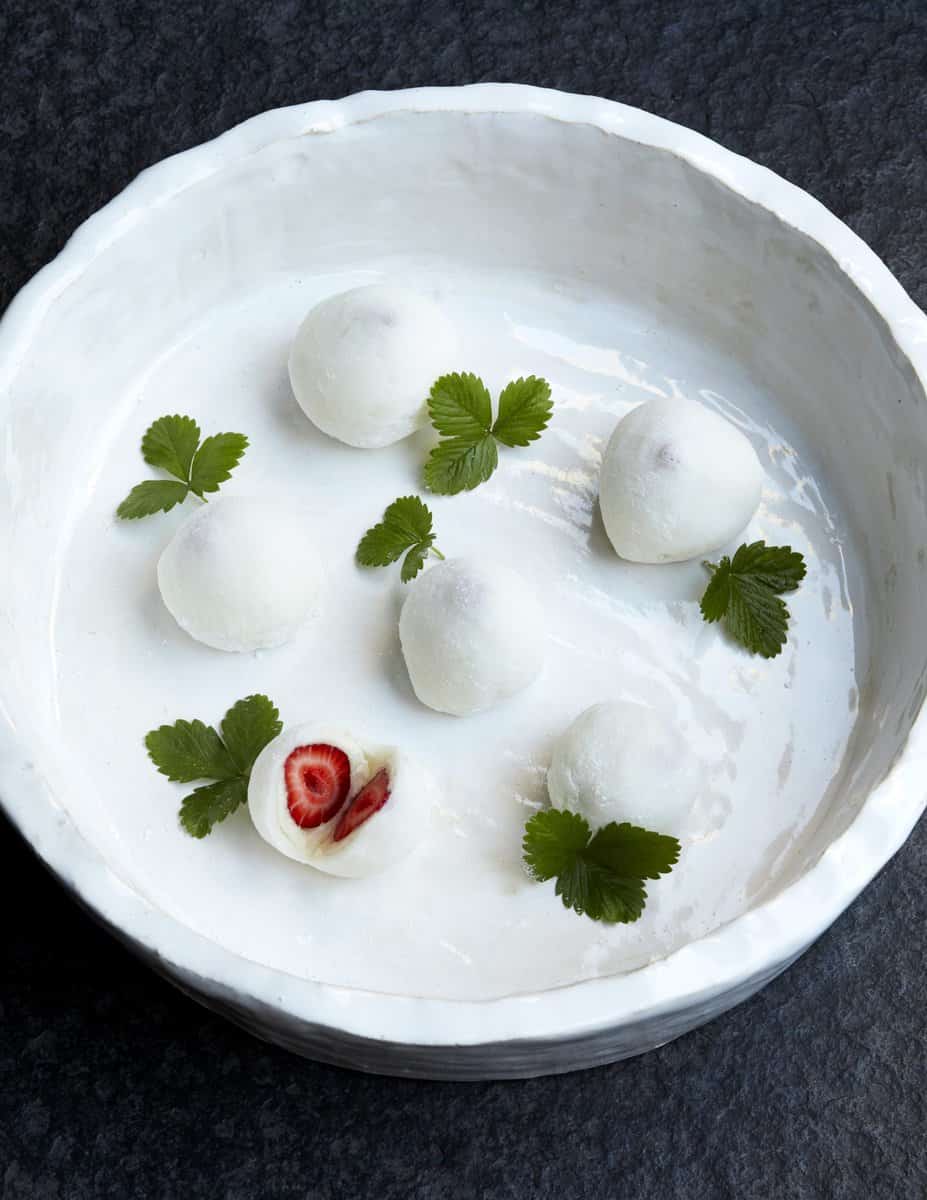
There is a bit of alchemy to ichigo daifuku. Rice, beans, and strawberries are transformed into snowy white balls with just the tips of the bright red strawberries showing through a semi-translucent skin of mochi. They look like a spirit from a Hayao Miyazaki movie. The mochi act as a blanket, trapping and intensifying the aroma of the strawberries. When you bite into a daifuku, the pent-up strawberry flavour is so strong that it almost tastes artificial. They are sensational. But wait to make them until you have glorious in-season strawberries. Look for ones that are red nearly all the way through and that you can smell from across the room.
Traditionally, the layer of bean paste between the strawberry and the mochi is made with dark red azuki beans. But former Rintaro Pastry Chef Junko prefers a sweet white bean paste called shiro koshian. It’s lighter in flavour, allowing the taste of the strawberry to shine, and she prefers the colour, as well. While making shiro koshian is not difficult, it is time-consuming. I’ve included store-bought sweet bean paste in the recipe below, but if you’d like to make it yourself, that recipe follows.
The trickiest part of making these is working with the super sticky mochi. To make it easier, generously dust the baking sheet and your hands with potato starch while you work.
6 oz / 165 g sweet bean paste (shiro koshian) homemade, recipe follows, or store bought
8 medium strawberries
MOCHI
5 tablespoons / 74ml hot water (from the tap is fine)
½ cup plus 1 tablespoon / 110 g sugar
Potato starch for dusting
1⅓ cups / 210 g mochiko sweet rice flour
¾ cup / 177ml cold water
If the bean paste is so wet that you can’t shape it into a ball by hand, place it in a saucepan over medium heat and cook it for a few minutes, stirring constantly to prevent burning, to evaporate some of the excess water. Then spread the paste on a baking sheet and let it cool to room temperature. Cover with plastic wrap and refrigerate until cold before using.
Rinse and dry the strawberries. Cut the stem flush with the top of the berry, but be careful not to cut into the strawberry itself. Once the flesh of the strawberry is cut, its juices will run, making the bean paste and mochi soggy.
Divide the paste into eight even pieces; lightly moisten your hands and roll each piece into a ball. Flatten each ball into a 2½-inch / 6 cm disk between your palms, remoistening your palms as needed to prevent sticking. Place a strawberry on top of each disk, stem side down. Push the bean paste up and around the strawberry, leaving just the tip exposed, then again shape into a ball. Transfer to a plate, tips up, and cover and refrigerate while you prepare the mochi.
To make the mochi: Bring a large saucepan of water to a boil over high heat.
In a small bowl, combine the hot water with the sugar and stir until the sugar dissolves. Set aside. Sift a generous layer of potato starch onto a rimmed sheet pan.
In a medium bowl, combine the rice flour and ¾ cup / 177ml cold water and knead well by hand until a smooth dough forms. Using your hands, divide the dough into four equal pieces; roll each piece into a ball. Flatten the balls into thin disks and punch a hole with your fin er though the centre of each disk so the mochi will cook more quickly and evenly. Add the disks of dough to the boiling water. When they float, use a slotted spoon to transfer to a medium saucepan (nonstick, if you have it). Mix well with a rubber spatula until you have a completely smooth dough.
Add one-third of the sugar water to the dough and use the spatula to lift the dough so the syrup runs beneath the dough (this will help prevent it from sticking to the pot). Set the pot over low heat and cook, stirring constantly. Keep mixing vigorously, scraping down the sides of the pan until the dough absorbs all the syrup and the texture is smooth and bouncy. Repeat this process three times until you’ve used all the syrup; the dough will remain very sticky but will become bouncier. Continue to cook over low heat, stirring vigorously, for 7 minutes. Use the spatula to scrape the mochi dough onto the prepared sheet pan, then sift more potato starch over the surface of the dough. Let cool to room temperature. Once the mochi has cooled, you need to work quickly, since it will soon become too hard to handle. Use a plastic bench scraper to divide the dough into eight equal pieces, each about 1¼ oz / 40 g.
To assemble: Remove the bean paste–covered strawberries from the refrigerator. Dust a work surface and your hands with potato starch (it’s crucial to handle the sticky mochi with starch-dusted hands). Working with one piece of mochi dough at a time, stretch it into a 2½ to 3-inch / 6 to 7.5 cm disk. Hold the mochi dough in one palm and place the strawberry ball, tip side down, into the centre of the mochi. Cup the mochi and the strawberry ball with one hand, as if you were holding a tennis ball. Use your other hand to stretch the mochi dough from all sides toward the centre, then pinch to close the gap and pinch off any e cess dough. Place the ichigo daifuku pinched side down on the starch-dusted work surface, then use both hands to shape into a ball, gently stretching the mochi down toward the bottom, as if you were forming a loaf of bread. Brush off any tarch from the ball. The daifuku are now ready to serve, and are best eaten the same day they’re made.
If you don’t plan to eat the daifuku immediately, dust them with potato starch and store in an airtight container. Keep the container in a cool spot; if the weather is hot, keep the container in the refrigerator.
This is an edited extract from Rintaro by Sylvan Mishima Brackett with Jessica Battilana
ABOUT THE AUTHORS
Sylvan Mishima Brackett is the chef/owner of Rintaro in San Francisco, which was named one of Bon Appétit’s Top 10 New Restaurants six months after opening in 2015. Sylvan was born in Kyoto and raised in Northern California. He is the former creative director at Chez Panisse, and trained at Soba Ro in Saitama, and at a Ryotei in Aoyama, Tokyo.
Jessica Battilana is a food writer, recipe developer, and author of Repertoire: All the Recipes You Need (Little Brown, 2018) and the co-author of over six cookbooks.



0 Comments