


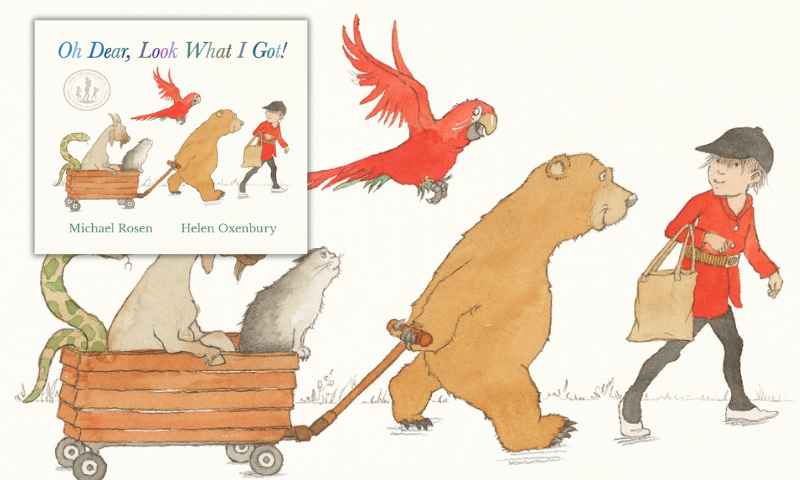
Oh Dear, Look What I Got! by MICHAEL ROSEN and HELEN OXENBURY is a classic new picture book by the creators of the bestselling We’re Going on a Bear Hunt. Read on for a Q&A.
What inspired you to create Oh Dear, Look What I Got!?
Helen: Oh Dear Look What I got! was very different to the stories I usually illustrate. It had a flavour of the Dr Suess books which I love! It was a challenge which I embraced. I saw in it an opportunity to illustrate the story in a different style.
Michael: The idea grew from a poem I wrote in ‘A Great Big Cuddle’ (Walker Books). We thought that it could be the basis of a picture book if there was some kind of interesting ending. So we worked on that, and you can see the end result in this book.
How did the idea to collaborate together again come about, 36 years later?
Helen: The idea of my working with Michael Rosen came about when my publisher showed me his new text for Oh Dear and suggested I might illustrate it. The challenge instantly appealed to me.
Michael: The idea for a collaboration came from our editors at Walker Books. I sometimes think that making picture books can be a bit like making films in Hollywood. Publishers are like producers who line up a writer, actors and crew. A publisher lines up a team made up of a writer, an artist, a designer and an editor. And like making a movie, if you’re the writer, you’re never quite sure what the team will be like.
How did creating this book compare to We’re Going on a Bear Hunt?
Helen: It was a very different approach. Bear Hunt was very concerned with landscapes where as Oh Dear concentrates on characters.
Michael: Similar, in that I worked on a text and it was handed over to Helen. With Bear Hunt, I worked on versions that I had heard from folksingers, American summer camp songs and from the Scout movement. With Oh Dear I worked on something that I had already written. The next phase in both books was over to Helen. As far as I know, Helen worked with designers and editors for some time and some of that meant that I got a message back asking me to tweak some words to fit Helen’s vision.
Can you share any memorable moments from working together on this project?
Helen: Michael and I don’t work together. He writes and I illustrate separately.
Michael: I find the most memorable moment for me is when I get to see the pictures for the first time. The thing is, I’m not as good as children are at looking at picture book pictures. I often miss the subtlety that Helen and others put in. So, first time round – to my shame – I missed the wonderful detail that Helen had done where when the shop-keepers hand over the package, you can see a hint of what’s in them each time! Shame on me!
Rhyme plays a significant role in the book. In what ways do you think it benefits early readers?
Helen: Young children love the sing song quality of rhyming text. They learn the words more easily, sometimes quite difficult words, which in a rhyming text become easy to remember. It boosts their creativity and literacy.
Michael: Part of the process of reading is prediction. Prediction is based in part on memory. Rhyme does this. You remember the first of, say, two rhyming words so that when the second one is coming up, you can predict and guess what that word might be. If you’re looking at the words, then this helps to teach children the way in which our writing system (‘alphabetic’), is a guide to how things are said. With English, this may not be perfectly regular, but ultimately, as readers, we learn the irregular and regular ones alongside each other. Rhyme helps children do this.
What do you hope readers take away from this story?
Helen: I hope as a first introduction to reading, Oh Dear will be full of fun and a jolly good laugh!
Michael: It’s very easy to sound high fallutin’ and pompous when interpreting children’s picture books, so you’ll excuse me if I lean a bit that way now. Very young children live in a world full of misunderstandings and mis-hearings. I heard of a child the other day who thought there was a ‘microwave’ and a ‘your-cro-wave’. Everyday, children are hearing and inventing these kinds of muddles. I guess this book lives in that world. We’re never quite sure who’s misunderstood what! Each time, it’s a mini-disaster and in books (not life so much) mini-disasters are funny. We might think, ‘Thank goodness it’s not me getting into that mess!’ As it’s a book for children, these mini-disasters don’t end up as a major unresolved disaster. We can leave that sort of plot to Franz Kafka! So in the end, in this book, after the mini-disasters, it all works out OK in the end. We might ask ourselves what do the happy endings in children’s books teach them? That difficulties can be overcome? That sorting things out is something worth aiming for? That we should carry a bit of hope with us as we face life’s challenges? Perhaps some of all that, eh?
ABOUT THE AUTHOR
 Michael Rosen is one of the most popular authors for children; his bestselling titles published by Walker Books include We’re Going on a Bear Hunt, A Great Big Cuddle and Michael Rosen’s Sad Book. A popular radio broadcaster, distinguished critic and academic, and multi-award-winning poet, Michael was appointed the Children’s Laureate from 2007 to 2009, and is now Professor of Children’s Literature at Goldsmiths, University of London.
ABOUT THE ILLUSTRATOR
 Helen Oxenbury is among the most popular and critically-acclaimed illustrators of all time. She has won the prestigious Kate Greenaway Medal twice. Her many award-winning books for children include We’re Going On a Bear Hunt, written by Michael Rosen, Farmer Duck, written by Martin Waddell and There’s Going to Be a Baby, written by John Burningham; as well as her classic board books for babies.

0 Comments