


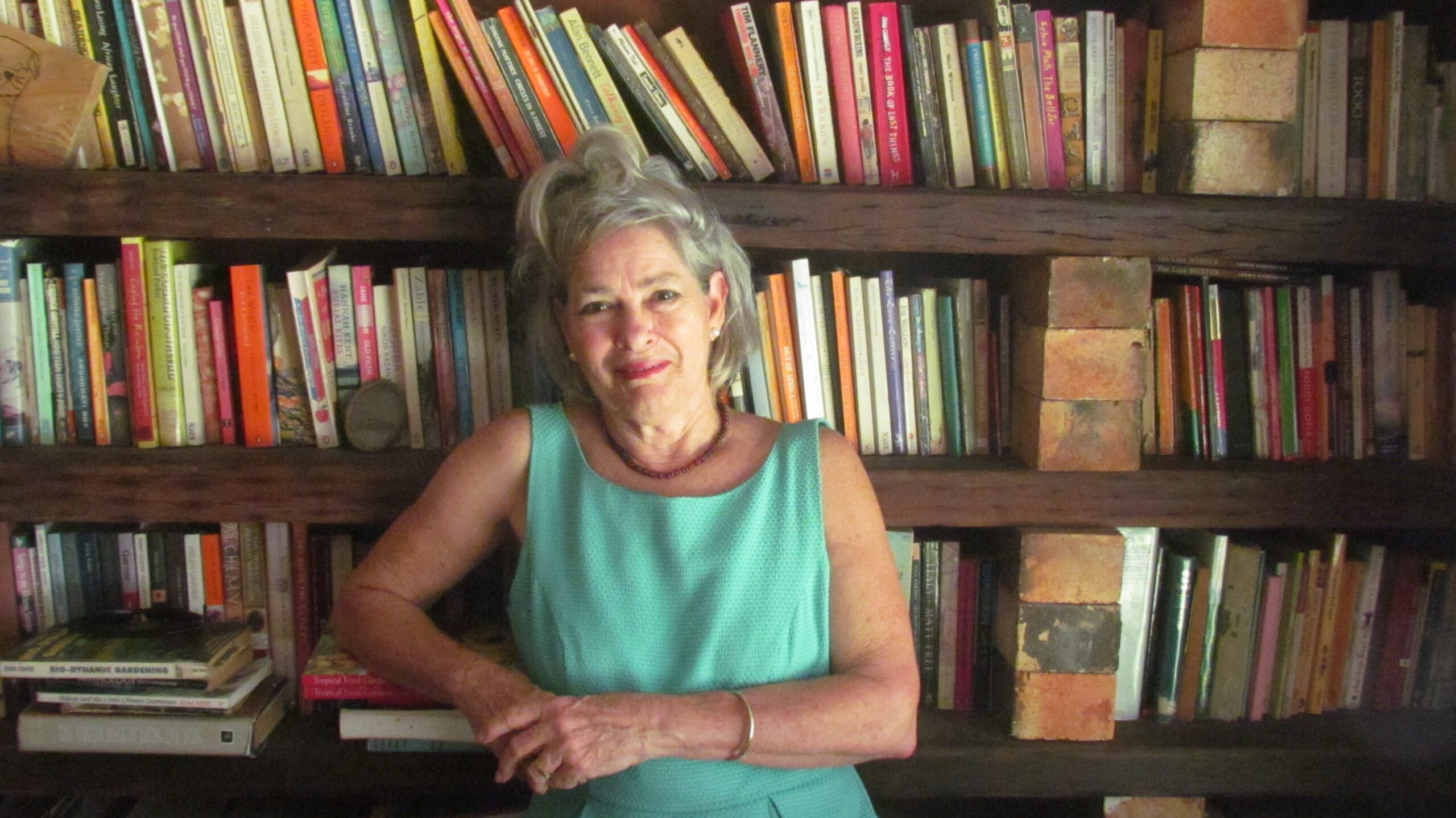
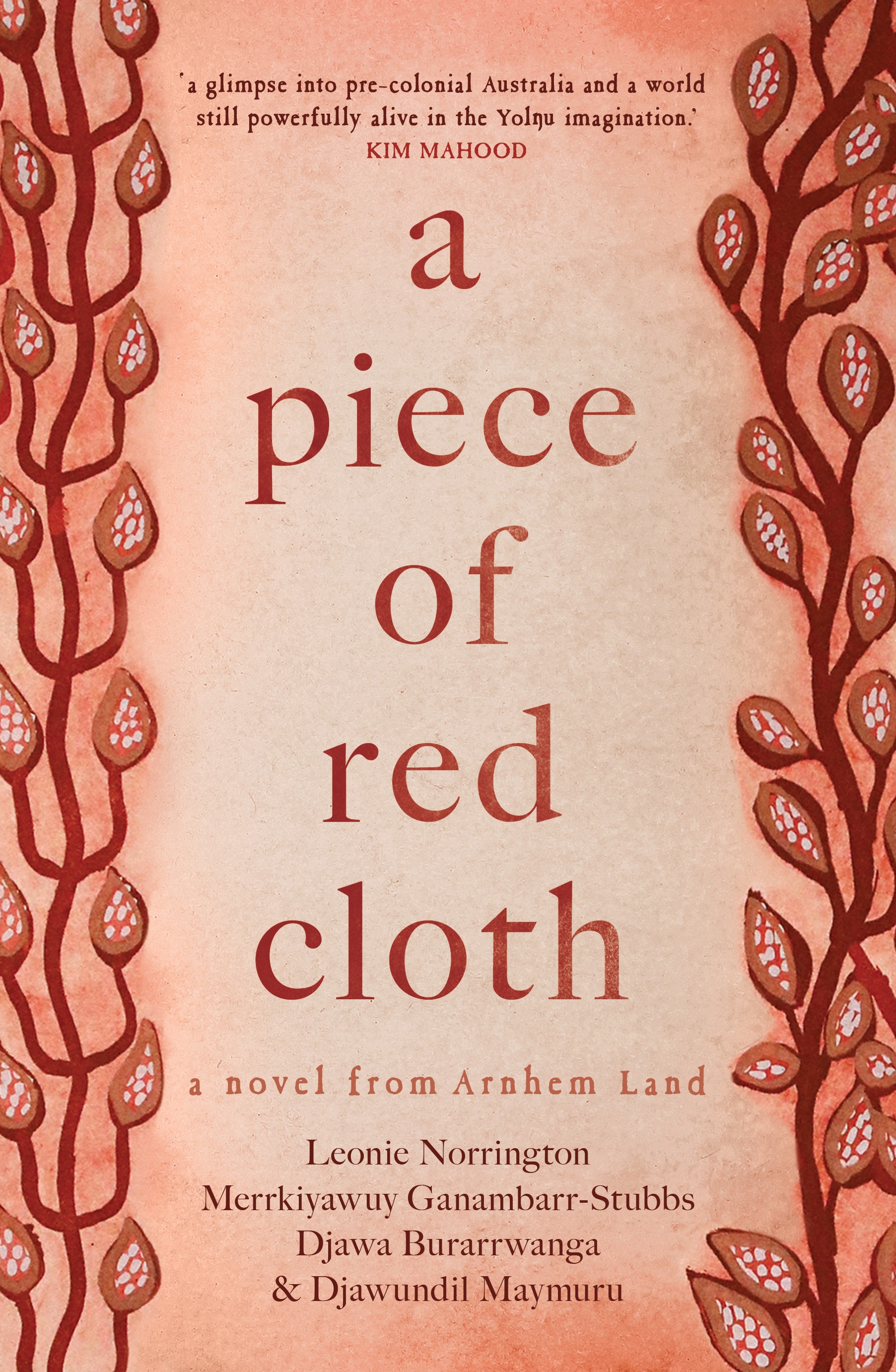
LEONIE NORRINGTON is a multi-award-winning north Australian author who grew up in the Barunga community in Arnhem Land. Her latest novel, A Piece of Red Cloth, is based on the oral history of the Yolngu people from north-east Arnhem Land and told through their eyes. We asked Leonie what books she’s reading and where she grew up.
Where did you grow up, and what are some of the most memorable experiences from that time?
I am the third of nine children in a fifth-generation Australian, Irish Catholic Settler family. I grew up on a remote community in Southern Arnhem Land – my father worked as the station and settlement mechanic. The Bush/Blanasi family of Yolŋu/Mayali language respectively in the Barunga/Wugularr area, adopted me along with my family. David Blanasi, a Mayali song man, and his youngest wife, Yolŋu woman Clare Bush, ‘grew us up’, taking charge of our education and being responsible to the community and the Country for our actions. Despite the invasion and subsequent dispossession, exploitation, abuse, slaughter, and ongoing subversion by religious, business and government agencies, the Mayali and the Yolŋu people still live on their Country and still engage in the pre-colonial narratives that legitimise their identity, their belonging and their relationship to the land.
I failed miserably at Western education and had great difficulty learning to read and write. But I grew up surrounded by an entanglement of Yolŋu, Mayali, Ancient Irish and Australian Irish Catholic settler stories. My biological dad told us stories about our people, bush people, who with hard work and ingenuity beat the environment, the powers that be, and were proud of their place on this land and in our culture. My biological mum told a combination of traditional and modern Irish Australian settler stories and historical stories; how the British caused the forced starvation of a million people and called it a ‘Potato Famine’. ‘We suffered from blight not famine,’ she said, ‘Food was plentiful. They just exported it all to England.’ In her stories, ordinary people like us suffered at the hands of evil imperialists and multi-national companies.
My adopting dad, David Blanasi, talked to us in Mayali, always in Mayali. With much courage, he slept alone near a grave to capture a brand-new corroboree, so that his ‘whitefella’ children could dance, despite not being born of the Country. My adopting mum Clare Bush told us ancient Yolŋu stories like the Djang’kawu Sisters dreaming story. Clare supervised me writing a collection of children’s books, set in remote North Australia, featuring Aboriginal and non-Aboriginal children. These stories turned into the award winning Barrumbi Kids series, (now a TV series) You and Me: Our Place, Look See, Look at Me, Crocodile Jack and Croc Bait.
Did your parents read to you or tell you stories? What do you remember about those moments?
All my parents were great storytellers.
My biological dad told us stories of floods and cyclones, of people getting thrown off horses and breaking their necks, of the idiots who thought that Fords were better than Holdens. We heard about children who were stolen by winds or tides, sucked into drain pipes or fell into mineshafts where they struggled, their cries unheard, they drowned alone, their bodies never found, their families wailing and cutting themselves with grief.
My adopted dad, David Blanasi told us stories and songs in Mayili, always in Mayili. The stories of the country had to be told in the language of the country. The reverence with which he told the stories, his actions and his body language filled in where our not quite perfect Mayili failed.
My adopted mum Clara Bush told us ancient Yolngu stories like the Djang’kawu Sisters. She was married into the Mayili language group of the Wugularr area, but, ‘I’m a Saltwater woman really,’ she would say with pride. She told us historical stories set during the ‘Macassan time’ or the ‘Killing time’. One day, while out hunting, she pointed to the large brown stain on a big flat rock and told us that at this spot some men on horse-back had hunted Mayali people, shot them, then piled their bodies up and burned them. We children, all of us, hated those evil murderers. We did not understand it as a story about black and white people. To us the story depicted good and bad people. Clara also told us exciting frontier stories about heroes who against all odds won against the invaders and those who had broken the Law.
My biological mum was a great storyteller too. Every night she would put on a classical record and tell us stories, all nine of us snuggled up on the floor in front of her, big kids playing with little kid’s hair or tickling their backs to keep them still. She loved the Grimms’ fairy tales. One night she was telling us the story of the ugly duckling. We were at the point where the little ducking was out in the cold, nearly dying, when my baby sister scoffed, ‘That’s gammon. You can‘t die from being cold!’ We had no concept of cold. In our country it rarely gets below 20 degrees. We knew you could die from heat. But dying of cold? Pahh.
So Mum stopped the story. She got up and changed the record to Hall of the Mountain King. She sat down again, waited for the dramatic music to take hold of us, and told us about when she was a child. How, when the Japanese invaded, she was evacuated from New Guinea with her mother and little sister while my grandfather stayed behind. How, when they got into Australia my grandmother was classified as a single parent so her children were taken away from her. My mum was six and her sister four. They were sent to live in an old stone convent where the floors and the walls were made of black ice.
Mum wasn’t trying to tell us a story about pain or suffering, she was telling us how it feels to be cold. But through her story we came to understand cold, not just the physical cold that cuts through your skin and makes your bones so brittle they’ll shatter if you run, but the cold of loneliness and abandonment; the real story of the ugly duckling. Unlike the story of the ugly duckling, which made no sense to us – ducks are something you eat, not feel sorry for – this was a story we believed – it happened to our mother. We knew instinctively without experiencing it ourselves, to fear that kind of cold, not the physical cold, but the coldness of being alone and shunned.
What were your favourite books or stories as a child?
I loved Seven Little Australians (there were seven of us at that time) and My Side of the Mountain inspired me to sleep alone in the
bush, something I still love to do.
What are you reading now, and why?
I’m interested in the places where language and cultures meet, especially how people use language and story to bridge cultural differences or to make statements about their separateness. I’m reading Plainsong by Kent Haruf, Thirty-Two Words for Field by Manchan Magan, The Wren, The Wren by Anne Enright and How to Build a Boat by Elaine Feeney.
Who are the Yolngu People and can you tell us about the inspiration behind your novel?
Yolngu people ‘come from’ or ‘are’ the Country of north-east Arnhem Land or Miwatj. My adopted mother, Yolngu woman Clare Bush, followed the complex ceremonies and observances of her traditional Law. She also worked as a nurse and educator within the mainstream Western health and education systems. She supervised me writing a collection of children’s books because she believed that personal experience or its close affiliate, storytelling, could cure racism. As Clare grew older and less mobile, she watched many Australian TV series and films that included Aboriginal characters and regularly identified the persistent, negative and patronising attitudes toward traditional Aboriginal people in those narratives. One day, while I was visiting Clare, she said, ‘I want you to write the true history of Australia, the proper one, not that “Captain Cook” one.’ Her ‘true’ history was pre-colonial history.
At first, I panicked. No! it is impossible! I can’t! I believed I could write children’s books about children like me and my friends growing up in a remote community based on my personal experience, but I didn’t think I could imaginatively experience pre-colonial Yolŋu life well enough to do it justice in a historical novel. I tried to tell Clare my concerns, but she just scoffed, ‘I’ll tell you the story. You write it down. We read the story to the right people (the Yirritja Elders who own the Baijini/Macassan stories from coastal Arnhem Land), they make the changes they want. You make a book.’ So, despite my disconcertment, I wrote an outline and some chapters for a historical novel based on a story Clare often told of a young girl who an evil Macassan captain kidnapped. In the story as in real life, the girl’s family retaliated by killing the captain and crew, rescuing the girl and refusing all Macassans access to the trepang sites on their country evermore.
Then Clare passed away.
After a few years, Clare’s families asked me to continue writing the book. But how could I write the story without her guiding hand? How could I get permission from the Elders who owned the Macassan time stories without Clare’s legitimating introductions? Then one day, when I arrived to visit my family at Wugularr, a new movie had the community buzzing with excitement. That evening we took the TV outside and lying on blankets in the cooler night air, we watched Ten Canoes (De Heer, 2006). The film had everyone engrossed –adults and children alike – their pride and joy in reliving their ancestors’ lives was palpable. All through that night and the next day, people talked about the movie and how it related to and affirmed their understanding of themselves and their culture today, in the modern context. It occurred to me that the humans and non-humans who populated pre-colonial Australia are a constant source of inspiration, and fundamental to how these Aboriginal families understand themselves today. Meanwhile, mainstream Australia has never had to try and experience the lives and loves of the people who lived in Australia before colonial times, let alone have any notion about how important these pre-colonial narratives still are to people who live in Australia in our modern times. I realised why Clare wanted me to write ‘the true history, not the “Captain Cook” one’. A Piece of Red Cloth is based on the outline I wrote with Clare and expanded into a novel under the supervision of her sisters Muluymuluy Marawili and Mulkun Wirrpanda (deceased) and the story holders in the Yirrkala area; Merrkiyawuy Ganambarr-Stubbs, Djawa Bururrwanga and Djawundil Maymuru.
A Piece of Read Cloth is based on the oral history of the Yolngu people from north-east Arnhem Land – can you tell us about the collaboration process of writing this book and its significance?
Narratives created in collaboration with and under the supervision of the knowledge holders who are the ‘us’ within these stories allow Aboriginal people to take control of the way they and their ancestors are represented. Collaboration is more than just gaining permission to use a story. A Piece of Red Cloth is based on a traditional story about a young woman getting kidnapped by foreign sailors. This story is told and owned by the people who are the land all along the coast of North Australia where sailors from what is now Indonesia came to trade. This traditional story continues to be told in song, dance, historical oral histories and in painting. Paintings that depict this story are held in state and national art galleries and the story is told in various historical and academic sources. My adopted mother, Clare Bush, and later her sisters Muluymuluy Marawili and Mulkun Wirrpanda (deceased) and the Macassan Time story holders deliberately chose to have me write the story as a historical novel in the English language so that it could reach a Western educated audience.
I did the initial outline of the book with my adopting mother Clara Bush. I knew Clare spoke Nunggubuyu and had family in Numbulwar, so I started my search for people to supervise my writing the novel in Numbulwar. When I rang the Numbulwar Language Centre cold, I felt my lack of connection keenly. But I had no choice, I didn’t know anyone who had links to that organisation who could introduce me. However, as soon as I told the lady who answered the phone my name, she exclaimed, ‘Leonie Norrington? Croc Bait? The Barrumbi Kids? Yes, come. We translated Croc Bait into Wubuy. The kids will be excited to meet you.” I felt relieved. I might not have known anyone at the Language Centre in the flesh, but they knew me, through knowing my words. On the phone, I explained that I wanted to write a book set near Numbulwar during Macassan time, and asked if she thought it might be possible. ‘Yes, come,’ she said. ‘We can talk about it. We can put Wubuy words in the story.’ I tried to tell her an outline of the story, but she just reiterated that I should come (a more than 10-hour drive for me), and then we could sit down and make a decision about whether or not I should write the story.
When I arrived at Numbulwar, the senior women who worked at the language centre had already discussed my project and had organised two people to supervise my writing. They were, Jangu Nundhirribala, a Wubuy translator who often worked on bilingual projects – a slight woman, white haired and dignified, with a ready smile, and Nyalik Murruŋun, the Traditional Owner of the land on which the story is set – a distinguished elderly man, debonair, with his shirt buttoned up to the neckline and long trousers. Introducing myself, I told them about how my adopting mother Clare Bush had grown me up, and how she wanted me to write a novel based on the true story of a girl who a Macassan captain had kidnapped during Macassan time, long before the British invasion. They looked at each other and laughed. ‘I told him,’ Jangu said. ‘I said to him, “that Leonie Norrington, she was grown up on Country. The Old People taught her to write them books Croc Bait and The Barrumbi Kids.”‘
‘Ma’,’ Nyalik said, keen to get to work straight away. Clare and I had already created a detailed plot of the story, so I told them a synopsis of the novel. They identified the story as a true story and an ‘open’ story, and agreed that it could and should be available to a wider audience. I elaborated then on the story, telling them the narrative with all its intricacies. ‘Whose story is that?’ Nyalik said. Without much thought I blurted out ‘A made-up story. A story like a movie.’ That is how, up to this point, I had been explaining this project to myself and others. As I said the words however, I began to have doubts. A very short but deep silence ensued. ‘A liar one,’ Jangu explained and Nyalik nodded, understanding. Trying to regain some credibility, I prevaricated. ‘Little bit liar, but based on that true story of that girl the Macassan captain kidnapped.’ Then to bring the focus back to the ‘true’ story, I asked, ‘Where did that story happen?’ Nyalik took out his phone and with practiced ease pulled up Google maps and showed me where the people were living when the Macassans kidnapped the girl. He looked me in the eye and said seriously, ‘It’s alright. I can meet with you now,’ he said, ‘to put you on the right track, you know. But we can’t talk serious here.’ He made it very clear that any significant discussion and approval for the story had to be talked about on Country. ‘You have to go there so the Old People can hear what we’re talking about. It’s their country too.’ I looked at the map again, calculating. Nyalik’s homeland was at least 200km away as the crow flies so probably four or five hundred kilometres on a rough four-wheel drive track. We would need a few four-wheel drives to ensure we could take him and his family. We would need camping gear and plenty of food, risk management forms … ‘When?’ I asked. ‘Dry season,’ he answered.
Late that afternoon, one of the women from the language centre, Hilda Ngalmi, came to take me hunting. She said the women at the language centre wanted to use the novel to present Nunggubuyu culture and language. They wanted the women in the novel to do ‘open’ women’s and baby’s ceremonies and to show how to hunt and cook food from the mangroves, the beach, the bushland and the billabong. That first day Hilda took me out onto a huge mangrove mudflat to collect mud mussels. Hilda conversed in sign, pointing with her lips to show me the mud mussels, often forced to poking with her digging stick before I could see the tiny slit of shell exposed above the wet grey earth.
For the next weeks, Jangu, Nyalik and I met in the breezeway near the language centre and discussed the storyline. Nyalik referred often to Google maps, always connecting the spoken story back to its embeddedness in Country. For example, when we talked about the older women taking the young women away when the Macassans arrived, he showed me on the map the actual billabong they retreated to. Jangu and Nyalik’s attitude showed they were proud of the story and their ancestors. When we talked about how, when the Macassans kidnapped the girl, the Nunggubuyu people retaliated, killing the crew and burning the boat, Nyalik said, his pride palpable, ‘They didn’t mess around, those Old People.’ As I told the story, I kept asking them if it sounded true. ‘Is that what they did back then?’ Nyalik and Jangu corrected the story with confidence and explained in detail the cultural etiquette that surrounded the events. I wanted to describe an Old Man getting ready for an important meeting and asked if I could talk about him painting himself and bringing his totem into his body. Nyalik said ‘That’s good. The kids can learn the right way. Some of these kids, they don’t know.’ I asked, ‘But do you think those old people who lived long ago would be okay with me saying that?’ ‘We will go there, [they will listen themselves]’ Nyalik said, patiently reminding me that we had to go and sit with the ancestors, on Country, where they could approve or disapprove of the story themselves.
During that first visit to Numbulwar, Jangu and Hilda spent many hours educating me on various hunting techniques. They brought birdsong to my attention, pointed out the black line that showed a crocodile out on the ocean, and turned their faces to acknowledge a change of wind. They also insisted on taking me out to sit, our bare skin touching sand or earth, to be with Country. Growing up, Clare used to tell us we had to sit like this and ‘listen to the Country’ and ‘let the Country know you’. In all the places I went to read and edit the novel, the people who hold the Macassan time knowledge showed me the cultural norms they wanted represented in the novel, but they also took me to specific places to sit and be, without any overt teaching. For example on Elcho Island, Old Man Walung took me and a group of students and teachers to the significant Macassan sites. He told the stories in Warramiri and organised a corroboree so that the information could be presented in its proper context. His daughter Galalwuy insisted I watch her cook and share a sea turtle, insisted I taste the soup, the fat, the meat. She woke me up before dawn so I could sit and watch the sun rise over the ocean in silence, and walk with her on the beach near her father’s house in the moonlight, again in silence.
At Garig Gunak Bariu National Park after I read the story and incorporated the changes they wanted, Kathleen Cunningham and Dulcie Cunningham took me hunting for oyster to show us the traditional way of harvesting so I could add that to the book. They also took us to the places where their ancestors waited to see the first Macassan praus arrive each year so I could get the descriptions of that right.
While I was in Yirrkala I quite by accident met someone who changed the trajectory of the research entirely. In Yirrkala I met Clare Bush’s elder and younger sisters, Muluymuluy Marawili and Mulkun Wirrpanda. They told me that while Clare grew up in Numbulwar in southern Arnhem Land, and then moved to Mayili country in South-West Arnhem Land, her traditional country was in northern Blue Mud Bay in Yolngu speaking country. Up till this point I had set the novel in the southern part of Blue Mud Bay, closer to Numbulwar, in Wubuy speaking country. However, when the Yolngu Knowledge holders realised that my connection to the story and the country was through Clare Bush, they insisted that the setting of the novel be moved to Northern Blue Mud Bay and the Aboriginal language in the novel should be changed from Wubuy to Yolngu. But I had been working with the knowledge holders from Numbulwar for the past three years and I was worried that they might be annoyed. However, when I talked to Jangu Nundhirribala the lady I had been working with at Numbulwar over the phone and told her that I had met Clare’s sisters and that they thought it would be better if the book was set on Clare’s traditional country, she quickly agreed that the novel should be set in Yolngu country and use the Yolngu rather than Nuggubuyu language. One very important part of the collaboration was that once the book was completed, I had to read the novel to the Country, to the Old People who are the Country.
You are a multi-award-winning author – what inspires you to write?
I want to change the way that Australian literature is so Eurocentric and urban. Australian books that are set in the Australian outback or in bushland tend to present the bush as a dangerous place, full of dangerous people, a wilderness, a place that is ‘other’ – the kind of place urban (normal) people go to find themselves, or to deal with a personal challenge. I want to present the outback, as we who live here see it – as normal, comfortable, home – a place where our culture is immersed in the land, where our families are strengthened by our living layer upon layer, generation upon generation on the same country – a place where we rejoice in the changes of the seasons and the spirits that are the land.
Both Indigenous people and outback people are also often presented in literature as ‘other’. We are the strange ones, the exotic. I am inspired to write stories from our point of view so that our voices are the centre of the universe (so that the literary point of view is ours).
And can you discuss the power of storytelling?
I believe that humans beings sing, write, read and speak themselves into being. We understand ourselves, our place in society and our potential through story. The stories we live (that is, our personal experience) the stories we hear, read, and see around us, shape our worldview and our lives.
It is natural for humans to categorise – that is how our brains are wired. Creating categories makes humans successful, enables us to make decision quickly, to react in a dangerous situation or respond to an advantageous one. But it also means we categorise other people, by the colour of their skin, their history, their religion or their sexual preference. All Irish are all musical, Italians are all great cooks … Aboriginal people are all … We assume these categories based on what we see and hear in our lives and if we don’t hear or see stories that undermine these stereotypes, they become entrenched.
Stories are powerful because they can undermine these categories and stereotypes. Stories are imaginary but they hook into and become just like our real-life experience. They allow us to inhabit other lives, show us images and feelings we have no real-life access to and so stories can give us insight into and let us celebrate the sameness and differences of human nature.
Do you still have any of the books you read as a child?
No. All our belongings, except the dirty dishes in the sink got destroyed in 1974 when Cyclone Tracy hit Darwin.

0 Comments