




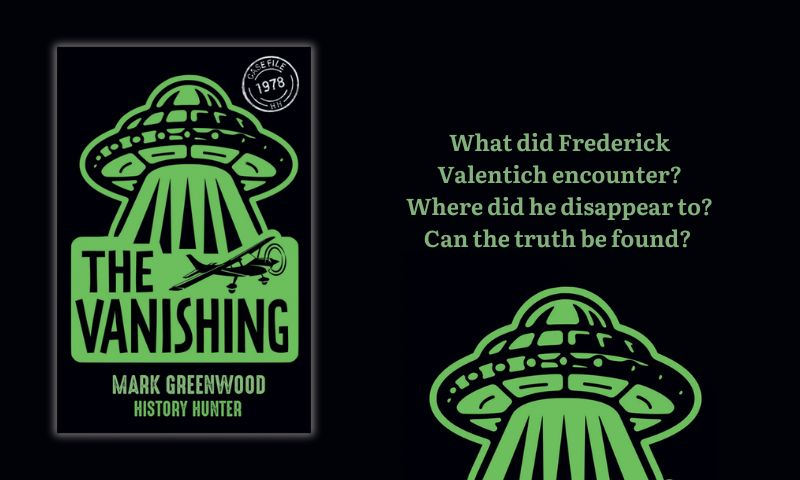
Author MARK GREENWOOD’s The Vanishing investigates the 1978 disappearance of a young pilot during a routine flight over a notorious stretch of water.
Good Reading for Kids asked Mark about the mystery surrounding Frederick Valentich and what he loves about history.
You’ve been described as a history hunter – what do you love about history?
I’m hooked on history. I’m curious about the past and enjoy researching puzzling cold cases. I’m drawn to well-known and little-known slices of history. Most of all, I love sharing the stories that I find. My task as a History Hunter is to fossick for stories that take readers on journeys of discovery to search for the truth. The disappearance of the young pilot, Frederich Valentich, has always fascinated me. The past is full of wonder, adventure and mystery. I was determined to delve into all angles of the story so that readers of The Vanishing could reach their own conclusions.
Who was Frederick Valentich and what initially drew you to his story?
Frederick Valentich was an ordinary young man from Melbourne who found himself in an extraordinary situation. In 1978, during a twilight flight from Melbourne to King Island in the Bass Strait, the young pilot’s eerie communications with an air traffic controller sparked one of Australia’s most enduring cold cases. Despite being assured that there were no other aircraft in the vicinity, Frederick Valentich continued to describe an Unidentified Flying Object before he reported having engine troubles. His last words, ‘…it’s not an aircraft’, are as mysterious today as they were the night he disappeared. Did Frederick Valentich encounter an intelligently controlled flying object? If so, his extraordinary conversation prompts the question that has intrigued humankind for centuries – are we alone in the universe? I was drawn to the mystery of The Vanishing to search for the truth.
What can you tell us about the mystery surrounding the disappearance of Frederick Valentich in your book The Vanishing?
Frederick Valentich disappeared during a routine flight over the Bass Strait. Over many years, reports of unexplained phenomena have earned the notorious stretch of the sea its nickname, ‘The Bass Strait Triangle’. Like the Bermuda Triangle and other places that seem to draw mysteries to them, ‘The Strait’ has a reputation for vanishing ships and planes. Did Frederick Valentich encounter a UFO, or did he misidentify what he thought he saw? Perhaps there are other explanations. Could government files be hiding the evidence? As a History Hunter, I enjoyed imaginatively reconstructing this perplexing case file to share the many theories about what may have occurred on Saturday, 21 October 1978.
Where did you get your drive for solving mysteries?
I view research as an adventurous journey of discovery that helps balance creative interpretation with historical authenticity. The exhilaration of unearthing fresh evidence fuels my search. However, history is not an exact science. There is so much we don’t know. We can only draw conclusions and make objective interpretations to tell a story about what happened. To bring historical characters and events to life through research is like excavating an archaeological site by brushing away the layers of information. But the goal of research isn’t just to gather documents and collect evidence. These are only the raw materials, not history itself. To tell a story like The Vanishing requires imagination, passion and enthusiasm.
During your research what was the most interesting fact you uncovered?
In the days leading up to, during and after the night Frederick Valentich vanished, hundreds of puzzling accounts of unexplained lights and strange flying objects came in from all over Victoria, Tasmania, the Bass Strait and King Island. The sheer number of sightings reported to government investigators, police and news media suggested something unusual was happening in the skies. Sceptics were not convinced. After so many sightings, they argued, why was there not one photograph? One of the most interesting facts I discovered during my research was ‘The Manifold Photo’. Only minutes before Frederick Valentich alerted the Melbourne control tower to his strange encounter, an amateur photographer was holidaying near the Cape Otway lighthouse. Roy Manifold positioned his camera on a tripod at the top of a cliff to take a series of sunset photographs. The unidentified object he captured just before Frederick Valentich vanished has been analysed by photographic consultants who determined it to be a solid structure. I was honoured to be given permission by the Manifold family to include the photo in The Vanishing.
Describe this book in three words.
Mystery. History. Truth.
ABOUT THE AUTHOR
 Mark Greenwood is a history hunter. He enjoys searching for lost explorers and glittering treasure, delving into baffling mysteries and investigating famous cold cases. His award-winning books examining history and multicultural themes have been honoured internationally.
Mark often teams with his wife, illustrator Frané Lessac, to produce books that promote an understanding of multicultural issues, such as Drummer Boy of John John, Magic Boomerang, Outback Adventure, and Our Big Island. Their other books include Ned Kelly & The Green Sash (winner of the WA Young Readers’ Book Award and Children’s Book Council of Australia (CBCA) Notable Book), The Mayflower and Midnight: The story of a light horse (also a CBCA Notable Book). Mark’s recent books include the History Mysteries chapter book series, Moonwalkers, The Book of Stone, Our Country: Ancient wonders and Our Country: Where history happened.
Mark’s books, The Legend of Moondyne Joe and The Legend of Lasseter’s Reef won the West Australian Premier’s Award. The Happiness Box was a CBCA Honour Book. Simpson and His Donkey was also a CBCA Honour Book and a United States Board on Books for Young People (USBBY) Outstanding International Book. Jandamarra, illustrated by Terry Denton, was shortlisted for the CBCA Eve Pownall Award and the NSW Premier’s Literary Awards for Children’s Literature. Boomerang and Bat was a CBCA Notable Book.


0 Comments