


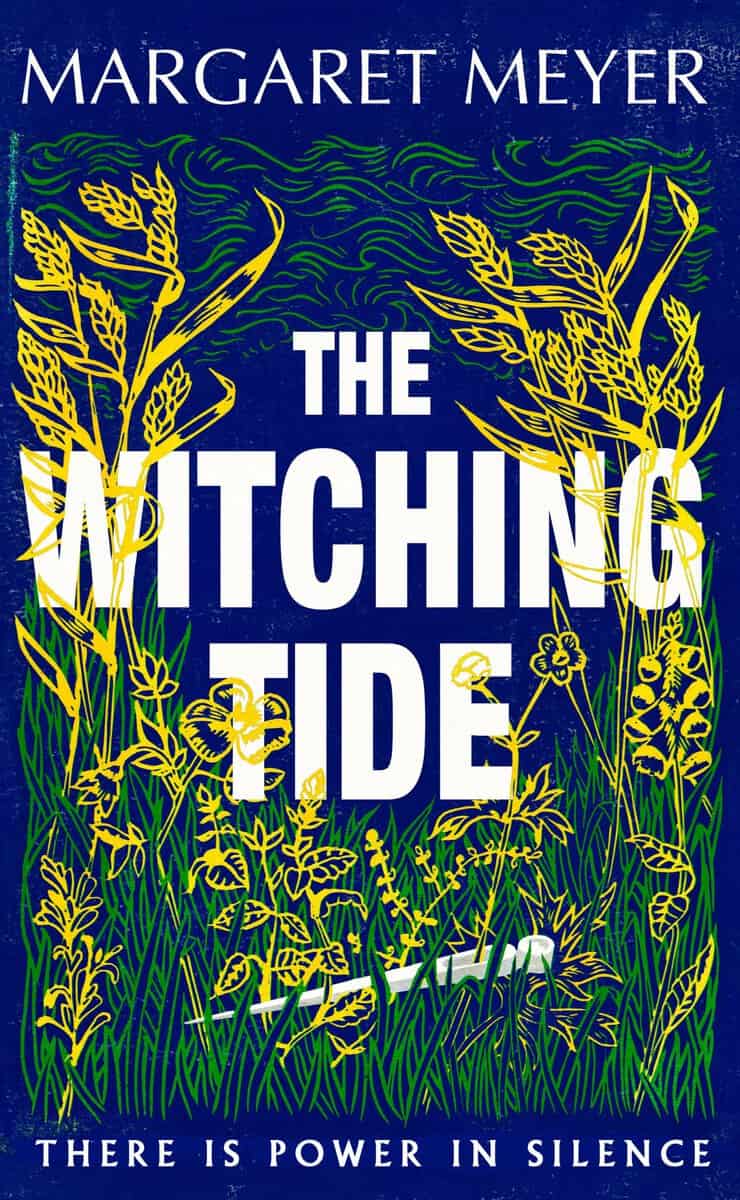
In her debut novel, The Witching Tide, MARGARET MEYER tells the story of a silent midwife hiding a secret and a witch-hunt that tears a community apart.
Good Reading caught up with the author to find out the inspiration for the book and witches she’d like to meet.
What motivated you to write The Witching Tide?
In 2016 I visited a local museum in Aldeburgh, Suffolk, and discovered a small display about the East Anglian witch trials of 1645-7. Although I knew a bit about this particular hunt, I hadn’t realised its extent. It was England’s deadliest: more than 200 lives were lost, most of them women, and all of them were innocent.
In Aldeburgh alone, seven women were hung in just one week. Later on, when I was doing my research, I was shocked to discover that only two of Aldeburgh victims were named. The names of the other five women were never recorded (though the names of everyone else involved, including the judge, the jurors, the gaolers, the tavern mistress who supplied food to the prisoners, the noose-maker and the hangman) were all written down.
I was so affected by the fact that not just these women’s lives but the fact of their existence had been totally extinguished, that I resolved to try and write about them.
 This book is set in 1600s England, so can you tell us about your research process when exploring this time period?
I started by reading everything I could find on that particular witch-hunt and its leaders, John Sterne and Matthew Hopkins, two ‘gentlemen’ from Essex. Although latest research indicates that it was likely John Sterne who started the hunt, Hopkins was the one who styled himself the ‘Witchfinder General’, implying he’d been appointed by Parliament, which he wasn’t. To understand why Sterne and Hopkins were able to drum up such momentum, I read more generally around conditions during the time of the English Civil War (1642-51), especially the lives of lower-class women. A book I love, and was very important to my research, was Jane Sharpe’s The Midwives Book, which has all kinds of detail about herbs and humoral medicine. I also visited and read various histories of the East Anglian towns my book is based on – places like Aldeburgh, Chelmsford, Dunwich, Ipswich, Lowestoft and Great Yarmouth. This was one of the most fascinating parts of the research.
Can you reveal any specific true events or characters that feature in the novel?
One thing that I hadn’t known when I started the research was that women were actively involved in the witch-hunts. Sterne and Hopkins each had their preferred women ‘prickers’ – experienced midwives who would examine the suspects looking for ‘witch’s marks’, which could be a freckle, mole, birthmark or skin tag. The practice of ‘pricking’ came from a belief that, when needled with pins or bodkins, these marks would not bleed. If their official prickers weren’t available, Sterne and Hopkins would sometimes involve local midwives to do the pricking.
I was so struck by the role of the prickers, I decided to make them the core of my novel. What must it have been like, to be enlisted to prick other women – especially women you might know? My main character, Martha Hallybread, is based on an actual pricker, Mary Phillips , although I’ve found very little information about her in the records.
Do you have a favourite part about writing historical fiction?
I love the research – it’s fascinating. I also enjoy the challenge of trying to recreate the ‘world’ of a particular time period. Often the smallest details can convey so much of what life was like long ago – someone’s favourite meal, for example, or a treasured possession.
The Witching Tide is a story about mass hysteria, so how did you approach writing such intense subject matter? Do you think of this has an element of a horror novel as well as historical?
The East Anglian witch-hunt took place at a time of massive upheaval in England. There were food shortages, outbreaks of disease, refugees pouring into already overstretched parishes. Against the backdrop of this perfect storm, it’s hardly surprising that people became as suspicious and fearful as they did. So, while I don’t think of The Witching Tide as a horror novel, aspects of what it portrays are, and were, horrifying. Some parts of the novel were really harrowing to write, but any time I had doubts or felt overwhelmed by the material, I reminded myself of those Aldeburgh women and made myself keep going.
Witches are quickly turning into icons. What do you personally think makes them so enduring?
Winston Churchill famously said that ‘History belongs to the victors.’ It’s not true. Our interest in witches and witch trials is powered by a genuine desire to reclaim these aspects of history, to understand why women were singled out in the way they were, and correct imbalances in the historical record. As well, witch-hunting is not a thing of the past – it’s still going on today, and people (women) in many countries are still losing their lives because of it. All around the world we’re seeing women’s rights and freedoms being curtailed or over-turned. The figure of the witch has always been an affront to patriarchal values, an icon of subversive power. It’s not so surprising that we turn again and again to the figure of the witch for inspiration, and I don’t see this changing any time soon.
Is there a ‘witch’ character, real or fictional, that you’d like to meet?
I’d be fascinated to meet the witches from Shakespeare’s Macbeth – I’d like to know their backstory, and what they make of having such an influential role in the play.
What do you hope readers take away from this story?
The Witching Tide has been described as a #MeToo novel for 1645. It tells the story of Martha, a devoted servant and midwife, who, against her will, becomes a witch pricker. Martha can’t speak and communicates in sign language. Although this proved a technical challenge to write – how to do dialogue scenes with a character who can’t speak? – her voicelessness is very much standing in for the way women have been quelled and silenced throughout history. I hope readers might be as galvanised as I was by the parallels between then and now. We have to keep speaking up, for ourselves and our rights! I’ve dedicated the book to the women who lost their lives in 1645, but I very much wrote it with today’s women in mind.
Do you have any projects planned for the future? Is there a period of history that you are desperate to write about?
I’m working on a sequel to The Witching Tide which will tell the stories of other women owners of the poppet – both before and after 1645.
I’m fascinated by Anglo-Saxon history, and also the period in (9th -10th centuries) when the Danes ruled quite a big chunk of eastern England. I really want to write about this period. I just wish someone would invent a time-machine so that authors could go back in time – even for a few hours – to find out what it was really like …
You might enjoy this book if you enjoy books by Stacey Halls, Maggie O’Farrell, Jessie Burton, or Hannah Kent.


0 Comments