



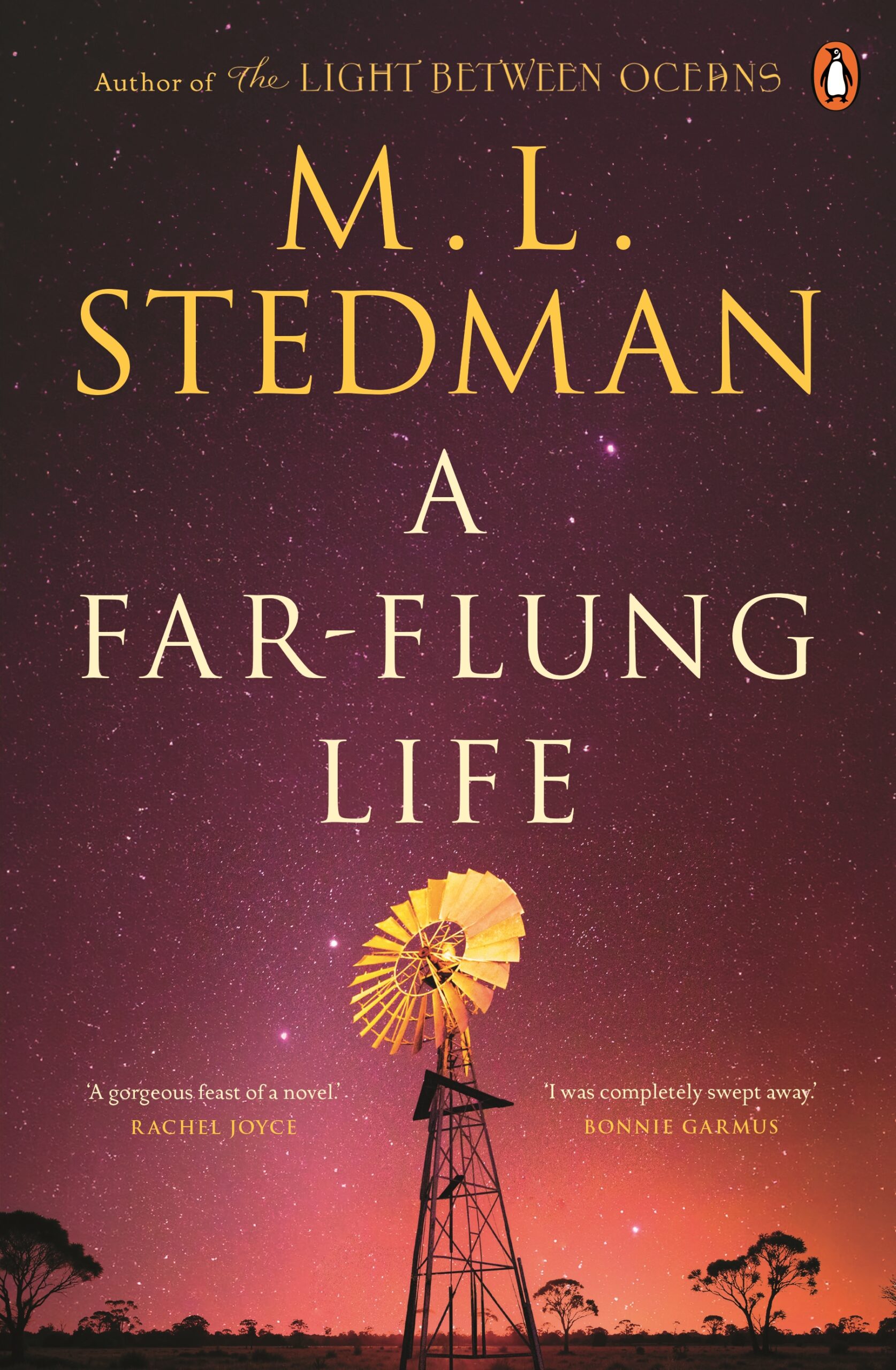
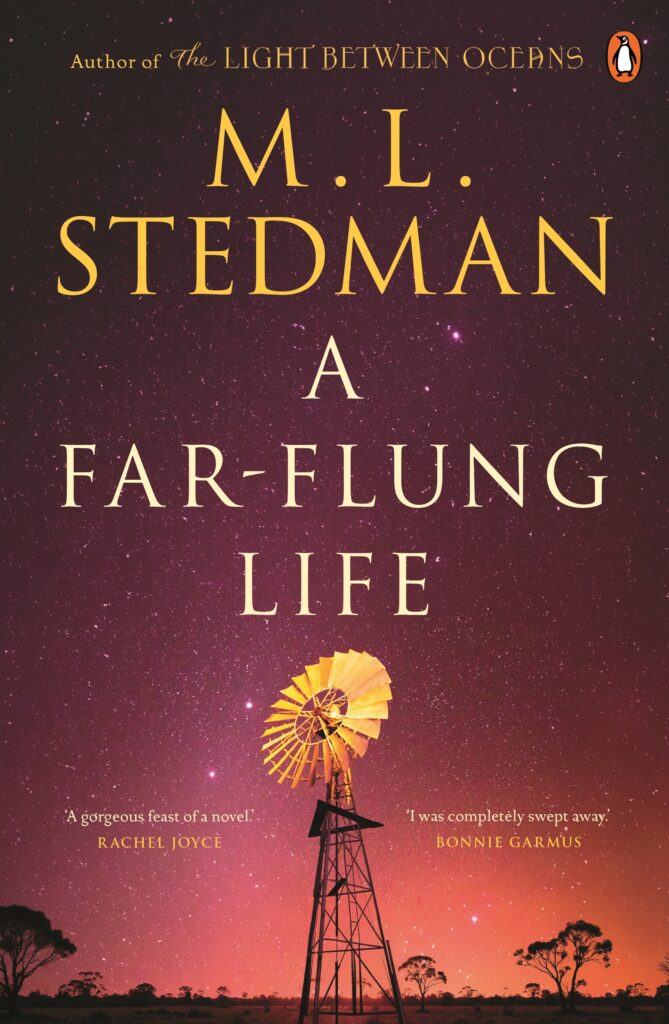
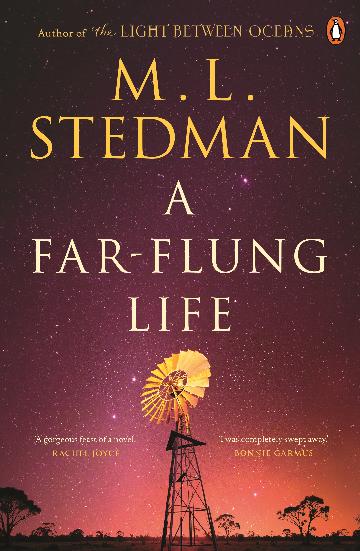
M L STEDMAN is the best-selling author of The Light Between Oceans. Her next book A Far-Flung Life explores a close-knit family on an isolated sheep station in rural Western Australia, and the secrets they must keep to survive.
Read on for a Q&A with the author.
MEET M L STEDMAN
What inspired you to write A Far-flung Life?
As with all my writing, there was no particular inspiration – story very much emerges as I write, rather than as a result of some grand plan. I usually don’t really know what I’m writing until I’ve written it. Setting is always crucial for me, so the Western Australian landscape was there from the beginning. I wrote the book over a very, very long time: it grew and took shape organically over years. Characters turned up bit by bit, often just materialising when I started to imagine a scene. The process is quite mysterious to me.
 You gained international success with The Light Between Oceans, which was released back in 2012. As there have been several years between your two books, have you noticed any significant changes in your writing process? Or has the publishing industry changed much since your first book?
The way I write hasn’t changed much, except for the fact that it took a long time after my first novel came out before I could find quiet time and space again, which for me is essential. I think the whole world has changed dramatically since The Light Between Oceans came out: the publishing industry, like everything else, has been massively affected by technology in all its forms.
This story follows several different characters across generations, so which was your favourite character to write?
I enjoy sinking into the life of each character, and while I’m thinking their thoughts, each character has to be my favourite – I have to see the world from their point of view, understand why they do what they do. That said, it was perhaps easiest to write Pete Peachey, the Roo Shooter, who has such a wise take on life – it’s a very reassuring mindset to inhabit.
The Light Between Oceans is set on an island, and A Far-Flung Life is on a rural sheep station. There’s a clear connection between such remote and sweeping settings out in nature, so how does placing your characters in isolation incite the conflict in your narrative?
I wouldn’t say that isolation incites the conflict, it’s more that it intensifies it. It concentrates focus, like the sun through a magnifying glass, burning into them. With no distractions and no physical escapes, issues are distilled. The physical isolation mirrors the isolation characters feel as they are trapped within their dilemmas, unable to unburden themselves because to do so will harm an innocent party. In very small communities, there’s nowhere to hide, no sanctuary of anonymity, which raises the stakes.
Both of your books are historical fiction set in the past, with The Light Between Oceans in the early 1920s and A Far-Flung Life in 1958. What research did you do for this novel, and how do you find your voice as an author in a time that is so different to our own?
Research is one of my favourite aspects of writing. For this book, I travelled a lot within Western Australia, read a lot, listened a lot: to people; to the sound of the wind in the trees and the night creatures of the Australian bush; above all, to the deep silence that envelopes the far-flung places I describe. I spent a long time in archives, exploring records that left my fingers covered in the red dust that filled the pages. I was incredibly fortunate to speak to pastoralists and geologists and other people of the generation in which Australia ‘rode on the sheep’s back’, who recounted their stories and guided my research. I studied rocks and sheep and mining practices. I visited various stations, sometimes ‘hitching a ride’ on small aircraft visiting remote places, or delivering supplies to a station cut off by floods.
As for the authorial voice – it just emerged naturally, helped by recalling the voices that surrounded me as I was growing up in WA, as well as listening to people – either the ones I spoke to directly, or those in archive recordings of voices now long gone.
 Your latest novel focuses on a family experiencing a series of terrible tragedies, starting with the traumatic car crash that affects the whole MacBride clan. How do you approach the process of writing such a confronting story and where do you find the hope in this narrative?
As I mentioned, I don’t start out with a plan. Things turn up on the page. Because I don’t know what’s happening next, it can be very draining to write scenes in which terrible things occur. As I stayed with the characters, I got to know them, got to understand their lives, both as seen by those around them, and as they saw themselves. They changed, they developed. I don’t write chronologically, so whatever I write starts off in a sort of universal ‘now’. All the scenes co-exist, and it can take years before I know the order in which events happen, or why. In life, we can’t tell our own future, and nor can these characters. And the way I write, for great swathes of time, I can’t tell their future either.
I think the book is founded on hope, which comes from a belief in the fundamental goodness of humans, and the healing power of time. As long as society prizes forgiveness above blame and retribution, and as long as the past is allowed to fade into the past and allow people to do their best to live well and make amends for mistakes, there’s hope to be had.
You’ve mentioned the term ‘forgetment’ in connection to A Far-Flung Life, as a word for the things we forget. Could you expand on how both forgetting and memory is central to this story.
The concept of ‘forgetment’ is foundational to the book. Our life is shaped by what we can or can’t remember, and what we can or can’t forget. I’m fascinated by exactly how the ‘known now’ becomes the ‘lost past’. The book makes a reference to Sleeping Beauty, in which a whole castle disappears from the memory of a town. The fact that we accept that story so readily bespeaks how familiar we are of the process of ‘un-knowing’.
I’m also interested in the role of forgetting in forgiving (there’s a reason we say ‘forgive and forget’). Humans have been outsourcing memory since they first drew on cave walls. Writing supercharged this, and relatively recently, technology has increased it exponentially, so that even the most trivial details are now indelibly recorded and subject to instant recall, without effort or context. Does this mean as a society we’re losing the ability to forget, or at least, as individuals, to choose what is remembered about our lives? If every fault or grudge or transgression remains fresh in our minds, does it diminish our ability to forgive? And what is this doing to the human need for spontaneity, and the inevitability that everyone will get things wrong sometimes? I think it was Jung who said that to be perfect means giving up on being whole, and to be whole means giving up on being perfect. I wonder whether technology is holding us to a standard of absolute perfection that is simply unattainable for any ordinary person.
Did you get hands-on with this novel and try sheep-shearing as part of the experience? Also, is Meredith Downs based on a particular location in the WA outback?
I did have a very brief taste of shearing a sheep (under extremely close supervision!). Meredith Downs isn’t based on a particular place. I travelled around the state over the years, so absorbed various details here and there. That said, almost every WA reader I’ve spoken to tells me they have a very clear idea of where the station is, and what their reasons are (no two readers point to the same part of the map, though). I take that as a compliment, because it means they’ve really inhabited the story.
What do you hope readers take away from A Far-Flung Life?
I think it’s possible to read the book on many levels – as a page turner, or an exploration of WA in a particular era, or as a philosophical exploration of time and fate and memory and how they shape us. A lot of the issues, particularly about what information is shared with whom and when, and who has the right to love and be loved, have contemporary resonances. In Letters to a Young Poet, the German poet Rilke said that the important thing in life isn’t to find answers, it’s to live the questions. I hope that readers will take the time to consider the novel’s questions and come to their own conclusions.
READ MORE ABOUT HER FIRST NOVEL
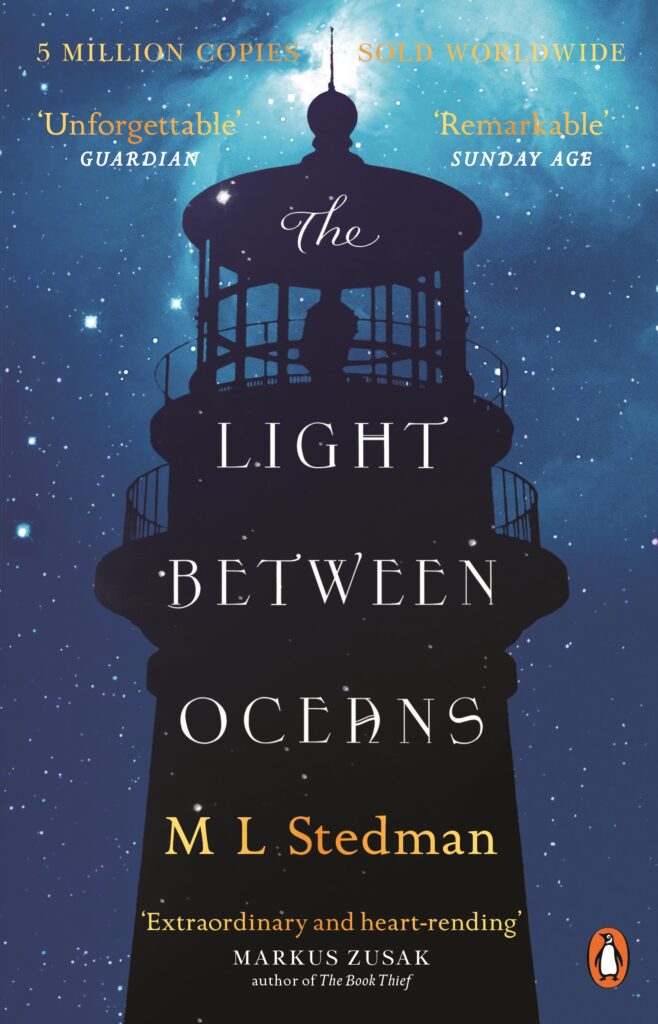
1926. Tom Sherbourne is a young lighthouse keeper on a remote island off Western Australia. As the only inhabitants of Janus Rock, he and his wife Isabel live a quiet life, cocooned from the rest of the world. Then one April morning, a boat washes ashore carrying a dead man and a crying infant and the path of the couple’s lives hits an unthinkable crossroads. Only years later do they discover the devastating consequences of the decision they made that day – as the baby’s real story unfolds…
M. L. Stedman’s first novel, The Light Between Oceans was the winner of three prestigious ABIA awards, including their ‘Book of the Year’, and also won the Indie Awards’ ‘Book of the Year’.
This mesmerising, award-winning Australian novel has sold close to 5 million copies globally and was made into a DreamWorks film starring Michael Fassbender and Alicia Vikander.

(5/5)
We start off with a tragedy, two deaths, and a severe injury, and this sets the stage for the novel.
As the reader, I felt like I was floating above the action, almost as if I were a Greek God observing the fortunes of the MacBride family. At times, I wanted to shout warnings to the characters as their fates unfolded.
This style of writing complements the sense of isolation of the characters and the location. Funnily enough, you also get a sense of the claustrophobia of living in a small community; however, there is also compassion and support to be found.
Once again, like “Light Between The Oceans”, ML Stedman continues with the themes of isolation, family, duty, and loss. I enjoyed this book very much.
(5/5)
A Far-Flung Life is a novel of secrets, the grip they hold over lives, and the insatiable human compulsion to uncover them, heedless of the toll.
The MacBride family, pastoralists in rural Western Australia, are beset by a series of tragedies, the effects of which ripple through several generations as they struggle to conceal facts that would result in social ruin if revealed. As they grapple with their personal challenges, doing their best to protect those they love, they are also contending with the evolution of rural industries, seeking the best way to sustain their life on the land.
The novel is about choices, consequences, and living with their aftermath. Ultimately, it is a testament to the way love can both complicate and redeem. A compelling, if not always happy, read.
(5/5)
From the moment I started reading I was engrossed in this family and the events in their lives. The descriptions of the area and life on the station brought clear images to mind and the landscape became like another character in the book.
I was invested in the stories of each of the main characters throughout – their highs and lows. The latter brought tears to my eyes. Beyond the generations of the McBride family are other community members with pasts just as interesting.
I would recommend this as a book to read more than once because of the beauty of the language and the connection people will feel to Nora and her family.
(5/5)
I was captivated with the story of the pastoralist family The MacBrides on their Meredith Downs property in the late 1950’s. Life is tough, but the MacBrides do well enough, and you are taken back in time and feel like you are part of the story observing this fictional tale first hand.
When tragedy strikes the MacBride family you feel like you are right there with them. Stedman reminds us how life was different back then and how one tragedy can turn into many with repercussions for generations.
Stedman takes you on an emotional rollercoaster ride, especially with Matt MacBride, the sole survivor of a tragic accident that took his dad and older brother. The moral dilemmas faced in this book provide climatic and unexpected turns and I really enjoyed the way in which the intertwined storylines introduce us to complex but realistic characters.
The proof of a great story is when I still think of the characters and their futures long after finishing the last page and this story still has me wondering so, in my view this makes it one of the best books I have read in a long time.
(5/5)
A Far-Flung Life is a big, bold novel that completely immerses the reader in the lives of the MacBrides over many years.
Life is harsh for this family of pastoralists who have lived off the land in Western Australia for several generations. Their vast sheep station, Meredith Downs, is isolated, but the issues of their lives are not remote from the outside world.
A series of tragedies befall this family and the resultant trauma is long-lasting and feels heartachingly real. As they struggle with their own demons, they must also to deal with enemies from outside – the collapse of wool prices, the incursion of mining interests, and the ever-present realities of droughts, floods and fires.
Not a word is wasted in this stunning novel. The depiction of the inner turmoil and pain of the main characters, the descriptions of the work, the faces of the people, the land they live on and live off, and even the animals, are simultaneously vivid and restrained.
I was captivated and engrossed by this novel and, just as The Light Between Oceans has, it will stay with me forever.
(5/5)
This book blew my mind, I couldn’t put it down and it was that good which suited the outside cover “the biggest Australian novel of the year”
Set against the vast and timeless landscape of beautiful Western Australia, a beautiful tale of lives blighted by innocent guilt, epic, grand and intimate. At times I was in tears because of the secrets, lies and mistakes written on the pages.
Heart-wrenching and beautifully set, a feast of a novel about family, loyalty, community, love, compassion and the lengths we will go to save them all. The story line portrays what lengths people will go through to save the family name, reputation, and relationships, so it can be honoured and upheld and how mistakes and tragedy can bring it all crashing down.
Normally I wouldn’t read or even pick up this sort of book and story, but I’m so glad I was given the opportunity to read it. I plan to read more of M. L. Steadman’s books and books similar to this one.
(5/5)
I loved everything about this book, the story, the characters, the setting, the writing style and the ending. It has been a very long time since I read a book that has brought me to tears and also got me so annoyed at some of the characters.
The story is mainly set on a WA outback sheep property and the repercussions after a tragic accident that devastates the McBride family. Over the next decade the gentle main character, Matt, continues to live and run the property with his mother Lorna, all the while coping silently with his secret.
All the characters were believable and I had a real dislike for Sergeant Benedict Rundle, on a stepping stone promotion and determined to do some tidying up of old files regardless of who could get hurt.
Then there was the nasty busybody Myrtle Eedle in the post office, wanting to know all the gossip and secrets, I had no sympathy for her.
Roo shooter Pete Peachey was a favourite, a loner with a sad background, a kind manner and badly treated in the end, but he still managed the situation on his own terms.
A thoroughly enjoyable book.
(5/5)
A well-researched and constructed history of the development of the vast expanse of family pastural lands of Western Australia, seen through the MacBride family.
It follows the MacBride brothers who leave their motherland of “Old Blighty” to take up country on the other side of the world in the Swan River district in the mid 1800’s, building a massive land empire both North and South of emerging Perth.
Their descendants are Phil, wife Lorna, and their children Warren, Matt, and Rosie. Like all pastoralist families, they face Mother Nature, accidents, and tragedies, but in a split second, Lorna faces a double tragedy.
Grief cannot overcome Lorna for long as the immense sheep station Meredith Downs relies on her to continue managing it through the 1950’s, 60’s, and 70’s with only the help of one of her adult children and some regular itinerant workers.
Throw into the mix current issues relevant to the time of parenthood, sexuality, and social standing. The stiff upper lip and isolation of Meredith Downs help, and her family sustains a comfortable but at times threatened existence away from prying eyes and a nosy career-driven policeman.
Although slow to gain pace through the early pages, it does become a page turner as you read further in.
It will sweep you away.
(5/5)
‘A Far-flung Life’ is a sweeping saga that plays out in the unforgiving land of outback Western Australia. One can only be reminded of that other Australian classic, ‘The Thorn Birds’. Stedman expertly, eloquently, and emotionally traces the lives of generations of the MacBride Family as they struggle with the complexities of running a remote sheep station. Do the secrets of the past define who we are, or can we manage to rise above these to search for a better life?
Living on this remote sheep station, the MacBride Family is bound to the land, and the generations before them, physically, emotionally, and financially. As the youngest MacBride sibling, and after a series of devastating events, Matthew is left to choose between giving up his dreams and family duty. The family will need to draw on every ounce of resilience and love to face the challenges that come before them.
Stedman has created another extraordinary and lyrical book that is destined to become an Australian classic.
(5/5)
What a beautifully written, epic Australian story. I loved this book so much and have not been able to stop thinking about it. The writing was exquisite, with the unique and stunning landscape of Western Australia vividly depicted.
There was so much tragedy but equally so much love underpinning the narrative that it was possible to manage the journey through this book, albeit with many tears, and ultimately still feel hope.
There is a grey area of life that I think the author navigated with such grace. Grief, shame, guilt, secrets, family, landscape, forgiveness, belonging, love, and hope are all covered in heartbreaking depth. The characters were very authentic, and I could not wait to get back to them each time I put the book down. The MacBride family of pastoralists is complex and compelling, but the character of Pete Peachy had my heart.
I could not recommend this book more, despite the gut-wrenching moments. You will still be thinking about it, and the characters, long after the last page is turned.
(5/5)
This was not an easy read, but I was enthralled right from the first page. I was completely drawn in by the superbly crafted characters, even the ones that weren’t so likable. They all had wonderfully complex personalities shaped by their past experiences and scars they carried. Set against the vastness of the Western Australian outback, this was an epic generational story told with consummate skill. It will stay with me for a long time.
(5/5)
I was a huge fan of The Light Between Oceans, so this novel has a lot to live up to. I’m happy to report that all of my expectations have been exceeded. Stedman does a great job of making the Australian landscape its own harsh, ruthless, and unpredictable character. Meredith Downs felt real, as did the MacBride family and the rest of the cast of characters. I was heavily invested in their lives and all their misfortunes from the first page. While the story was heartbreaking, it was a page turner, and I suspect it will stay with me for a long time. Readers of historical fiction and family sagas will enjoy this book, and I predict that it will become an Australian classic!
(5/5)
It’s a big country, Australia, and this is a big story. It follows generations of the MacBride family, sheep pastoralists on an outback property the size of a small country. The novel begins with a young man’s dream for his future, a dream – and so much else – destroyed by a road accident in 1958 that kills the MacBride patriarch and his older son, leaving the younger son, Matt, with brain injuries. Stalwart mother Lorna and teenage daughter Rosie struggle to manage not only the property but Matt’s rehabilitation. Then the unthinkable happens. The reader is taken on an emotional journey across the next 40-odd years to find out how this story could possibly be resolved.
The novel is brilliantly written, capturing place, atmosphere, and feeling. This is an old Australia, when people kept quiet about problems and soldiered on. When bad things happened, sometimes it was better to just forget about it. And while the cost of taking responsibility for your actions can be huge, there are some situations for which the answer is not catharsis. Some deeds must be ‘destined to join the vast ocean of human forgetments’. A wonderful book that is both tragic and uplifting.
(4/5)
I thoroughly enjoyed this family saga set on a remote sheep station. The story, told over several decades is a story of tragedy, hardship, survival and hope.
Was beautifully written with realistically flawed characters. The setting was well described. It was a hard read in places due to the storyline and could be triggering in parts.
Keep an eye out for this one especially If you loved The Light Between the Oceans. This is going to be BIG.
(4/5)
A Far-Flung Life by M. L. Stedman left me with mixed feelings, and I won’t go into too much detail because it’s impossible to explain why without giving away the ending.
But, I will say this, and it is that not everyone deserves a happy ending, and this neat tying up of the story slightly detracted from what I’d loved about the book up until that point. I wanted vindication and felt that no one in that entire book faced any real consequences for their crappy behaviour, and that certainly rubbed me up the wrong way.
Stedman writes beautifully, there’s no denying that. Her language is stunning, and I really felt that she knew the community well. As someone who has lived in a mining and sheep station community, I found so much of it rang true. From the small town busybodies to the more uncomfortable undercurrents of prejudice, the social dynamics felt authentic. The landscape, too, is painted exactly as you’d expect from an Australian novel set in the outback. Big and breath-taking beautiful, but also simple.
Did I like all the characters? No. Pete Peachey, however, is wonderfully three dimensional and, for me, saved the book. I would happily read an entire novel with him at the centre. Matt, on the other hand, didn’t deserve his role. I struggled with the way he was surrounded by love and forgiveness and I don’t think he deserved it.
Overall, this is a four-star read that could have been a five. The writing and setting are exceptional. I just couldn’t quite reconcile myself with the ending.
(4/5)
If one were to sum up this eagerly anticipated new novel by M.L. Steadman is this line: “Sometimes our secrets aren’t ours to tell.”
Steadman has created another epic story that weaves through generations of a family making a living on an arid, remote sheep station in the outback of Western Australia. Immediately, the reader can get the sense of place and time, the harsh reality of being pastoralists on a million acres – the challenges, the perils, and the impact of intense weather events and being at the mercy of new industries threatening their livelihoods.
At the heart of the novel are the MacBride family and the tragic events that lead to decisions that have lifelong and lasting effects on themselves, their neighbours, and community members. The story does cover some challenging territory, but the moral dilemmas are sensitively written and beautifully conveyed through the eyes of some of the younger characters in the story.
This novel was essentially how all of the characters came to terms with their own life choices, the internal dialogue, and the ramifications of the path they chose.
It was quite a journey, I loved it for its raw emotion, yes, there was sadness, but also hope.
(4/5)
I was blown away by the emotional depth of this story. It follows the MacBride family, focusing primarily on Matt MacBride, who discovers something that changes the path of everything. It studies the sacrifices we make in the eyes of tragic circumstances, and I was enchanted by the mystery and secrets. I enjoyed the plight of the characters, and it got me thinking about how far I would be willing to go to protect family. Ultimately, this novel was thought-provoking and absolutely consumed in a single sitting.
(4/5)
A story encompassing how long secrets can be kept and for those trying to unravel a secret, how long they should persist.
Based in the 1950s/60s and beyond in outback WA. It’s real station life and uses plenty of Australian vernacular, and a country family lifestyle – it brings back vivid memories.
The writer brings you along with big defining moments. Sometimes you sense what’s coming and silently shout out, “No! Don’t go there!”, but then it’s written. Big breath. Characters are fully developed, and you feel a strong affinity with them.
(4/5)
In Western Australia, 1958, a moment’s inattention while driving shatters the lives of the MacBride family. “A Far-flung Life” explores the lives of the MacBride family, who have been sheep graziers for generations and call Meredith Downs their home. The devastating accident starts a chain of events that change the family forever.
The story is a slow-burning saga, you discover the lives of the district’s characters and their various roles in the community. There are dark unspoken secrets in the MacBride family. One of the main characters in the story carries a heavy, life-long burden due to a secret he can never reveal.
M L Stedman has written an engaging epic describing rural Australian life. The book is written with great descriptive prose in a relaxed and entertaining style. I particularly enjoyed the spoken dialogue that is so indicative of the Australian idiom of the time. The descriptive passages of the landscape are also delightful.
The characters in the book have well described personalities; as the story unfolded I formed a connection with the people of Meredith Downs. The author has cleverly portrayed the impact of events on these characters, according to their various roles in the story.
I found myself increasingly captivated by the narrative as the story unfolded. Overall it was a captivating read, and I would thoroughly recommend the book to all readers who enjoy a well written, entertaining read with more than a touch of drama.
(3.5/5)
The truck accident that was described in the opening chapter alters and shapes the MacBride family forever; the remaining family members rebuild the bonds that are strong and battered by mental fatigue and stress by the recovery of Matt, the son, and his mental state.
Lorna, the mother, responds to rebuild what remains of the family and builds the Meredith Downs property to withstand the ongoing pastoral and management issues with love and devotion.
Matt, the sole survivor of the accident, faces ongoing mental and physical scars and is compounded when a coupling of his mental state and despair leads to an undesirable connection with his sister Josie.
The introduction of a station manager from England, Miles Beaumont, assists Lorna in managing ongoing station issues and provides stability and relief, and is a prop for the unwed Josie! This relationship is, however, purely one of friendship.
The character of Peter Peachey, a roo shooter, is a loner who is content with his sole existence and love of the outback. However, his love for dressing up is brutally discovered and protected by his friend Matt from the intruders.
The local police and Post Office staff provide a backdrop of assertion and rumour, which creates interest and concern if the secret is unravelled.
The arrival of geologist Bonnie Edquist causes Matt to be attracted romantically to her, and the logistics of her working on the farm property assist in forging a relationship. Will it lead to a lasting one?
Grandson Andy provides a backdrop of child innocence and stimulates an interest in farm activities and rock collecting. Will the secret ever be revealed? Does Matt continue in his quest to form a tangible relationship with Bonnie?
The Australian background is craftily told and relayed in colour to assist the reader in imagining the country and farm life portrayed in depth in the novel
Rated a good read by me!
(3/5)
I was thrilled to receive an ARC of A Far-flung Life after having thoroughly enjoyed the author’s first novel, The Light Between Oceans, many years ago. However, I have to admit to finding this a much more difficult read with characters I struggled to connect with, and the narrative, at times, felt like trudging through mud.
The novel is a saga telling the story of the MacBride family over several decades, on their sheep station in rural Western Australia, and the tragedies that befall them. I found their lives to be extremely dark and depressing, with only the occasional moment of joy and beauty. Additionally, the story dragged on, going backwards and forwards, in a rather confusing way, so that while I enjoyed the beginning of the story, I had lost interest a third of the way in.
Overall, I am giving this one 3 stars for the descriptive passages, which, although beautiful at times, did not make up for the lost momentum and confronting themes.
(3/5)
Set in the 1950s outback of Western Australia, A Far Flung Life follows the MacBride family, offering a glimpse into rural life and family relationships. As the story unfolds, it reveals an imbalance of treatment between sons and daughters.
When Matt, the son, suffers a car accident resulting in memory loss, the family dynamics shift. Matt remains in the hospital for an extended period of time until he recovers. Meanwhile, his sister Rosie remains at home studying and helping their mother, Lorna, run the property. Despite Rosie’s efforts, her contribution goes largely unacknowledged, and she is repeatedly blamed and pushed aside. Once Rosie leaves for Perth, her absence is truly felt.
After Rosie becomes pregnant out of wedlock, she returns home with her newborn son. Lorna initially makes the decision that the baby is to be adopted.
While A Far Flung Life becomes more engaging as the story progresses, it takes time before the reader is drawn into the scenes and characters. The author, ML Stedman, relies more on a telling writing style rather than a descriptive writing style, which limits the reader’s use of imagination. With A Far Flung Life being close to 80 chapters and approximately 450 pages, I found the novel rather lengthy, and unfortunately, it didn’t deliver the impact by its claim as “The Biggest Australian Novel of the Year.”
(3/5)
I’ve read some very rich and beautiful writing along my reading journey, particularly this month, but M L Stedman’s writing is on another level, and luckily so, because that is the main win in my eyes with A Far-Flung Life.
From the opening pages, I was completely swept into life on a remote Australian sheep station in the 1950’s with the most immersive vivid descriptions.
The story began strongly, delivering some intense heartbreak, and I could not put it down until a dark turn shifted everything. That moment changed how I felt about the entire book, and from there, the reading experience became uncomfortable rather than compelling for me.
Lately, I’m noticing more novels leaning into confronting themes, and while awareness and conversations are important, I often struggle with why they’re included and what they truly add to the story. The dark theme in this book, which I won’t mention to avoid spoilers, seems like it could have been written very differently to avoid the ick.
It saddens me knowing that if this one theme had been avoided, this might have otherwise been a book I could have really loved.
That said, the writing itself is exceptional. The setting, the station life, and several characters (Myrtle deserved her own novel, honestly 🤭) were real highlights. Unfortunately, the storyline couldn’t recover for me after that pivotal moment.
If you’re someone who can handle darker themes and enjoy a slow, atmospheric, historical style read, this may resonate more with you than it did with me.
(2/5)
As I began reading this new release, the authors power of description meant that I could envision her words in my head.
Unfortunately I struggled with this book. I did finish reading it, but it was an effort.
I really wanted to love it