




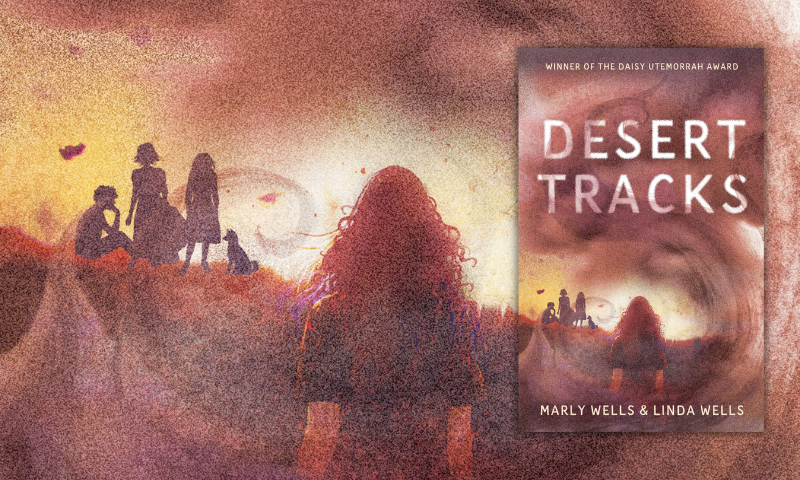
MARLY WELLS and LINDA WELLS’ Desert Tracks is a time travelling novel about young people in central Australia, the historical legacy of racist policies and the relationship between history and the present. Read on for the Q&A.
What sparked the idea for Desert Tracks?
As a young reader, Marly used to get lost in books. We are both passionate about the Central Australian desert and the town of Mparntwe / Alice Springs, how it is now and what has gone on in the past, which we see as being inextricably linked. We are also passionate about appreciating the cultures and languages of the First Peoples of Central Australia.
The story is based on our experiences living and growing up in Alice Springs. It is a love letter to our story, to this town and region, and the people who make it special and unique.
What’s involved in the writing process when co-authoring a book?
This story was born when Marly was about the same age as Millie, probably one day when we were out walking together. We used to talk about it, in broad strokes, and tiny details, while we discussed how the story could go. Then we started writing segments, reading each other’s work, making editorial suggestions and collating. We were both involved in it over the years. Then we got distracted by other things and the story sat as an unopened file for a while.
One day after Linda had finished her PhD she was wondering what to do next. She opened the document that was the bones of the Desert Tracks manuscript and started reading. Revisiting it after time away made her realise how much potential it had. She contacted Marly and asked her if she was interested in working on the story with the aim of finishing it and getting it published. Marly re-read it and was excited about working on it as well. This led to very long phone calls; Marly was in Alice Springs and Linda was in Melbourne. We worked the story up, developing its plot and characters and discussing it as if it was really happening, and they were actual people. We would then go off and write and edit sections, as we had done all the way along.
What can you tell us about your characters Millie, Sonny, Beryl and Spike?
They’re sweet. They care about each other, and their communities/ the worlds they exist in. They accept what happens in front of them but ask questions about why and how things happen.
Millie is a girl from the present, living in Alice Springs with her family, and learning about herself and her history through her family connections and her own interests and activities – such as school, friendships, reading and netball.
Sonny, Beryl and Spike live on the land. They are dealing with the demands of life on the frontier, in Central Australia in the early 1900s. They are connected and understanding of each other – their differences and similarities. Each of them is a product of the social and cultural time and place of their lives, as well as their own individual situations.
All these characters carry features of people we know. Who else could they be?
Millie travels back to 1924 in Alice Springs – what’s the significance of this time and place?
It is frontier times in Central Australia where there is a strong interplay between traditional Aboriginal cultures and societies and the incoming white society. It was a time and a town on the cusp of great change. It is also a time we know a fair bit about as Linda researched this period for her PhD and wrote about in her work of creative non-fiction, Living in Tin.
What inspired the time travel elements in this book?
A few inspirations converged to make time travel an obvious choice.
Marly has always enjoyed sci-fi and the mystical/ fantastical in stories. It is second nature to her. She also ponders how the dominant ways of measuring and perceiving time are artificial constructs.
Past and the present are so obviously interconnected in Alice Springs. There is a strong sense that the past has become the present, that the present in Mparntwe, is deeply influenced by the past, that these different periods of time are inseparable.
This thinking about the cyclical nature of time and the interconnectedness between eras is consistent with Indigenous perceptions of time that are much more aligned with concepts of regeneration and return than they are with western perceptions of time marching in a straight line and forward direction.
By travelling back in time – what did you want to convey about the relationship between past and present?
As above, that the past and present are inextricably linked, and that time is more cyclical than linear. We are shaping the future now, just as the past continues to influence how our societies are in the present day.
So much is different between past and present. We have big advances in ways of learning, in our understandings of nature, human psyche, science, technology. But the differences can also highlight how little has truly changed in other ways – how people are, the ways we treat each other, discrimination, and the ways that people from minority groups are treated. That expression comes to mind – the more things change, the more they stay the same.
What do you hope readers take away from this story?
Connection and wonderment. An enhanced love of reading and all that it can provide. An appreciation for the town of Alice Springs that has grown up on Arrernte land. That the troubles of the present are rooted in the colonial past and that the present is a direct result of the past. That colonisation has been cruel and brutal to Indigenous people, but that languages, cultures and people go on surviving and thriving despite those horrors.
ABOUT THE AUTHORS
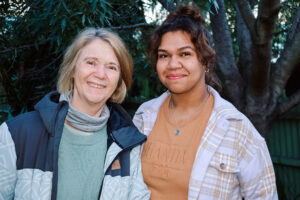 Marly Wells (RIGHT) is a proud woman of Warlpiri and white Australian descent. She grew up in Alice Springs. She completed a Bachelor of Arts at Melbourne University with majors in Sociology and Indigenous Studies. Marly lived in England for two years in her early 20s. She then returned to Alice Springs where she worked in the management of children’s services.
Marly has also worked as a freelance editor and researcher for Hardie Grant Publishing. She co-wrote a children’s book for the Girls Can Boys Can project in Alice Springs and an article for The Saturday Paper about the killing of Kumenjayi Walker at Yuendumu.
Linda Wells (LEFT) is of white settler descent and proud to be Marly’s mother. She is a teacher and writer. Linda has lived in Central Australia for many years and worked as a teacher on desert communities as well as in Alice Springs. For over ten years Linda also ran a small business, conducting guided walking tours of Alice Springs. She has a PhD in creative, post-colonial possibilities for writing Australian history and loves writing books.



0 Comments