


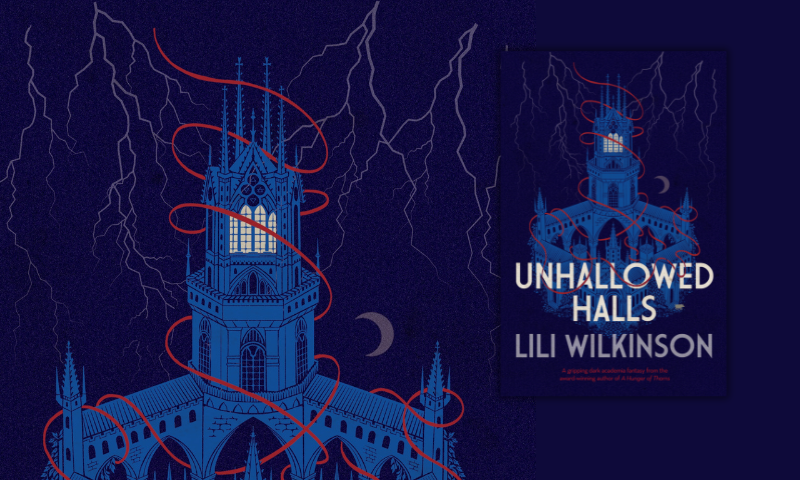
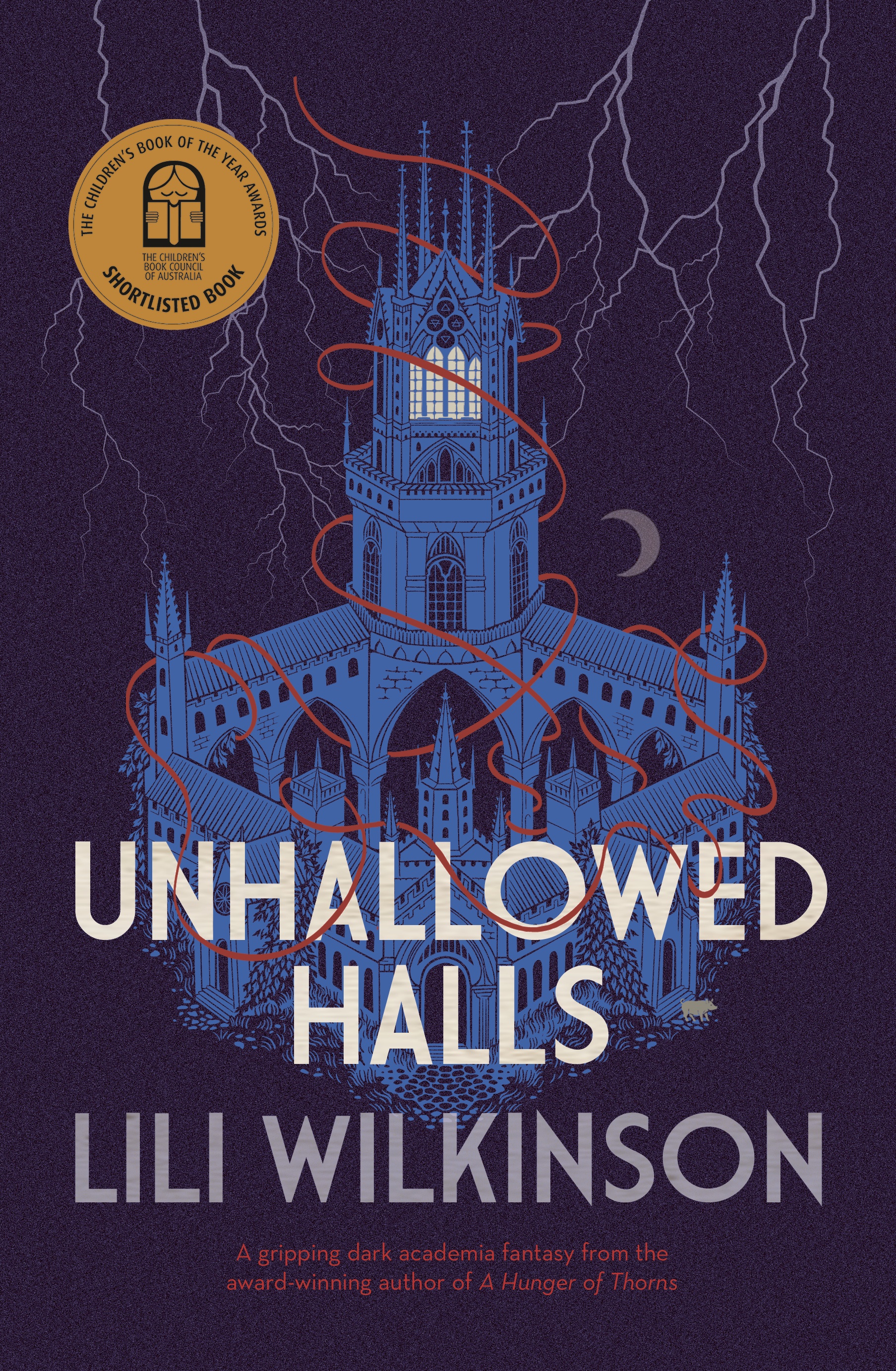
LILI WILKINSON’s latest novel, Unhallowed Halls, is a captivating dark academia fantasy. We caught up with the author to discuss her themes, characters and inspiration behind her book.
What inspired you to write Unhallowed Halls?
YA author Ellie Marney shared an article with me about a (now closed) US boarding school for gifted but troubled children. The place looked like a castle, with an actual moat, but held some very dark secrets. It immediately sparked an idea in my mind (what if this, but also demons?), and it just sort of grew from there.
Agathion College seems like the perfect setting for a dark academia novel. How did you go about designing this school? Were there specific elements or real-life locations that inspired the setting?
I had originally thought to set in in the US, like the school I’d read about, but quickly moved it to Rannoch Moor in Scotland. I hiked across the moor in my twenties, and have always wanted to write something gloomy and magical set there. I wanted the school to be deeply eccentric, and totally cut off from the rest of the world. I also wanted to capture some of the elements that make classic British boarding school novels so appealing – the uniforms, the lavish food, the friendly banter. Agathion had to seem like absolute paradise to Page … until it wasn’t.
What drew you to writing a character like Page? How does her outsider status influence the way she navigates the mysteries of Agathion College?
The students at Agathion all come from privileged and wealthy backgrounds, and I needed the protagonist to see them that way. She had to be an outsider – a kid from the ‘real’ world that readers know, who has never felt like she belongs anywhere, and is desperately seeking a place where she can be her true self. Everyone at Agathion is an outsider, but Page had to be an outsider to the outsiders, so that she can ask the questions that the reader wants to know the answers to.
How does Page evolve as she unravels the mysteries of the school and its ancient ties?
At the beginning of the book, Page has cut herself off from the world. She’s convinced herself that she doesn’t need to feel anything, that she doesn’t need friends. All she needs is books and ideas – a life of the mind. But underneath all that she is longing to be a part of something – to love and to be loved, and slowly, she starts to understand that, and allows herself to be vulnerable around her new friends.
One of the central themes of the book is the ancient society tied to demonic magic. How did you research or develop the concept of demonic magic for this story?
I did a lot of research into Greek philosophy and Celtic magic. The tension between these ideas – rationalism vs wild magic, mind vs body, alone vs together – became the thematic underpinning of the book. The mechanics of the demonic magic (I’m being deliberately vague here because of spoilers) was an absolute nightmare to get my head around. Thankfully my husband Michael has just the right kind of brain for this, and we spent many a lunch break at our kitchen table trying to puzzle it all out.
The mystery at the heart of Unhallowed Halls is shrouded in dark magic and secrets. Were there any particular moments that were especially fun to write?
There’s a big reveal in the middle of the book, where Page thinks she’s figured out what’s going on, then witnesses a ritual that reveals layers upon layers of secrets. It was a very difficult scene to write because of the aforementioned magical mechanics, but a lot of fun, and I loved finding ways to bring a little humour into it (usually through Lacey, who was an absolute joy to write).
Unhallowed Halls has been compared to Donna Tartt’s The Secret History. Are there any particular works of dark academia or other books that influenced you while writing this novel?
The Secret History was definitely an influence. I wanted to capture a similar vibe, in terms of the dark academia of it all. But I wanted Unhallowed Halls to be more empathetic in the way it views its characters and their ability to change and grow. Isobelle Carmody’s The Gathering was also a big influence – I absolutely adored that book as a teen. In terms of tone, I wanted to capture that heightened drama of gothic horror, so I dipped into the Brontes, Edgar Allan Poe, HP Lovecraft and Mary Shelley a fair bit while I was writing.
ABOUT THE AUTHOR
 Lili Wilkinson is the award-winning author of more than 20 books for children and teenagers, including Deep is the Fen, A Hunger of Thorns, After the Lights Go Out, The Erasure Initiative and Bravepaw. Lili established the Inky Awards at the Centre for Youth Literature, State Library of Victoria. She has a PhD in Creative Writing, and lives in Melbourne with her partner, child, dog and three chickens.
0 Comments