



‘Off with her head!’ The Red Queen roared in one of Lewis Carroll’s most celebrated stories, Alice in Wonderland. The famous tale of a little girl falling down a rabbit hole into a fantastical realm full of anthropomorphic characters has captivated children for more than a century.
CHANDRA HAZEBROEK searched for what could have stimulated such an outlandish imagination.
Charles Lutwidge Dodgson was born on 27 January 1832 in Daresbury, England. Growing up in an isolated country village, this budding creative writer, mathematician, poet, logician, artist, photographer and storyteller honed his skills by entertaining his 10 siblings with magic tricks, drawings and literature.
His pseudonym, Lewis Carroll, was derived by Latinising his first and second name, reordering, and translating it back into English. Carroll was afflicted with a stammer, which he referred to as ‘his hesitation’. The dodo in Wonderland is said to be Carroll, who often called himself Do-do Dodgson. Throughout his life, he diarised reoccurring aura migraines and partial blindness in one eye. One wonders if his vision troubles gave rise to the distorted world in the Alice stories.
In a modern world, we could speculate that his talents were a result of neurodiversity, however, no such label existed in his lifetime. We first need to understand the rules, before we can break them, something Carroll did with such alacrity. As a proponent of the nonsensical literary genre, Carroll wrote his well-known tales and also lesser-known poetry, which included The Hunting of the Snark and The Walrus and the Carpenter. Creative verbs and adjectives such as mimsy, chortled, and galumphing, from The Jabberwocky, are now forever etched into the English dictionary as a result.
Carroll called Christ Church, Oxford home from the moment he entered in 1850, as a student, to his death in 1898. As the college’s mathematics don, he published numerous academic books about mathematics and logic. Over the years, he held various positions in the college and was content with remaining a bachelor. Perhaps so he could give free rein to his fervent imagination.
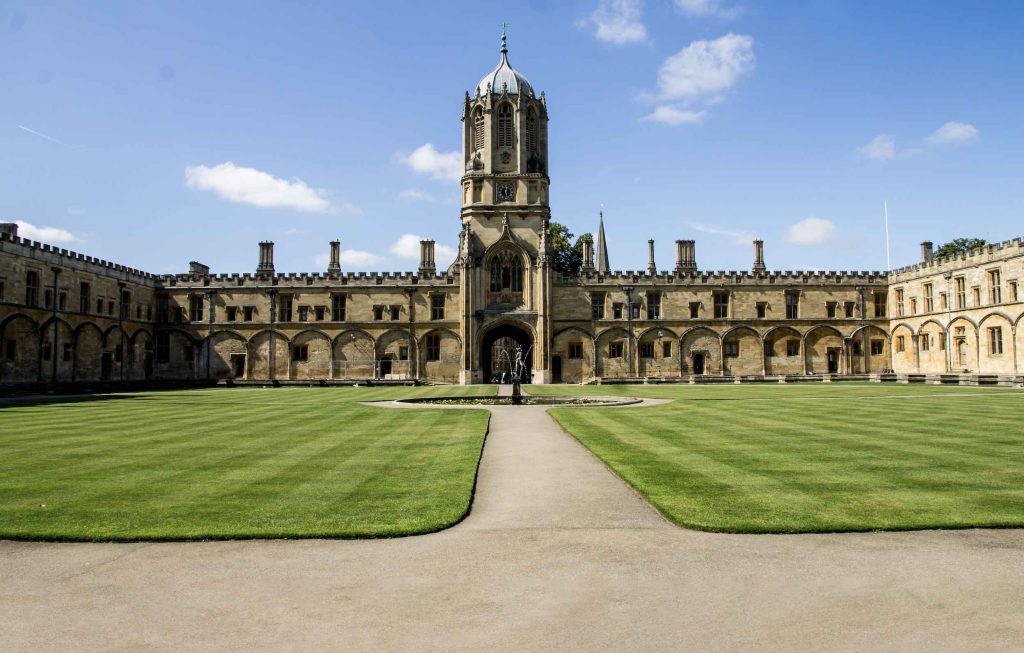
The sprawling college grounds, home to Christ Church Cathedral and Tom Tower define Oxford’s majestic skyline. The myriad architectural styles that have captivated students and visitors over the centuries include Medieval Gothic, Palladian Renaissance, and Baroque styles. Beautifully detailed stone buildings covered by elaborate carvings and ornate features invite closer inspection.
There is much speculation as to where exactly Carroll garnered inspiration for his fantastical tales. And much like Alice, I too fell down a rabbit hole of conflicting theories and conjecture on my quest to unearth what, and where, inspired the man behind such extraordinary fantasy prose. What is quite clear is that living at Christ Church proved to be a bonanza for Carroll’s imagination.
Not only were the college grounds and its architecture a source of inspiration for Carroll, but so were its occupants. As an observer of people with varied quirks and personalities, teamed with his brilliant, enquiring mind and personal afflictions, Carroll had a plethora of possibilities for creative prose. All of these elements, like a mathematical equation, aligning at just the right time, culminated in a fantasy world where everything happens in a moment and time stands still. It is easy to imagine Carroll strolling across the great Tom Quad quadrangle, finding splendour in the vast college gardens, and finding mystery in Christ Church’s stoic corridors and hidden rooms.
It was at the college where Carroll met Alice Liddell and her siblings through their father, Henry Liddell, the Dean of Christ Church. Carroll’s living quarters overlooked the Dean’s private gardens with its locked, Gothic-panelled wooden door set into a cobbled stone wall, where Alice Liddell may have dreamt of what lay beyond. In Wonderland, Alice finally opens the door to the ‘loveliest garden you ever saw’.
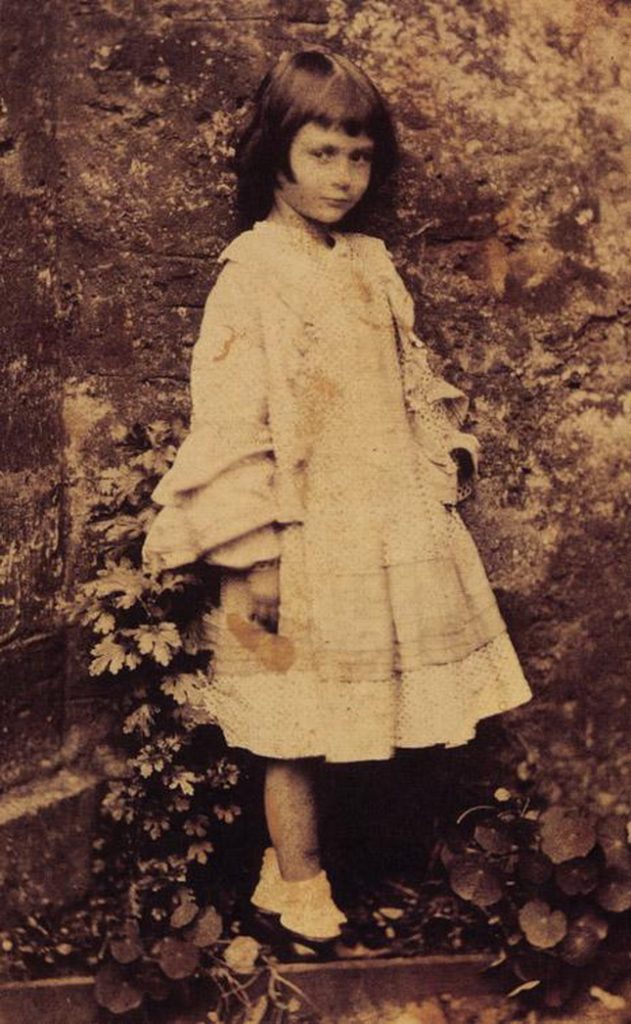 One afternoon in 1862 on a rowing boat excursion along the River Thames, Carroll entertained the then 10-year-old Alice Liddell, and her two sisters, with the first version of Alice in Wonderland titled Alice’s Adventures Underground. He captivated the Liddell sisters with a story of a girl, aptly named Alice, who falls down a rabbit hole and finds herself in a whimsical wonderland. After many incarnations, the tale was finally published three years later and has been in print ever since.
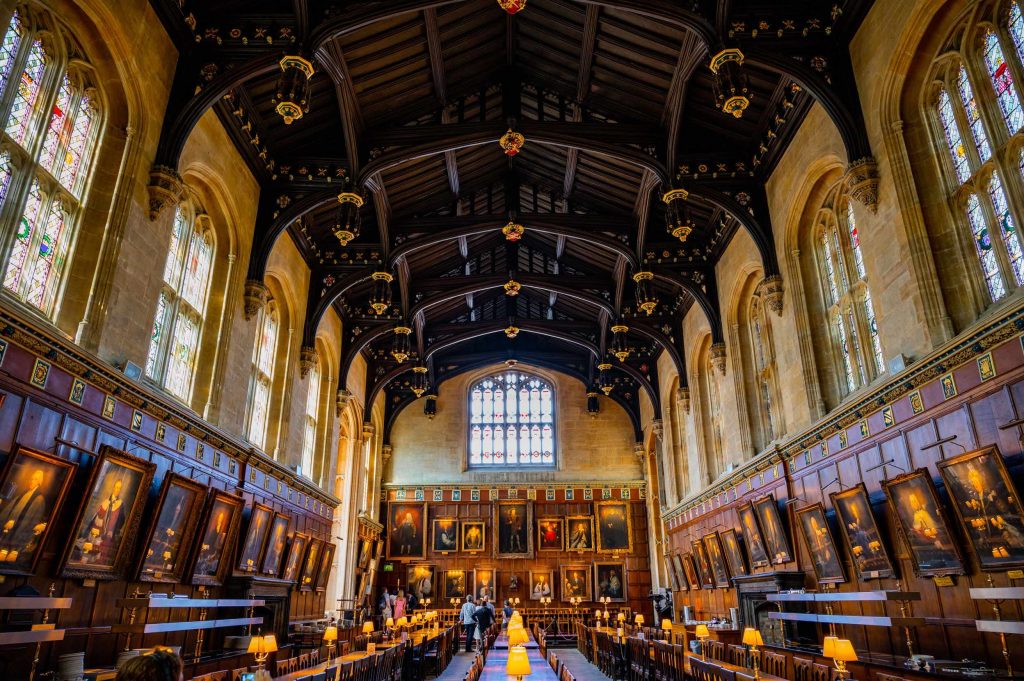
It is interesting to note that Henry Liddell was often observed running late to services and hurrying out of the Great Hall after dinner every night. The Great Hall, dignified and composed, with its soaring vaulted ceilings, ornate tracery and Gothic windows hosted feasts for the residents of Christ Church. The wooden panelled walls, adorned with unyielding mounted paintings of famous Christ Church alumni, were a constant projection and reminder of Christ Church’s opportunities.
Nestled in the centre is an imposing, antique-framed image of Christ Church’s founder, King Henry VIII, who was known for his predilection of separating ladies from their heads. Along another wall is a panelled door hiding a narrow spiral staircase leading down into private, secluded areas. It was here where Liddell often went down, glancing at his pocket watch, muttering just like the White Rabbit. ‘I’m late, I’m late, for a very important date!’ •
Find out more about Christ Church College, Oxford


0 Comments