


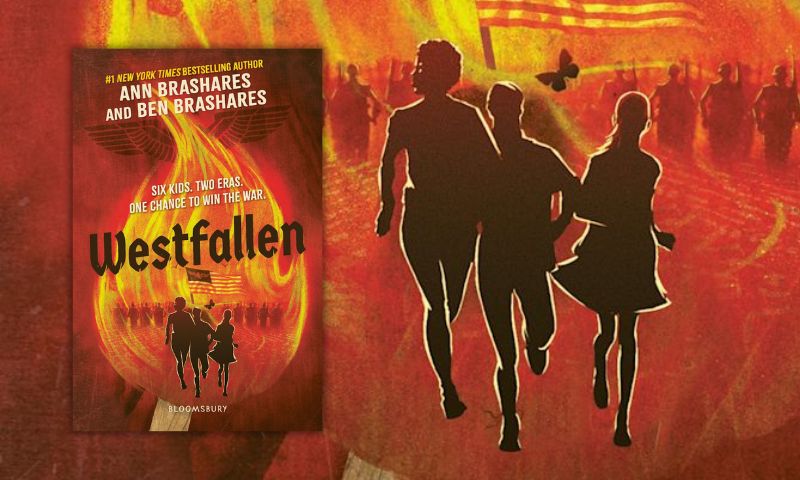
We caught up with ANN and BEN BRASHARES to discuss their book Westfallen, a story about two groups of 12-year-olds – one in World War II, one in the present day.
Where do you both get your love of storytelling from?
BB: Our family has always gathered around a good story. I’m the youngest of four, and I think I figured out at an early age that to get attention – and I always wanted attention – I could either cry a lot or make people laugh. I think I probably tried crying a lot and it didn’t get me very far. Trying to make my family laugh has always been tied to trying to tell a good story. So I think my antennae have always been up in that way –looking for things that would make a funny story. Sometimes even doing things – dumb things – just to be able to tell a good story after.
AB: As a kid there were some books I loved so much, I kind of lived in them. I think I read A Little Princess by Frances Hodgson Burnett about 100 times. The more times I read it, the more I got caught up in this mystery: how can a story be interesting, surprising, and heart-wrenching EVERY SINGLE time you read it? How does it work? How does a writer make a reader believe and feel and care about something completely made up, even if they’ve read it 100 times?
Where did you get the inspiration for Westfallen?
BB and AB: A lot of it came down to our sons. We each have middle grade readers who can be a challenge to entertain. First and foremost we wanted to write something that they would want to read and, ideally, talk to their friends about. This meant it had to have a ‘cool’ factor. It had to be a little scary, it had to have a good deal of mystery, and it had to be funny in parts. If we were able to spark their interest in history and some deeper issues surrounding race and identity, even better. We both love the idea of time travel and all the rich complications it brings. It seemed like a good starting point to try to fit all this in.
The time travel genre often explores difficult ethical problems – how did you navigate this in your own story?
BB and AB: It’s hard not to think about what you’d go back and fix or maybe what you’d do to get rich or famous. Our characters are pretty careful with this newfound superpower, but they still end up making a horrifying mess of things. They can’t ever shake the fact that they – just a bunch of kids – are responsible for such a massive, dark shift in world history.
The Nazi regime was horrifying, especially for the minorities it targeted. We made the decision to write a Jewish character in Westfallen, in part to represent the horrors that Jewish families faced in real history, but also to consider some things we take for granted now, and the idea that such brutality remains a danger now and always. We tried not to oversimplify: we show contemporary kids facing cruelty and bigotry in an invented world, but they also recognise that the real world they left behind is far from perfect. Mostly, we wanted to explore these ideas in a way that felt completely personal to each of our characters.
The two groups of kids are central to the story. What were the key dynamics you wanted to explore between them?
BB: I really wanted to express my own disappointment –through the eyes of the 1944 kids – that we still don’t have flying cars or jet packs in the ‘future’. I was glad I got a chance to do that. 🙂 There’s a ton of fun and interesting cultural material to cover with two sets of friends talking across time – the gaming, the phones, the music, the movies, etc. It was almost too much for me at times. Ann had to wrangle me back on track with the story a number of times. But after the initial discovery and timeline switch, it was really about how these two groups would support each other across time, both in trying to fix the timeline and trying to cope emotionally with what they did.
AB: The two groups of kids are 79 years apart. That feels like a huge distance and, at the same time, no distance at all. We use the radio to punch a hole through time, so kids who are far apart can talk together, can see how much has changed and how little. But you don’t need time travel to show how weird the passage of time can feel.
What did you enjoy most about exploring the ‘What if’ exercise of your story?
BB: The ‘what if’ is a powerful tool in the human brain. And like anything powerful, you have to be careful how you use it. Henry, the main character in 2023, has a tendency (like myself) to mishandle it and bring a lot of unnecessary anxiety into his life. For me, it was an interesting exercise imagining (‘what if?’) a kid who already had anxiety getting thrown into this new life where dangers are very very real and he doesn’t really have to do a lot of doom and gloom ‘what if’s’ because he’s already there. How would he handle it? Would it make some of the ‘unnecessary’ what if’s go away? Would it make them worse?
AB: I like thinking about how memory works. I found it fascinating to imagine, what if you woke up in a world where you were the only person who remembered America in the 21st century? What if you found you were inhabiting a different version of yourself, who led a life you can’t quite remember? What if suddenly you could speak a language you didn’t know you knew, play an instrument you didn’t know you could play?
What was your collaboration process like?
BB: I’d say the breakdown goes like this (we’re still at it with books 2 and 3): 45% complaining about our mother, 20% talking about our kids, 10% complaining about our spouses, and a solid 15% working on the book. Of that 15% work, I’d say 3% is spent worrying about our deadline, 2% Ann being mad at me for not writing fast enough, and 10% doing the ‘what if’s’ in the best way possible.
We talk a lot.
As far as the writing itself goes, in general, Ann writes the 1944 crew and I write the 2023 crew. And then Ann takes the slop I’ve written for the 2023 crew and turns it into something readable. I don’t do much for her 1944 crew.
AB: Ha. I’m laughing at what Ben wrote. Not completely reliable, but funny, which about sums up our process.
What do you hope readers takeaway from your story?
BB: I would love for readers to get more curious about history after reading this book. I’d love for them to think about our present day and 1. See how fortunate we are to live where we live, 2. See how we’re not so far off from those horrific times and that many of the injustices we see and feel today could so easily make a turn for the worse if we let ourselves veer off from the truth and our hard won lessons from history.
There’s also a lot in this book about identity and what makes us ‘us’. After the history lessons, maybe readers will dive into some philosophy. That would be pretty cool.
AB: Everything Ben said and also, I hope readers plain old enjoy it, that they’ll read with that simmering sense of, “I can’t wait to see what happens next.”
ABOUT THE AUTHORS
 Ann Brashares is a writer and mother of four living in New York City. She is the author of the #1 New York Times bestselling ‘Sisterhood of the Traveling Pants’ series as well as several other novels. Before becoming a writer, she was a student of philosophy, a receptionist, an editor, a ghostwriter, and, briefly, the co-president of a small media company. She grew up in Washington, DC, with her three brothers and a stunning number of weird pets. She helped her youngest brother, Ben, with his shoes (and the debilitating lumps in his socks) every morning before school until he learned to tie his own shoes … around eighth grade.
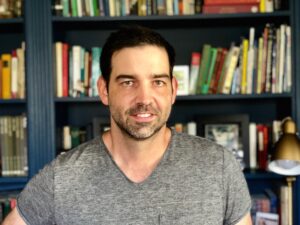
Photo credit: Wes Jones
Ben Brashares lives in Montclair, New Jersey, with his wife and three children. He’s the author of Being Edie Is Hard Today and The Great Whipplethorp Bug Collection. He holds an MFA in creative writing and has worked at and written for several magazines, including Rolling Stone, Men’s Journal, and Entertainment Weekly. He spent much of his youth wading through heaps of clothes in his big sister’s room looking for the family’s escape-artist tarantula, Fredricka … to put on his sister’s head while she slept. As an adult, Ben gets no help whatsoever tying his shoes. But he still has weird pets. And he still gets lumps in his socks.

0 Comments