



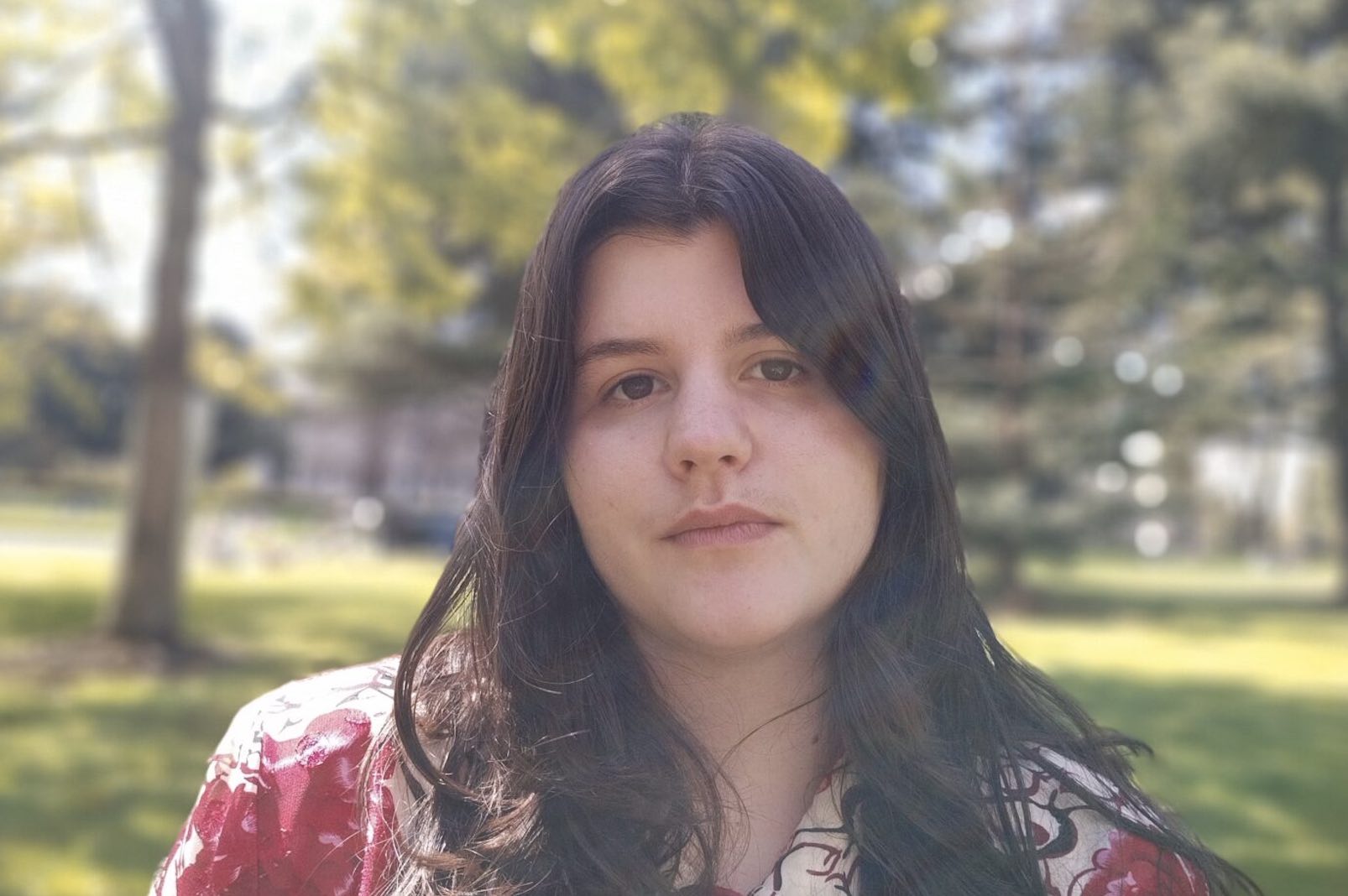
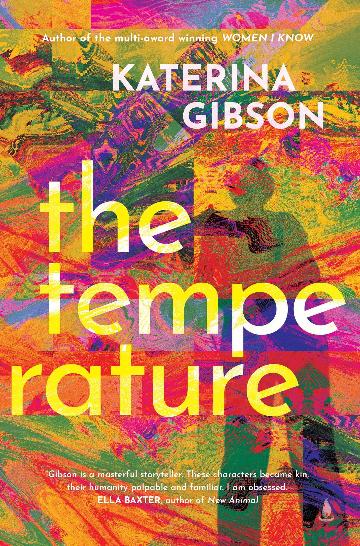
KATERINA GIBSON was a Sydney Morning Herald Best Young Australian Novelist in 2023. Her short story collection Women I Know won the Christina Stead Prize for Fiction in the NSW Premier’s Literary Awards 2023. She has returned with her new novel The Temperature. Good Reading caught up with Katerina to talk about the book and how she came up with the title.
What was the inspiration behind The Temperature?
I started writing this novel in late 2019, so when the bush fires started, when people in Australia began to realise, if they hadn’t already, that we were experiencing climate change. But of course we already were: the Great Barrier Reef had bleached twice in successive years, the Murray Darling Basin had had two major die offs. We were living through this great acceleration of not just extreme weather but environmental disasters. It really felt – feels still – but felt at the time like we were living through the end of the world. It felt like there floods and fires and cyclones every other week on the news.
By the time COVID turned up it was like: oh yeah, that makes sense. Politically too: all over the globe we were seeing the rise of fascism. And I think a lot of novels that were trying to capture that feeling of political and environmental catastrophe were writing the end of the world novel very literally, often spec-fic, and what have you, which there is a place for. But I wanted to write the type of novel I’ve always loved: a multi-charactered book about people, 20th century in sensibility, really. here’s a narrator, there’s something resembling a plot, it’s more about the way were relate to each other and our environment. So I wanted to write a novel about living through the end of the world and set it in contemporary Australia.
 How did the process of writing this novel compare to that of your previous book Women I Know?
Women I Know was much less unruly. That was a collection of stories I’d been writing for a pretty long stretch of years, they were each written individually, and if one didn’t make sense or wasn’t good enough it could be cut. Whereas a novel it can get a little more difficult to contain the longer it gets … and the way I write was often to start from the very start of the novel and read through to where I was I was before writing a couple of hundred words. So more time consuming is my main gripe.
What can you tell us about the six different characters and how their lives become intertwined?
Sidney is over educated and broke and Lexi is rich and Tomas is working class. Fi thinks she is working class but is very comfortably middle class. Lexi was once progressive but now holds some dated opinions. Henry is a bigot, but is also very lonely and traumatised. Fi is young and anxious, Govita is young and carefree and anxious. Sidney is youngish and depressed and Tomas is well and truly in his thirties and beginning to tire of his fuckboy tendencies. They are intertwined: sometimes through work, sometimes as friends, sometimes romantically, sometimes parasocially, sometimes barely.
Can you discuss any challenges you faced while writing The Temperature?
Me and Fi had a bit of trouble – I think it was very hard for me to forgive her more ridiculous qualities. A lot of the challenges in the novel were psychological on my part: I had to find a way to be kind to her. I also struggled with Sidney but I think that’s got more to do with her being the closet to myself in a lot of ways, so with her it was about find difference and distance. But most of the challenges were structural real-world ones. Do I have enough time and space to read and write? IS the space a nice one or am I navigating a difficult roommate? Am I working enough to pay rent and feed myself? am I neglecting the people I love to write this book? Is it worth writing a book if I spend more time with people I made up than I do with real people in the real world? Etc.
How did you land on your book’s title and what’s its significance?
The Temperature went through at least four titles, all of them too serious or biblical or general. So it was a lot of back and forth with Ben via email. I’m learning Italian at the moment and said to Ben that it’s a shame it wasn’t written in Italian because il tempo in Italian can mean both the weather and the time– which are the two main themes in the book. So The Temperature came from phonetically sounding like tempo. We sat with that for a very long time and realised I liked it – I like multiple meanings you can read into it in English as well – it’s a perfect title really, but it was a slow process.
Your novel looks at the deepening gaps between generations – what conversations or reflections do you envision this sparking for readers?
I’m not sure I have any conversations in mind, but perhaps we might do better to understand each other’s perspectives. Especially younger generations understanding older generations, and the historical and social reasons behind certain ways of thinking and how people got to where they are. This is frustrating, because a lot of the time that understanding is not going to be reciprocated – people who have grown up thinking a certain way are not necessarily interested in changing their minds, or being challenged. There is nothing more annoying than being dismissed on a subject that you know, or have thought more about. But I do think we still need to have that capacity to understand, so we don’t get self-righteous. And so we can keep our minds open when we, too, inevitably become bygone.
Which authors or books do your greatly admire?
Authors I love that helped shape this book: Michelle De Kretser, Jennifer Egan, Miles Allinson, Frank Moorhouse, Isabella Hammad, Ben Lerner, Jenny Offill, Ellen Van Neerven, Madeleine Watts, Peter Carey, Jhumpa Lahiri, Helen Garner, Fiona McFarlane, Shirley Hazzard, Thea Astley, Zadie Smith, Richard Powers, Tara June Winch, Josephine Rowe, Shubhangi Swarup, Gabrielle Garcia Marquez, Bernardine Evaristo, Natalia Ginzburg, among many many others.
What are you reading now?
I’m reading Evie Wyld’s The Echoes which I’m enjoying, and I’m reading a non-fiction anthology Venice and The Anthropocene, which I’m loving. Have recently also read The Book of All Loves by Agustín Fernández Mallo, which is brilliant, and Alexis Wright’s Praiseworthy which is genius.
 ABOUT THE AUTHOR
 ABOUT THE AUTHOR
Katerina Gibson was born in 1994. She is a writer and a bookseller living in Naarm. Her stories have appeared in Granta, Overland, The Lifted Brow, Island Online, Going Down Swinging, the Meanjin blog andKill Your Darlings’New Australian Fiction 2020 anthology. Her short story ‘Fertile Soil’ was the Pacific regional winner of the 2021 Commonwealth Short Story Prize. Katerina is a 2021 Felix Meyer Scholar and a Sydney Morning Herald Best Young Australian Novelist 2023. Her short story collection Women I Know won the Christina Stead Prize for Fiction in the NSW Premier’s Literary Awards 2023.
Visit Katerina Gibson’s website


0 Comments