




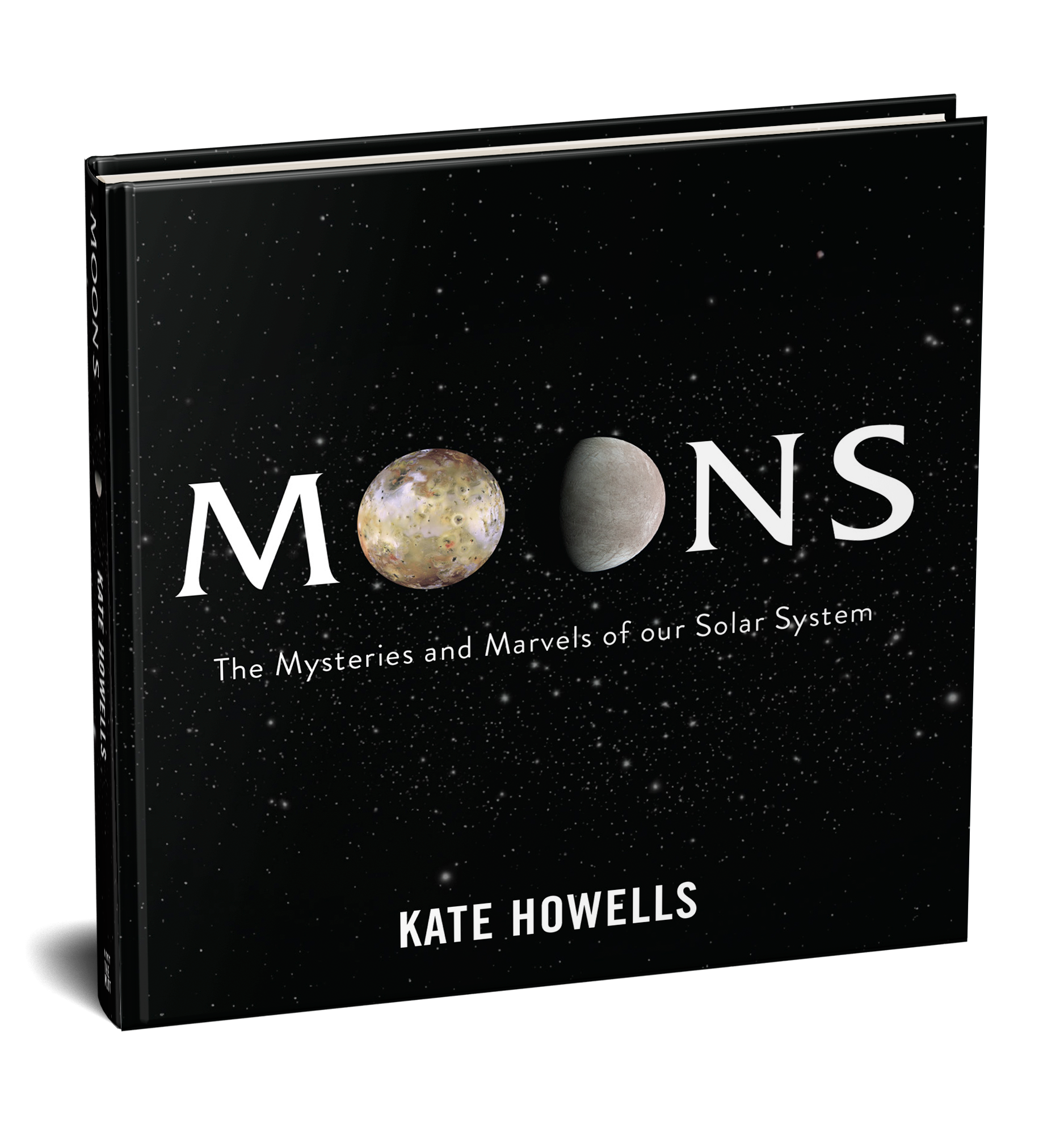
Almost every planet in our solar system has one, so why do we know so little about moons?
Join astronomer KATE HOWELLS on an interplanetary voyage to explore the mind-boggling moons of our solar system, from the volcanic hellscape of Io to the ice mountains and methane seas of Titan.
Illustrated with space photography and artistic interpretations, Moons is filled with unbelievable facts about our own galactic backyard.
Let’s take a peek at one of Saturn’s moons, Enceladus.
ENCELADUS
THE HOSPITABLE MOON
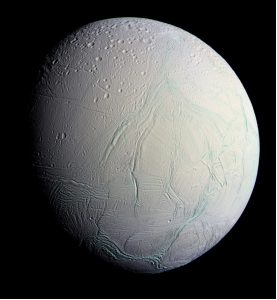
SATURN’S MOON ENCELADUS, IMAGED BY THE CASSINI SPACECRAFT. CREDIT: NASA/JPL- CALTECH/SSI/ KEVIN M. GILL
For a long time, all we knew about Saturn’s moon Enceladus was that it was there, and that it was very bright.
It had been discovered in 1789, but could only be seen as a little dot through a telescope until the Voyager spacecraft flew through the Saturn system in the early 1980s. These fly-bys yielded the first close-up images of Enceladus, but these didn’t spark a lot of exciting discoveries beyond awarding Enceladus the title of brightest object in the solar system. All we saw was a blindingly white snowball world.
A couple of decades later, NASA’s Cassini spacecraft became the first mission to enter into orbit around Saturn to study the giant planet and its rings and moons up close over many years. When Cassini flew by Enceladus in 2005, the little icy moon finally got its chance to impress us.
At the south pole of Enceladus, Cassini observed some very strange features. The whole region is covered in a series of huge, long gashes that the mission team dubbed ‘tiger stripes’.
These stripes are enormous fractures in the surface ice, with long mountainous ridges along either side. Around the stripes the ice appears young, far less cratered than the ice on the moon’s northern hemisphere. The explanation for this area’s rejuvenation came pretty quickly.
As Cassini continued to observe Enceladus, it saw enormous plumes shooting out of the south pole, beyond anything seen on Jupiter’s icy moons. These were extremely large, active cryovolcanoes blasting huge amounts of water, ice, organic molecules and other material into space. Cassini counted more than 100 of these cryovolcanoes in the south pole area alone.
These volcanoes collectively shoot about 200 kilograms of material (mostly water vapour) per second. All of this material exits the volcanoes extremely fast, moving at about 400 metres per second and reaching hundreds of kilometres high.
While this amount of cryovolcanism is a lot to wrap your head around, it makes a lot of sense when you consider two factors: Enceladus’ size and its location.
Enceladus is only about 500 kilometres across. Europa, for comparison, is over 3000 kilometres across, and the rest of Jupiter’s major moons are even larger. Scientists didn’t expect Enceladus to have liquid water in it, since bodies this size and this far from the Sun are normally frozen all the way through.
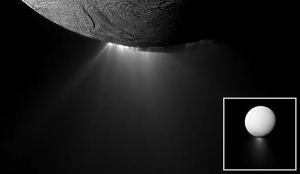 But, like Jupiter’s geologically active moons, Enceladus orbits a humongous planet and has other big moons on either side of it. You know the story from here: the other moons tug on Enceladus, making its orbit around Saturn a bit uneven; it gets squeezed gravitationally and its interior heats up. The effect on Enceladus, though, is very different because it’s significantly smaller than its Jovian cousins – and small size means low gravity.
When cracks form in Enceladus’ icy shell and the liquid water beneath gets pushed out, there’s a lot less holding it back. This is the same reason that volcanoes on a little moon like Io shoot plumes so dramatically high into space compared to the volcanoes that we’re used to here on Earth. With less gravity to pull it back down, the force of an eruption can really blast stuff – be it lava or water – in huge quantities, at breakneck speeds, and to astonishing heights.
A lot of the material erupting from Enceladus’ south pole falls back down as snow, giving the moon its bright, white coating.
But the lighter particles escape the moon’s weak gravity and get swept up into orbit around Saturn. It turns out that Saturn’s widest and outermost ring (called the E ring) is mostly made of material that was spewed out of Enceladus’ interior.
For obvious reasons, the discovery of massive plumes of water shooting from Enceladus was big news. Over the next few years, NASA had Cassini fly past Enceladus a few more times to find out more about this suddenly exciting and important little moon.
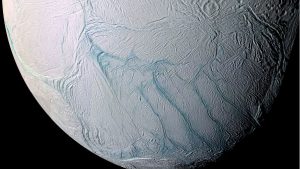
THE TIGER STRIPES’ ON ENCELADUS’ SOUTH POLE, IMAGED BY THE CASSINI SPACECRAFT. CREDIT: NASA/ESA/JPL-CALTECH/SSI.
When NASA built the Cassini spacecraft, they didn’t know that Enceladus had a subsurface ocean spewing out of its south pole, so there were no specific instruments on board to collect and analyse that water. But when the plumes were discovered, the mission team knew they had to get a sample. Luckily, space scientists and engineers are a scrappy bunch of problem-solvers and are famous for coming up with ingenious ways of doing things on the fly. Since Cassini was intended to orbit near Saturn and its rings and moons but not touch them, it was mostly equipped with tools for measuring things from a great distance. Some of these long-distance tools were put to use to analyse the plumes of Enceladus, but scientists were also able to adapt the function of an instrument that was designed to collect and analyse tiny grains of cosmic dust.
For its first encounter, Cassini skirted the edges of the plumes to see if they would damage the spacecraft. When it came out unscathed, the spacecraft made another pass through a denser part of the plumes. This was where a lot of the exciting data showing the chemical composition of the plumes were found.
Cassini’s dip through the plumes showed that Enceladus might just about have the best life-friendly conditions you could ask for. Beneath about 30–40 kilometres of radiation-shielding ice, there is a deep, salty ocean that comes into direct contact with a rocky seabed. That seabed almost definitely has active hydrothermal vents which bring energy into the ocean, helping to create complex molecules like amino acids that are the building blocks of life.
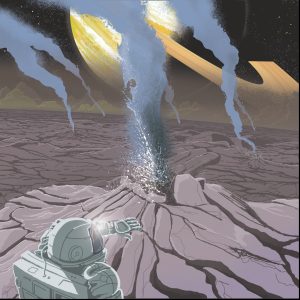
AN IMAGINED VIEW OF AN EXPLORER ENCOUNTERING AN ERUPTING PLUME ON ENCELADUS. CREDIT: GORDON AULD.
What’s almost painfully tantalising about this discovery is that it’s possible that life may already exist in Enceladus’ oceans and may even have been present in the plumes that Cassini sampled. Unfortunately, no amount of creative problem-solving could equip the spacecraft’s instruments to detect this. Figuring out whether something is living is a whole different process from measuring its mass or chemical composition. So until we send another mission to Enceladus to specifically look for signs of life, we won’t know for certain whether this is just a habitable world, or an actual inhabited world.
ABOUT THE AUTHOR
 Kate Howells is a science enthusiast and evangelist whose mission is to get people to feel some awe and wonder about the reality around them. In her day job, she works for an international NGO, The Planetary Society, where she does community engagement and writes about planetary science and exploration. Kate didn’t grow up a space nerd but became one in her twenties, proving it’s never too late to get obsessed with something. Kate lives in Guelph, Canada. Space is Cool as Fuck is her first book.


0 Comments