


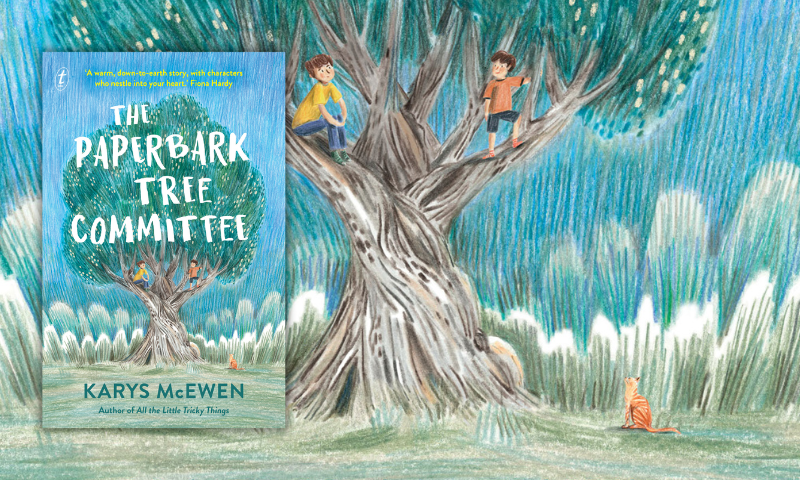
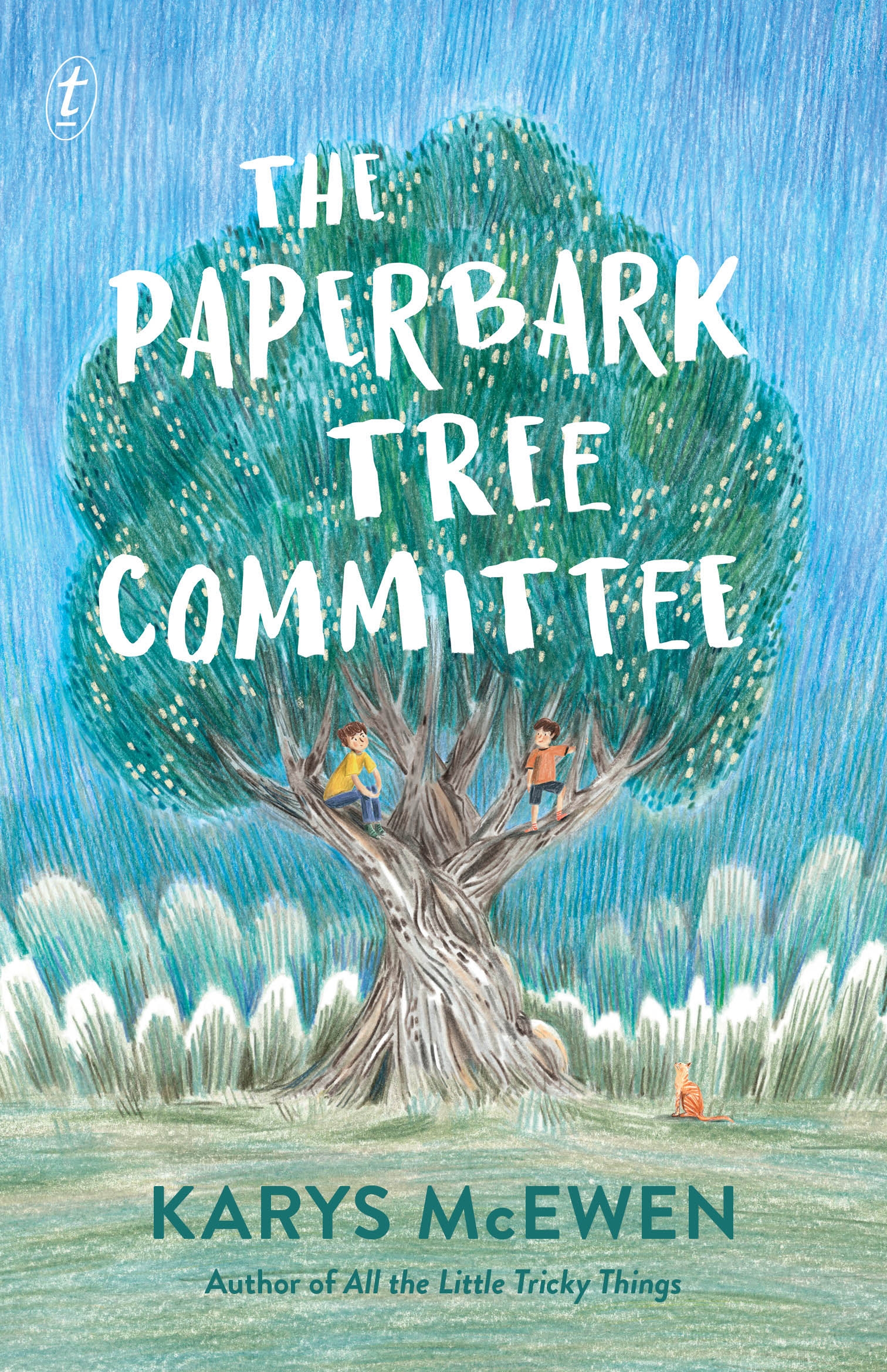
We caught up with author KARYS MCEWEN to discuss The Paperbark Tree Committee, a heartfelt story about growing up and leaving childhood behind.
What inspired you to write this book?
A few things! The title came to me first, alongside the idea of a sibling relationship where one kid is becoming a teenager and starting to grow up a bit more, while the other still has a lot of the innocence of a young child, and the temporary rift that may cause between them. I wanted to write about the made-up games we play as children, and the feeling of leaving them behind as we get older. I also wanted to celebrate chosen family and gaining new hobbies, and write about figuring out where you fit in the early stages of high school. I wondered if I could mix all of this together and come up with a story that felt authentic, and relatable.
While all these things were percolating, a Year 8 student approached me in my school library and asked me for a book about ‘a normal high school boy with normal high school boy worries’ and although I found a couple, I felt there weren’t enough that were suitable for his age (kind of between middle grade and young adult). So, I set about doing my very small part to try and fill that gap.
The paperbark tree is an important symbol in the book. What does it represent to Art and Hilary, and did you have a special place like this growing up?
For Art and Hilary, the paperbark tree is a safe, secretive place where they can support each other through the big and small things that crop up in their lives. It’s a way for them to come up with solutions to real problems, away from the eye of adults or others, somewhere they can just be kids, and also be themselves. I think it’s important that they turned this into a bit of a game; I hope it adds a lightness to it, and a sense of play, even though they are often pondering some really big questions and working out how to navigate some tricky challenges.
And yes, my sister and I did have a special place like this! For us, it was a big old Moreton Bay Fig tree in our backyard. We didn’t have a ‘committee’ like Art and Hilary, but we used to play ‘spies’, and the tree was our base. We had little notebooks and we’d creep around spying on our parents working in the garden, or our neighbours in their yards, and make notes on what they were doing. I just love these kinds of games that kids come up with, where you don’t need anything but your imagination and it feels like a separate world.
Stepmum Sally is a great support for Art. How important was it for you to show a positive step-parent relationship?
I think it was important for me to show that biological parents don’t necessarily have to be the only source of grown-up support in a young person’s life. I’ve been really lucky to have a wonderful immediate family, that has also been enhanced by my connections with the ‘chosen family’ I’ve found. This has included teachers, former-bosses, women I’ve met through the Children’s Book Council of Australia, and other mentors I’ve met through my career and interests. I don’t think you can expect to get all the encouragement or help you need from one person, so although Art doesn’t always have the best relationship with his mum and dad, he’s been able to find support in Sally, and open up to her.
The story deals with making mistakes and learning from them. Was there a particular scene or moment that was especially meaningful for you to write?
Art makes plenty of mistakes, like we all do! For me, it was meaningful to write from Art’s perspective in that he sort-of already knows he’s about to make a mistake, before he even does. I feel like this is a universal experience, and we can develop a lot of shame around things we knew we shouldn’t have done, but did anyway. When Art tries to intervene in his dad and Sally’s relationship, or get revenge on his bully, deep down he knows that both are going to fail, but he goes ahead anyway. We don’t always make the best decisions, and so we need to be able to admit when we’ve been in the wrong and make amends, but also be kind and forgiving to ourselves when we stuff up.
What was the most challenging or rewarding part of writing The Paperbark Tree Committee?
The most challenging part was writing from the perspective of a young male character, and trying to make the brother relationship as real as possible. I have a sister, so I drew on that a little for the sibling dynamic, but I also know that boys that age can operate quite differently, and I wanted to get it right. I spoke to a lot of my students, and male friends, in order to try and write something that rang true.
The most rewarding part was honestly the same thing, if that’s possible! After All the Little Tricky Things, which centres on only-child Bertie, I was keen to explore similar coming-of-age themes in my next story, but from the perspective of a teenage boy, and through a sibling relationship. I hope I’ve pulled it off, and it was a lot of fun to try!
If you could ask young readers one question after they finish the book, what would it be?
I’d love to know which moments, even if they’re very small, they could relate to. Was it the fact that Art finds he doesn’t fit neatly in any one box? Was it discovering how enjoyable running could be? Was it secretly never having seen the Star Wars movies? I really like it when readers are able to see themselves, even in a very slight way, on the pages of the stories that I write. I hope that there’s a mirror in each of my books in some way, for all young people.
ABOUT THE AUTHOR
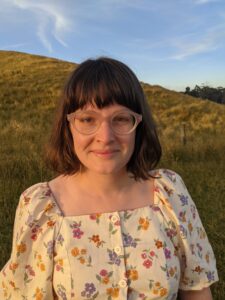 Karys McEwen is a school librarian, bookseller, vice president of the Victorian branch of the Children’s Book Council of Australia, and education advisor for the Melbourne Writers Festival. She is passionate about the role libraries and books can play in the wellbeing of young people, and she writes the substack ‘I Read A Lot’.

0 Comments