



The Ministry of Time is an original and fun fusion of ideas from debut author KALIANE BRADLEY.
We chatted with the author about her inspirations and research process.
ABOUT THE BOOK
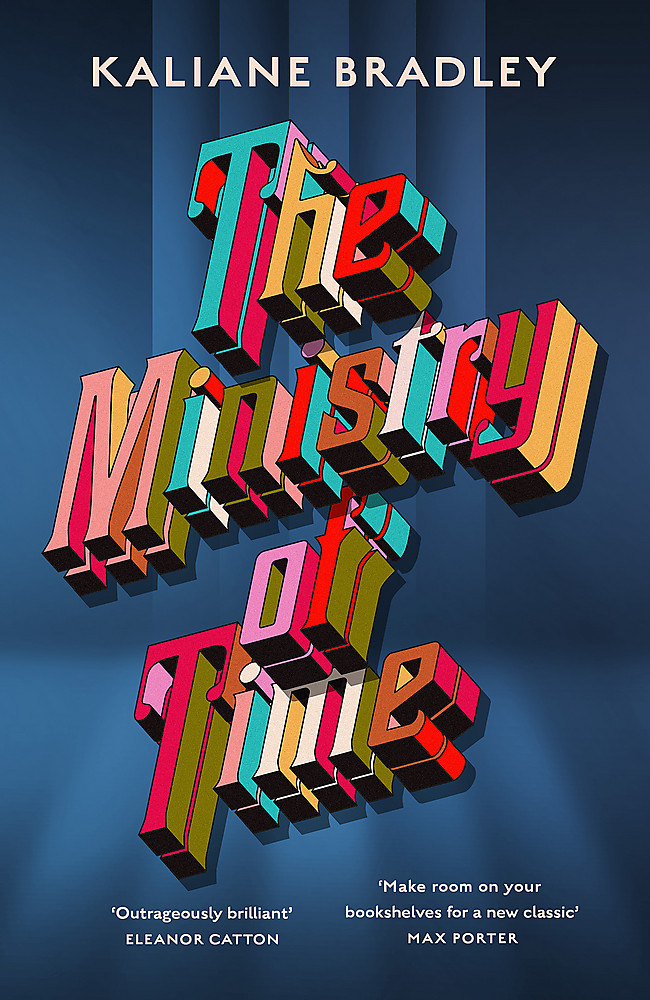 In the near future, a disaffected civil servant is offered a lucrative job in a mysterious new government ministry gathering ‘expats’ from across history to test the limits of time-travel.
Her role is to work as a ‘bridge’: living with, assisting and monitoring the expat known as ‘1847’ – Commander Graham Gore. As far as history is concerned, Commander Gore died on Sir John Franklin’s doomed expedition to the Arctic, so he’s a little disoriented to find himself alive and surrounded by outlandish concepts such as ‘washing machine’, ‘Spotify’ and ‘the collapse of the British Empire’. With an appetite for discovery and a seven-a-day cigarette habit, he soon adjusts; and during a long, sultry summer he and his bridge move from awkwardness to genuine friendship, to something more.
But as the true shape of the project that brought them together begins to emerge, Gore and the bridge are forced to confront their past choices and imagined futures. Can love triumph over the structures and histories that have shaped them? And how do you defy history when history is living in your house?
MEET KALIANE BRADLEY
The Ministry of Time is your debut novel – what inspired your foray into writing a novel?
It happened by accident! (I always feel like I’m at the scene of a crime when I talk about the genesis of the novel. ‘I’m so sorry, officer, I didn’t mean to write the novel, it just… happened.’) The text that would eventually become The Ministry of Time started as a literary parlour game – a joke, for a group of friends, the sort of joke that begins Imagine if a historical figure lived in your house…
What sparked the idea for The Ministry of Time?
During the pandemic, I got very into John Franklin’s lost 1845 expedition to the Arctic. I became obsessed with this expedition, historical polar exploration in general, and one officer – Graham Gore – in particular. I went looking for archival material about him, but there wasn’t much. So I had to start extrapolating details, filling in gaps creatively, and eventually dragging him into the 21st century so I could get a proper look at him, literarily speaking.
Commander Graham Gore finds himself in a future world. How did you approach crafting his character and navigating his experiences in world vastly different to his own time?
The honest answer to this is that I became so deranged about a dead man that it felt effortless to keep up his half of the conversation – and he was an explorer, after all, so often found himself in new and surprising environments. But there are some helpful indicators in contemporaneous accounts. A colleague once called him, ‘a man of great stability of character, a very good officer, and the sweetest of tempers’. I used that descriptor like a compass when it came to crafting his character.
The relationship between Gore and the ‘bridge’ is central to the story. What were the key dynamics you wanted to explore between them?
Firstly, I think arch flirting between two people attracted to but nervous of one another is fun to write and also read. Much Ado About Nothing is probably the best Shakespeare comedy because of it. So there’s that. But, the fact is, you can’t write about a historical polar explorer without also coming to terms with the British imperial project; you can’t be interested in historical polar exploration without confronting it. I wanted to explore the friction between the values of a 19th century white man and a 21st century white-passing woman, both of whom were ‘officers’ of their respective era’s governments: what has changed, what meshes, what is different?
In The Ministry of Time ‘expats’ from various time periods are brought back to the 21st century – how did you research and integrate these historical elements?
Arthur Reginald-Smyth, who is pulled from the First World War, was easiest. I feel like I have absorbed a great deal about Edwardian-era Britain from reading Edwardian-era fiction. E M Forster really lit my way here. Margaret Kemble, who is pulled from the Great Plague of London, was harder. A Journal of the Plague Year by Daniel Defoe and Samuel Pepys’s diary formed a base, but Margaret is, I hope, very unlike what you might expect from a woman of her era – a lot of her is a jumble of my best friends. Ultimately it was about knowing what to discard of my historical research, and what was most joyful and crunchy to write. I place a lot of emphasis on having fun when I’m writing. Otherwise I never get my writing done.
The time travel genre often explores difficult ethical problems – how did you go about navigating this in your own story?
The time-travel element I was most interested in exploring was not time-travel itself, or timeline-altering consequences, which is why there is essentially no time-travel on the page in The Ministry of Time; instead, I was interested in the parallel between being whisked from history and placed in 21st century Britain as a refugee from time, and being whisked across the globe and landing in 21st century Britain as a refugee from another country. I wanted to see Britain from ‘outside’, the myth of it, the culturally imagined version, and these ‘expats’ from time were a great way to do that. I don’t think the refugee experience should preclude joy or companionship or exciting discovery, which is why I wanted to show these ‘expats’ thriving as well as struggling.
What was the most challenging part of writing this story?
Deciding how much I wanted to bring in Cambodia. The book’s narrator is, like me, British-Cambodian, with a family history of refugeeism. I wanted to draw on elements of my family’s experiences and my personal experience to enrich the book, but I didn’t want it to be read in any way as autobiographical, or for the narrator to be understood as me.
What do you hope readers take away from The Ministry of Time?
That we don’t need to travel into the past to change the timeline – we can change the future with the decisions we make today. That individuals matter and that the narrative imperative of history can be resisted. That Graham Gore is really hot.
ABOUT THE AUTHOR
Kaliane Bradley is a British-Cambodian writer and editor based in London. Her short stories have appeared in Electric Literature, Catapult, Somesuch Stories and The Willowherb Review, among others. She was the winner of the 2022 Harper’s Bazaar Short Story Prize and the 2022 V. S. Pritchett Short Story Prize. The Ministry of Time is her first novel.



0 Comments