




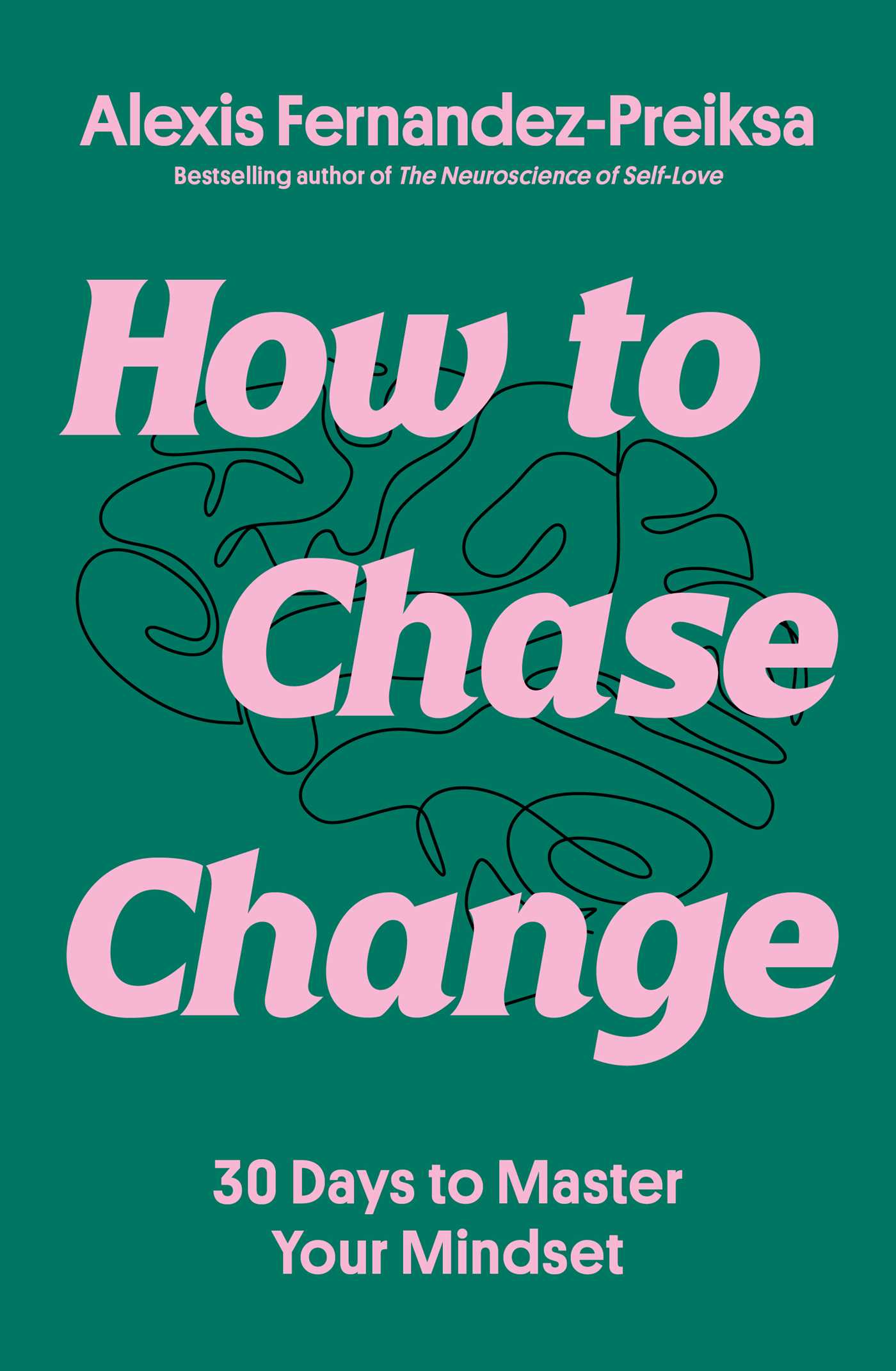
Alexis Fernandez-Preiksa is the host of the podcast Do You F*cking Mind?. In How to Chase Change Alexis offers you the ultimate guide to shifting your mindset to create the change you envision for your life – from your physical and mental health to your relationships, career, self-confidence and beyond – in a step-by-step 30-day program.
Read on for an extract …
ABOUT THE BOOK
Host of the hit podcast Do You F*cking Mind? offers you the ultimate guide to shifting your mindset to create the change you envision for your life – from your physical and mental health to your relationships, career, self-confidence and beyond – in this actionable, step-by-step 30-day program.
If you want to change your life, but you don’t know where to start, know that you already possess your most powerful tool: your mind. How to Chase Change is the ultimate guide to utilising your mindset to become your best self. This 30-day program covers everything from turning aspirational goals into action, increasing self-confidence and overcoming heartbreak, to eliminating negative self-talk and committing to small changes that will help you achieve big results.
Each module is designed around timeless wisdom you can return to again and again as you work through different challenges and transitions. Alexis combines fascinating tidbits of research on the human brain, poignant inspirational moments, and insight from her own experiences to give you everything you need to create lasting, positive change. How to Chase Change improves your mental, physical, and emotional health one day at a time.
Alexis Fernandez-Preiksa, neuroscientist is known for her no-holds-barred, tough love attitude, and accessible approach to scientifically proven mindset hacks.
**********
EXTRACT
 Today is day one of 30, the first step toward making changes in your life to master your mindset. During the next 30 modules, you will have access to tools that will help you procrastinate less, improve your focus, become more decisive and clear on what you want, feel confident in your own skin, feel more confident in your relationships, and feel happier and more satisfied overall.
By putting into action certain behaviours, removing others, and simply changing how you approach your own thoughts, you will notice a difference in how you feel and how you show up in the world in a very short amount of time. In this book, my aim is to have you focus on what you can achieve within your own mind. To do that, it’s important to have a clear idea of where you are now and where you want to go, from a brain and mind perspective. This program is not about how to gain external or material things; it is focused on your internal power, and concerned with how you feel on a daily basis and your outlook on life.
Have you ever heard the saying, ‘Fix your own home before you fix others’? Well, here I want you to work on your own home (your brain and mind) before you target all those other, external things. And that’s why understanding identity is the most important place to start.
Now, before we get started, you may be wondering how the brain and mind differ. In this book, you will see me talk about the brain and mind as two intertwined but distinct things. While they are heavily involved with each other, and you cannot have one without the other, they are still separate. The brain is a physical organ, consisting of neurons, glial cells, blood vessels, fluids, and grey and white matter. It is separated into different regions that perform different tasks, and it can be observed. The mind cannot be observed directly: it is the intangible home of thoughts and all of our feelings and emotions.
Think of the brain as hardware, and the mind as software. Both influence each other significantly but serve a unique purpose. Exercises within the mind, regarding how you think and learn to process things, influence how regions of the brain may be connected and wired or strengthened. And changes in the brain, like injury, atrophy, or increases in volume caused by physical exercises, will impact your mind via your mood and your emotional and mental health.
The mind is the most variable factor when you look at happiness, performance, determination, and overall success.
It is what controls your physical self, what sets beliefs, what drives you or gets in your way: it is what determines if you will give up on something or keep trying. And understanding your mind begins with understanding your identity.
1.1 Get set up for success
The first neuroscientific concept I want to share with you is something called a schema. This is, to put it simply, a way of thinking and behaving that you use to interpret and understand the world. It’s how you organise the information that comes into your awareness for your brain to work more efficiently – and the brain loves efficiency! We have four kinds of schema: objects, self, roles, and events. And like a lot of processes in the brain, these can be edited and changed throughout your lifetime, several times over.
Jean Piaget, a Swiss psychologist in the 1900s, created a cognitive theory explaining how a person can change their schema with the term ‘adaptation.’
According to his work, there are two different methods of adaptation: assimilation and accommodation.
Assimilation is where you incorporate new information into existing beliefs or structures. So, for example, if you were to come across a new piece of information that aligns with your current beliefs, then these things would integrate together and strengthen the current understanding or idea you have of the world. For example, imagine if you only ever saw black cats, and then one day see an orange cat. You would know by assimilation that this animal was also a cat.
Accommodation is different. This requires modifying and expanding existing cognitive structures. This may happen when we encounter information that challenges current ideas – something that forces you to actively adapt in order to accommodate these new experiences that do not easily fit in with your existing schema. Let’s say, for example, you were raised to fear or dislike a certain group of people. You believe, based on what you had been taught or how you had been raised, that these people are essentially bad. Then one day you have to interact with this group of people and realise they are fun, kind, and share similar values and beliefs to yours. This changes everything you thought you knew about them. So, you now have to dig into that belief pattern you held and restructure what you thought about this group. Because that belief was challenged, you can no longer go on believing what you did – it no longer makes sense in your mind.
The mind is the most variable factor when you look at happiness, performance, determination, and overall success.
This concept applies not only to the world around us but as a kind of self-reflection. Accommodation is a great way of changing our beliefs about ourselves and what we are capable of doing, achieving, or having. If you can question your beliefs when necessary, you will be able to expand on your existing structures, challenging thoughts about your own abilities and what you deserve.
That is exactly what I’m here to teach you: your ability to expand on your existing cognitive structures that will show you a new way of experiencing your life, relationships, and the world. So be prepared to do a lot of accommodating in the next thirty days. Especially when it comes to statements about yourself.
The next concept I want to explain is cognitive bias. This is when people create their own version of reality based on how they perceive information that is coming in, and not necessarily paying attention to all the objective information that’s in front of them. An example would be saying something like, ‘Everyone in this city is rude,’ then constantly highlighting all the rude encounters you experience. You’re not paying attention to the people who are polite, and you use the evidence of the rude people to confirm your belief, ignoring all other information in front of you. Or, you could say, ‘All men are assholes,’ because you had a bad experience with dating a few men, and have seen some of your friends in bad relationships with men.
This becomes your bias, and it’s difficult for you to give a great man a chance, or to admit how great other men are because you’re always looking for instances and examples that confirm this bias. Anything that negates this bias is overlooked.
Cognitive bias does not align with logic or reasoning, but it does shape how we make decisions, how we behave, and how we judge things outside of ourselves. In the modules to come, I will give you many examples of how you may be biased to believe something, and how you can challenge those beliefs to change how you experience the world. As you become more self-aware, you will start to notice many areas in your thought processes where you hold a bias, and where that bias can be detrimental for you. Learning to debate with yourself and argue both sides is a great way to challenge any bias you may hold, which will help you not only become more open-minded but process pain and adversity in a healthier way.
As you are starting to see, you hold an incredible amount of power in your own mind. And right now, we want to channel that power toward goal setting. I want you to under- stand the importance of having a goal that is tied only to the progress you make within your mind. I want you to see what that would look like, and how that can be measured. Because when you understand what it feels like, you can seek it out.
Having goals that involve things outside of you (relationships with others, careers, many experiences, family) are awesome. But without nailing the goal of strengthening the mind first, it’s a game of luck. Will I have a healthy relation- ship? Will I have a career in which I succeed and thrive? Can I get all the money I dream of having so I can pay for the things I want? SO many of these answers can be unlocked by first addressing your mindset.

ABOUT THE AUTHOR
Alexis Fernandez-Preiksa is the creator and host of hit podcast Do You F*cking Mind? and helps people to align their physical and mindset training every day through no-nonsense, science-backed advice. She’s released over 300 episodes of the show since its launch in 2020. She is also the author of Be Bold: Manifest Your Dream Life and The Neuroscience of Self-Love. She lives in Sydney.


0 Comments