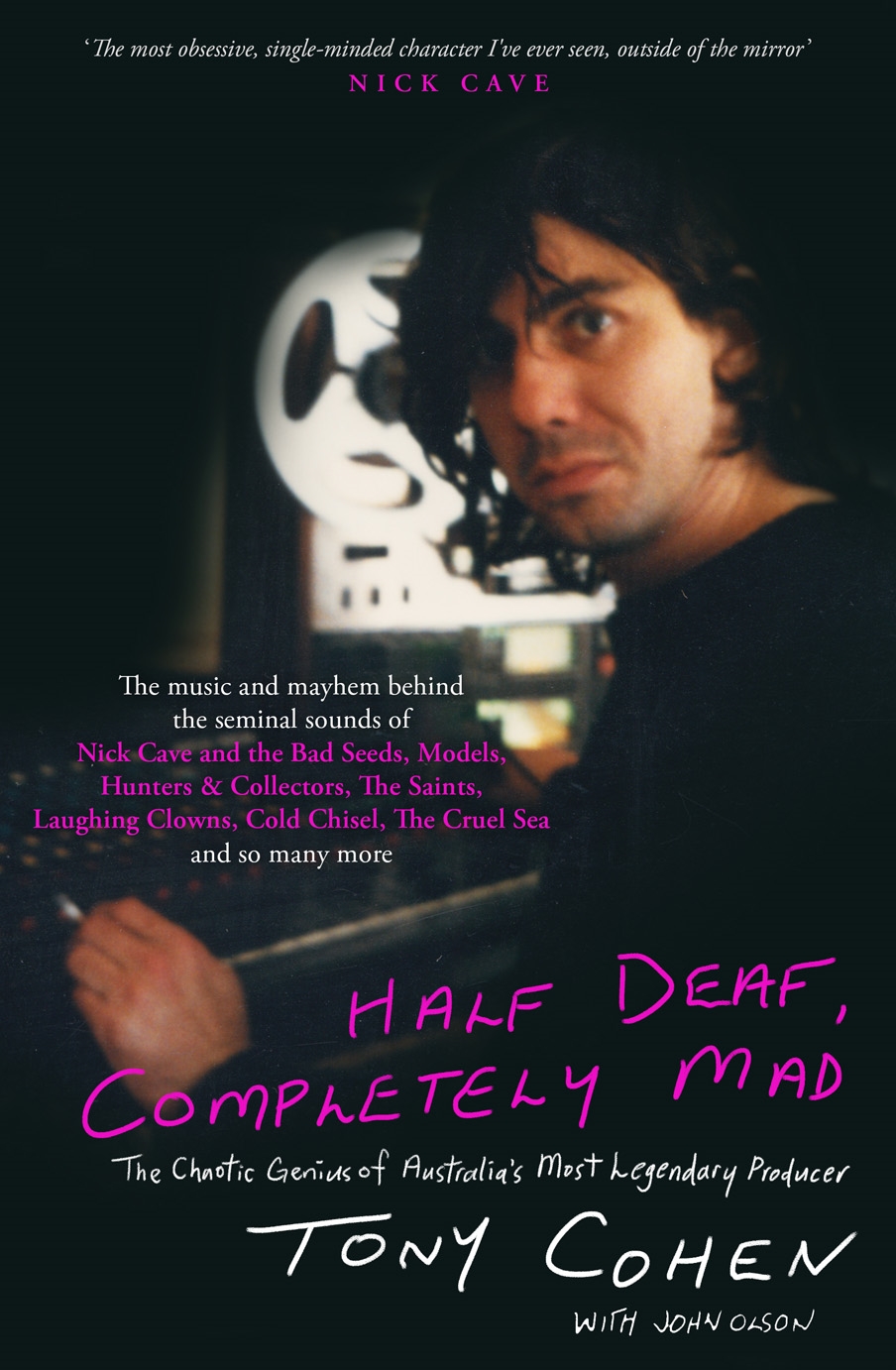
In Half Deaf, Completely Mad, TONY COHEN shares with us the music and mayhem behind the seminal sounds of Nick Cave and the Bad Seeds, Models, Hunters & Collectors, The Saints, The Go-Betweens, Cold Chisel, The Cruel Sea and so many more. Read on for an extract.
Door, Door (1979)
One band that stood out was The Boys Next Door. I first met Nick Cave, Rowland S. Howard, Mick Harvey, Tracy Pew and Phill Calvert at Richmond Recorders in January. I appeared shoeless, red-eyed and late. As usual. The grand piano was overflowing with bits of metal, microphone stands, anything that wasn’t nailed down. ‘That should sound interesting,’ I said.
It was the start of a great love affair.
I didn’t know The Boys Next Door, they were just another band coming to the studio to record. It wasn’t like later years when people would ask to work with you, or perhaps not go anywhere near you! Back then I was the house engineer, so they had to work with me. Side one of Door, Door had been recorded with producer Les Karsky prior to Rowland joining the band. It didn’t go well. Nick was asked to double track his vocals. It’s a recording technique that involves singing the songs exactly the same way twice. That’s how Karsky knew to make records, but it was never going to work with The Boys Next Door.
Nick had his own way. He’d jump about all over the place, tearing headphones out of the wall. We’d often end up with only one pair left. I didn’t give a shit – these guys were going to break new ground and that suited me just fine.
T.C.
One of the most valuable things a band can have is an outside opinion, offering ideas where necessary. When you’re close to something and working on it intently you can often miss things that are obvious. Not to say everyone will agree.
Rowland wrote most of the tracks on side two of Door, Door, but I wasn’t familiar with his earlier Young Charlatans’ version of ‘Shivers’ when I suggested that he sing the track. Two vocals were recorded: one from Nick, and the other Rowland. Finishing late at the studio and feeling wound up, we’d sometimes head out to Tullamarine airport, the only place to get a drink at that time of night. I argued that hearing another voice on the album would provide a good contrast, much like Keith Richards singing the odd Stones track. Nick, however, wouldn’t have a bar of it. ‘No, I’m the singer. We’re not using Rowland’s vocal.’ I admitted defeat. He’s a proud man and didn’t want anyone else singing on the record. I still think I was right, the sound of Rowland’s lovely deep voice, but Nick’s version is pretty good too.
*L|STEN* ‘Shivers’ – The Boys Next Door
I became very influenced by The Boys Next Door. I got my hair cut and bought a pair of shoes! I wasn’t much interested in the punk thing, but the drugs and ratbagginess of it all was fantastic. For me, it was a chance to get a bit more out of it and be a little less responsible. Yeah, I thought. This is the way to live!
T.C.
I have a huge amount of respect for Mick Harvey. We taught each other a great deal. Aside from Molly’s theories, I learnt more from Mick than I did even from Roger Savage and Ernie Rose. They taught me the technical stuff, but doing things different? Mick had so much to do with that.
Mick was good at describing what he was looking for in a certain instrument or blend of instruments. He was a natural. ‘Why are you putting reverb on that?’ he’d ask. I’d explain it might give the mix depth to push one instrument back or bring another forward. ‘Oh yeah,’ he’d say. ‘Why not try this?’ Mick was easy to understand because he never complicated things. It was my job to work out where to put microphones to make instruments sound good. He had no idea about that and wasn’t particularly interested either. Mick just knew what he wanted to hear.
Richmond Recorders was a small 1970s non-reverberant design, acoustically dead. I started to move the drums out of the booth and into the live area of the studio. I’d put microphones in the corners of the room, facing away from the drums, to pick up sounds reflecting off the walls. I tried the technique on lots of instruments. You can get great sounds mixing together three or four ambient signals.
T.C.
On ‘The Hair Shirt’, Nick sang through a telephone. It was hysterical. He wanted a screechy voice underneath his lead vocal, so I gave him the studio phone. I ran upstairs to the office, picked up the handset and set up a microphone to record the speaker. The sound was piercing. It blew your head off, but combined with the lead vocal it sounded great.
*L|STEN* ‘The Hair Shirt’ – The Boys Next Door
Rowland always wanted more treble on his guitar, so I brought in sheets of corrugated iron and made a tunnel covering his amp, with contact mics placed all the way along. It sounded awesome, completely over the top, which was exactly what he wanted. Tin exaggerated the treble frequencies. Unfortunately, we couldn’t use much of the sound in the mix because it destroyed everything else. I tried the technique on kick drums but it didn’t work, it just made the fillings pop out of your mouth. We were experimenting a great deal. Not all of it was brilliant, but it’s nice to explore.
I often drove the band home after sessions, all piled into the back of my Mini. Tracy cracked the back window, the bloody boofhead! After the Kombi debacle I had bought another van. I almost got talked into buying a Mini Moke convertible. Can you imagine them in the back of that?
T.C.
Michael Gudinski lost The Boys Next Door because he couldn’t deal with them. Keith Glass took over managing the band and that’s when things got interesting. He had played in bands in the 1960s and ran a record store and label called Missing Link.
I became closely connected to the underground scene, but I never followed trends. I still don’t and prefer to stumble through blindly. It’s good because you can’t copy things if you don’t know what they are. I’m very grateful to Keith because he brought me fantastic acts to record: The Boys Next Door, Laughing Clowns, The Go-Betweens. At the time, I didn’t listen to much music. I was busy working with the hippies and these were the punks about to emerge from it all. They were a different lot, but I fell into it quite comfortably.
The musicians were the same age as me.
Keith and I worked together for a while. He co-produced The Boys Next Door’s Hee Haw EP. We respected and understood each other but never became close as a production team. I wish we had, we could have done some good work together, but it didn’t come about. After Door, Door The Boys Next Door didn’t want a producer, just an engineer they could trust. They wanted to express themselves without any rules.
ABOUT THE AUTHOR
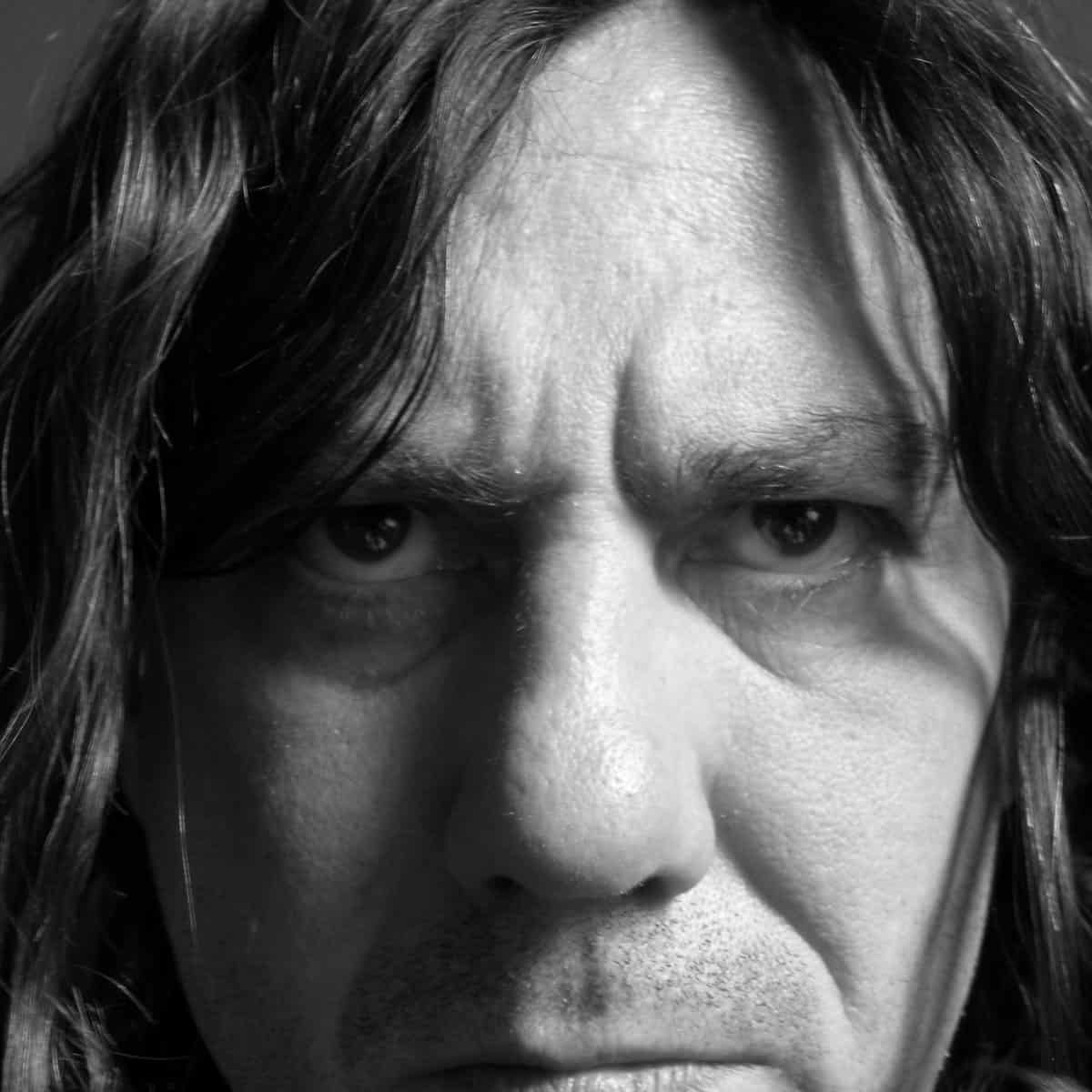
Tony Cohen started out as a 15-year-old dubbing boy at Armstrong Studios and went on to become the most sought-after music producer in Australia and the winner of three ARIA awards.
Tony Cohen defined Australia’s punk and rock sounds in the late ’70s, ’80s and ’90s. His long and celebrated career took him from the studios of Melbourne and Sydney to West Berlin and London’s Abbey Road, working with innumerable bands up until his death.
Cohen had been a long-term alcohol and drug user, his health deteriorated in the 2010s and he died in 2017 at Dandenong Hospital, aged 60. In November 2017 he was posthumously inducted into the Music Victoria Hall of Fame.




 Tony Cohen started out as a 15-year-old dubbing boy at Armstrong Studios and went on to become the most sought-after music producer in Australia and the winner of three ARIA awards.
0 Comments