



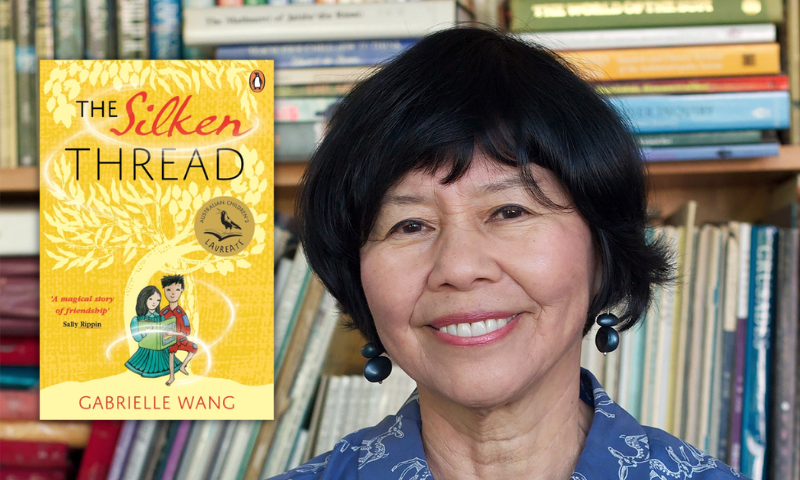
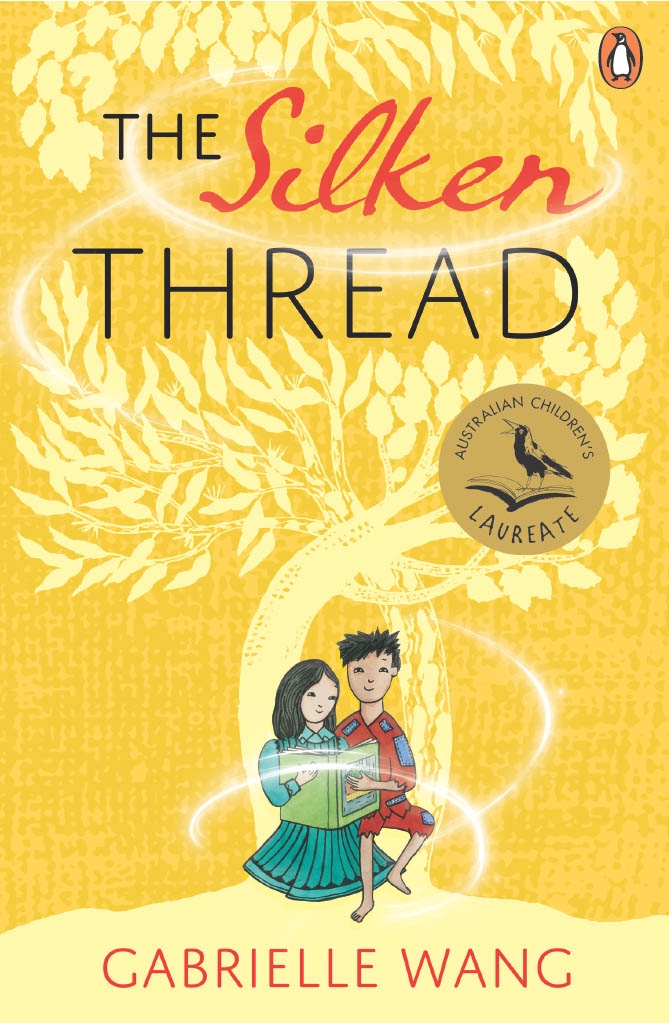
GABRIELLE WANG’s book The Silken Thread is a magical story of friendship forged over distance between two children, from very different worlds, who share a common experience of loss and a passion for a life where dreams can come true. Read on for a Q&A.
What sparked the idea for The Silken Thread?
I was reflecting on my parents’ deep connection and love for one another, which seemed to have roots stretching back to their childhoods. It struck me as quite remarkable given their very different upbringings – my mother was third generation Chinese-Australian, her paternal great grandfather came to Australia in the 1830’s and she grew up in the suburb of Carlton in Melbourne. My father on the other hand was from Jiangsu Province in China. It was actually World War II that brought them together when my father was stationed in Melbourne as a soldier with the Chinese Military Mission. I often find myself drawn to creating stories where disparate worlds intertwine, and I had an idea that perhaps a magical silkworm cocoon could serve as the catalyst for the two children meeting in a parallel dimension. Silkworms played a big part in my father’s life when he was growing up in the countryside in China.
What can you tell us about Moonie and Little Dipper’s bond?
The character of Moonie was inspired by my mum. Like her, Moonie has a passion for drawing and designing clothes. But Moonie’s life in Carlton is thrown into uncertainty when her Ma Mi is sent away following a nervous breakdown. It is during this tumultuous time that Little Dipper enters her life, arriving on a magical silkworm thread. Little Dipper faces his own challenges in China. His greatest wish is to go to school, but his parents are poor peasants and the need to help out on his family’s farm takes precedence over his education. Because of their individual hardships, Moonie and Little Dipper forge a deep bond.
In what ways have you drawn from your heritage to shape this book?
My mother completed her memoir the year she passed away at the age of 92. She was a wonderful writer and it contains detailed accounts of her childhood growing up in Carlton. I wanted the same authenticity when it came to my father’s childhood but he wasn’t one to dwell in the past, and since he died relatively young, I never had the opportunity to ask him. All he ever shared with us was that he lived on a farm with his mother, father and four brothers in a one-room mudbrick house with a dirt floor. Luckily his younger brother shared much of their childhood with me including how my father had to walk many li to school in the dark, the way haunted by ghosts, the will o’ the wisp, Japanese pirates and wild animals. Many of these stories found their way into The Silken Thread.
What drew you to the magical elements in this story?
In my daily life, I often encounter odd occurrences that feel like glimpses into other realities, which is why I often explore magical realism in my novels. A particularly strange incident happened when I was writing a scene for The Silken Thread. In this scene, Moonie’s brother accidentally puts his finger under a Chinese chopper just as Granny is bringing it down on a chicken bone. Poor Floppy’s pointer finger is severed. Later that same day, when I went to the laundry to do some washing, I found in the sink a severed pointer finger from one of my green rubber gloves. It looked as if it had been cut with scissors. I couldn’t help but smile at the thought of a playful ghost or djinn causing such mischief.
What was your favourite part of writing this book?
I had never thought about this before but now I realise that one of the most rewarding aspects of writing this novel was the opportunity it provided to delve deeply into my parents’ early lives. This was particularly meaningful when exploring my father’s childhood. Since he worked so hard and died when I was in my 20s, I never had the chance to know him. However, by imagining him as a young boy growing up in China in those difficult times, I gained a deeper understanding of him as a person.
Describe this book in three words.
Friendship Perseverance Destiny
ABOUT THE AUTHOR
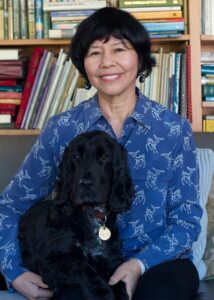 Gabrielle Wang is an author and illustrator, and the Australian Children’s Laureate for 2022 to 2023. Born in Melbourne of Chinese heritage, her maternal great-grandfather came to Victoria during the Gold Rush and her father was from Shanghai. Her stories are a blend of Chinese and Western culture with a touch of fantasy.
Gabrielle’s first children’s novel, The Garden of Empress Cassia, won the 2002 Aurealis Award, was shortlisted for the Queensland Premier’s Literary Awards and was a CBCA Notable Book. The Pearl of Tiger Bay was shortlisted for the 2004 Aurealis Award and The Lion Drummer was a Notable Book in the 2009 CBCA Book of the Year Awards. A Ghost in My Suitcase won the 2009 Aurealis Award, was a CBC Notable Book, was shortlisted for the 2011 Sakura Medal and received a Highly Commended in the 2010 Prime Minister’s Literary Awards. Her first young adult novel, Little Paradise also received a Highly Commended in the 2011 Prime Minister’s Awards. Gabrielle’s picture book The Race for the Chinese Zodiac (2010) illustrated by Sally Rippin and Regine Abos was a Notable Book in the CBCA Awards for 2011 and shortlisted for the 2011 YABBA and WAYBRA awards. Gabrielle created two characters, Poppy and Pearlie, for the highly successful Our Australian Girl series.
The Wishbird was a CBCA 2014 Notable Book and was shortlisted for the 2014 Australian Book Design Awards, Yabba Awards, Kroc Awards, Koala Awards, Cool Awards and Crystal Kite Award. Zadie Ma and the Dog Who Chased the Moon was shortlisted for the 2023 Prime Minister’s Literary Awards, the New South Wales Premier’s Literary Awards, and the Queensland Literary Awards.
Gabi’s books also include the suspenseful The Beast of Hushing Wood for middle readers, and a sequel to the award-winning A Ghost in My Suitcase called Ting Ting the Ghosthunter.

0 Comments