


 During the holidays I read a very enjoyable and different little novel called Life Hacks for a Little Alien by Alice Franklin. It’s the story of a little alien, a girl, who doesn’t fit in, feeling like she’s from another world. She is relegated to a class for slow readers. Her home life is challenging with a mum dealing with mental health issues and a dad trying his best to hold everyone together. When our little alien finds information about the Voynich manuscript she becomes obsessed with learning about it. When she is sent to the library on weekends, she spends countless hours asking questions of the librarians and researching the manuscript. Her knowledge grows as events and the world around her turns.
I really enjoyed this book, but it also prompted me do my own research on the manuscript as I was intrigued.
The Voynich manuscript is an illustrated codex, an historical ancestorial format of the modern book. ‘Technically, the vast majority of modern books use the codex format of a stack of pages bound at one edge, along the side of the text.’ Now the term codex is mostly used for older manuscripts, which used vellum, parchment and papyrus.
In contrast to the paged codex format there were books published previously in varying ways, from long scrolls to continuously folded pages, like a ‘concertina’. The Romans created wax tablets, which were made of wood and covered in wax. They used a stylus to write on the wax.
The creation of the codex was an almighty leap forward for the design of the book, which equates to the world-changing event of the invention of the printing press. This form of the book has never changed since that time. How many inventions in the world can you say have lasted so long with no sign of change? Even the e-book and audio book haven’t managed to even scratch the surface of changing the printed bound book.
 But back to the Voynich manuscript.
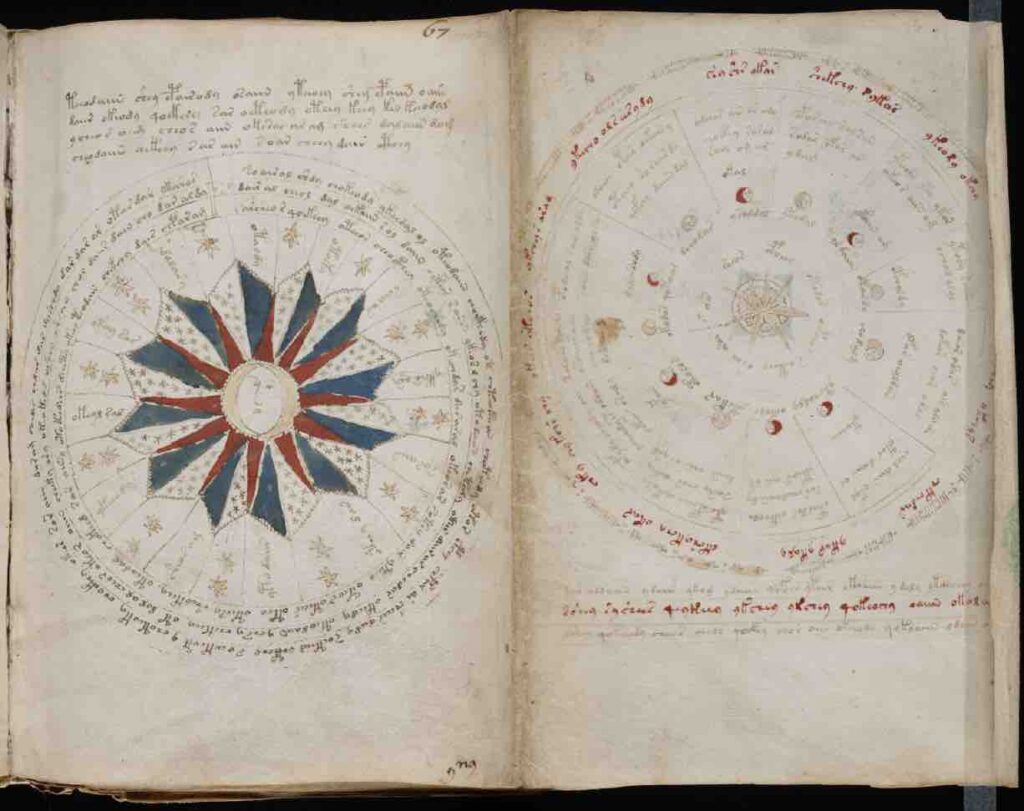
The manuscript is in hand-written text (possibly by more than one person) in an unknown script referred to as Voynichese. It is made of vellum, prepared animal skin or membrane, and radiocarbon dating puts its creation to around early 15th century (1404–1438). It is an enigma. No-one really knows the origins, who wrote it, or what its purpose is.
‘Hypotheses range from a script for a natural language or constructed language, an unread code, cypher, or other form of cryptography.’ It could even be a hoax, or a novel. It’s been speculated that it might be a reference work of some sort such as an index or compendium. It is named after Wilfrid Voynich, a Polish book dealer who bought the manuscript in 1912. Codebreakers from World War II have studied the manuscript but failed to understand it. Professional cryptographers and many amateurs have had a go. But it’s meaning remains elusive.
The Voynich manuscript is about 240 pages long, but it appears that some pages are missing. It also has unusual fold-out pages so that adds to the length. There is a suspicion that the pages were in a different order at some stage which adds to the mystery and challenge to decipher it.
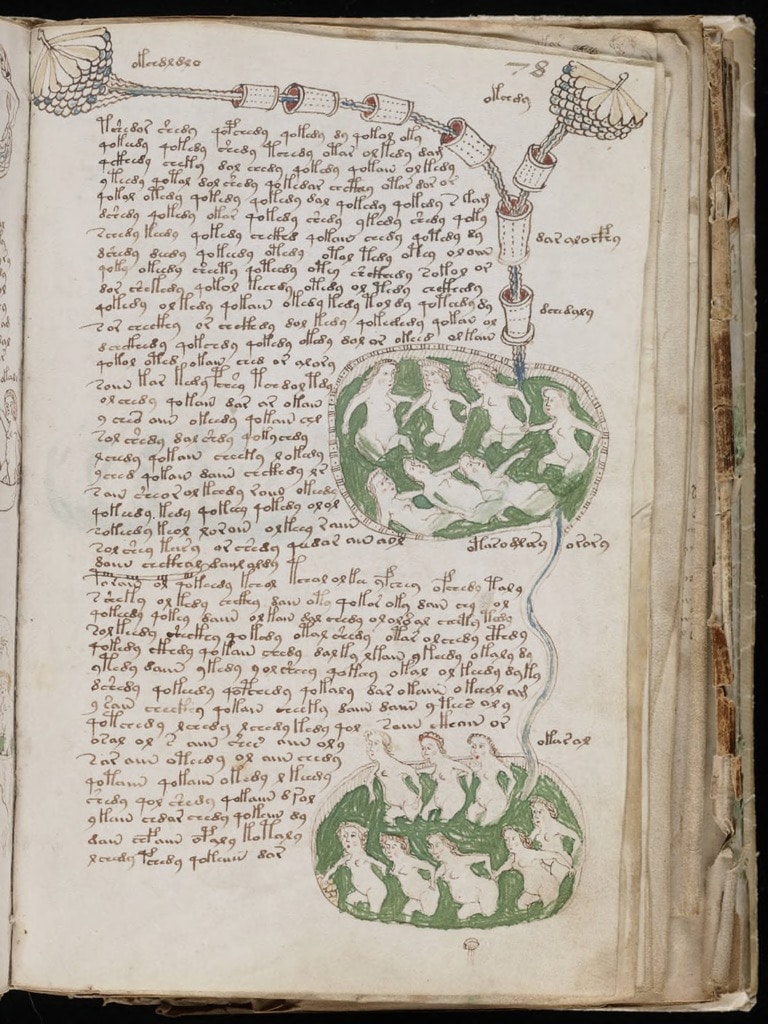 ‘The text is written from left to right, and some pages are foldable sheets of varying sizes. Most of the pages have fantastical illustrations and diagrams, some crudely coloured.’ Text appears on every page in the unknown script.
It has been hypothesised that the book is designed as a ‘pharmacopoeia or to address topics in medieval or early modern medicine’. Although the illustrations of the plants don’t seem to relate to anything researchers can find. In fact, some parts of plants known, seem to be attached to others unrelated.
Someone speculated that Voynich may have fabricated the manuscript himself. Looking at the pages makes me wonder at that as it would have been a tremendous amount of work to create it, so surely unbelievable.
Yale University holds the manuscript in the Beinecke Rare Book and Manuscript Library. They published the manuscript online in its entirety in their digital library.
I love how books can send you down rabbit holes finding subjects you might never have known about and even discovering new books in the process. I have imagined how the author of Life Hacks for a Little Alien might have discovered the Voynich manuscript, how she might have become a little obsessed herself and then wove that into her own novel with our little alien.
Just magic.
Rowena
0 Comments