




Mark Haddon, author of The Curious Incident of the Dog in the Night-time, is such an interesting figure that it feels inevitable his memoir would be equally compelling.
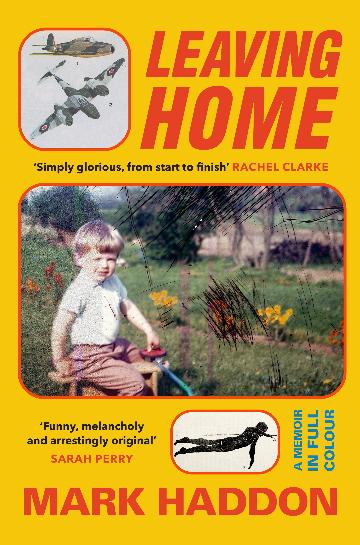
Leaving Home: A memoir in full colour is anything but a conventional autobiography. Rather than moving chronologically from childhood to the present, Haddon leaps across time and memory, from here to there and back again. The pages are not solely text; they are interspersed with photographs, drawings and quirky images that, on closer inspection, deepen the meaning of the stories they accompany.
 The book opens with a vivid childhood memory: his sister waking from a nightmare, his mother unsure how to respond, and the chilling moment when his sister screams as her father approaches, ‘No! He’s got the knife!’ Her dream that would haunt her for the next 45 years.
Haddon reflects that he, too, was plagued by recurring dreams, cinematic in their intensity: vast post-apocalyptic landscapes, giant insects advancing from every horizon, or being trapped in a diving suit, drowning in a narrow pipe.
Nightmares thread through his early life. After reading about great white sharks in a book his aunt sent him, he dreams of treading water in a vast, dark ocean as they circle below. A frightening episode of ‘Star Trek’ sparks another terror – legless, translucent jellyfish-like creatures dropping from above to burrow into human bodies and make them do their bidding.
His upbringing was marked by emotional distance in the family home: conversations were sparse and, while words were exchanged, little of consequence was ever said. He remembers music with the occasional outburst – ‘Jesus wept’ or ‘Wait till your father gets home’. He thought what mattered most was ‘the thing that happened inside my head’. His father was an architect, designing abattoirs. His mother’s job was to keep a clean, neat and tidy house. He felt she never wanted to be a mother, he says she was never warm towards them. When he visited her in her later years in a nursing home she would cry and cling onto him when he gave her a brief hug. He says he felt uncomfortable as he ‘had no memory of being hugged by her.’
 His teenage jobs included working for a company who made Formula One engines, tediously ‘manually renumbering every single engine part they made by copying the numbers from one ledger to another’. He also worked at a bakery where his job was to extract jammed white bread from the loaf-slicing machine. He did a similar role with a film processing machine, taking the photos out and smoothing out the creases before placing a sticker of apology on the photo. The favourite bit of this job was seeing all the risqué images.
The story continues to quickly shift between periods of his life, moving from early memories to major later events, including his triple bypass surgery with which he shares a picture of the zipper-like stitches running up his chest. He explores his visceral fear of flying, his mother’s lingering disapproval of his pierced ear as she tells him, ‘Only inadequate men have earrings.’ He suffers terribly from a series of phobias that grow into an overwhelming fear of death. At one point, convinced he had cancer, he found himself unable to watch films like Lethal Weapon without scanning the actors’ faces for signs of skin cancers.
 When he talks about teaching writing he shines, as you can clearly see what a clever teacher he is and what an opportunity it would be to learn from him. It’s the clever way he tells us these stories that bring us incredible insight into moments of his life. He is a sharp, talented writer who can make you smile even through a sad story.
Often what he tells us of his life I can see somewhat reflected in a particular book he has written.
There is far more in this creatively original memoir than can be in any way contained on these pages. Haddon lays out his life stories for us, packing startling revelations with humour, all rolled up with moments of genuine poignancy. Each vignette – accompanied by the photos and intriguing images – builds a portrait that is fragmented yet deeply cohesive.
The result is a memoir that is as inventive and unpredictable as the mind behind it: surprising, unsettling, often very funny, and ultimately, quite brilliant. •

0 Comments